
Agriculture Minister Reveals Nine Government Strategies to Achieve Food Self-Sufficiency
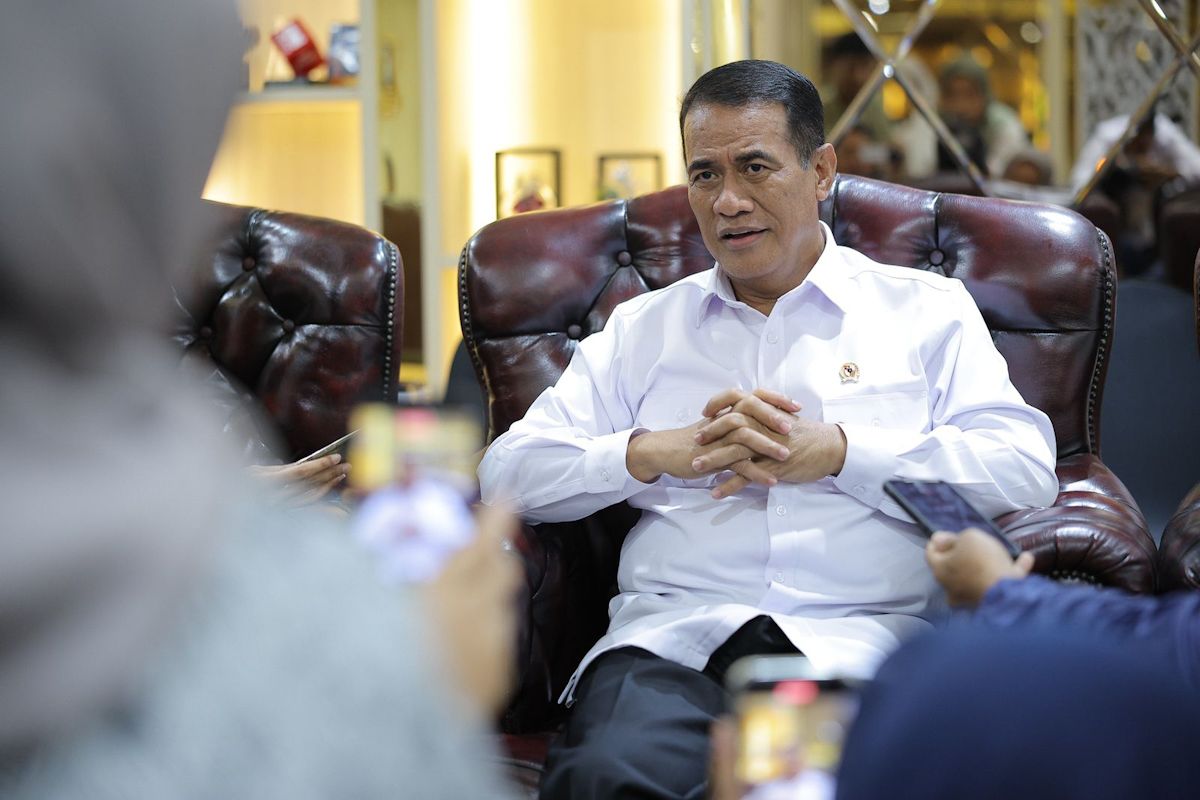
Jakarta (ANTARA) - Agriculture Minister Andi Amran Sulaiman has revealed nine key strategies undertaken by the government as the foundation for national food self-sufficiency, through measured steps to strengthen production and Indonesia’s food security.
“The target for national food self-sufficiency, originally projected within four years, has been accelerated to one year through a comprehensive transformation carried out by the Ministry of Agriculture,” Amran stated in Jakarta on Wednesday.
The nine strategies include, first, policy and regulatory reform through the simplification of hundreds of rules and the issuance of at least 16 strategic regulations in the form of Presidential Regulations (Perpres) and Presidential Instructions (Inpres) to accelerate food production and distribution and strengthen cross-sectoral coordination.
“We started by improving policies. We reformed the regulatory policies. To date, 16 Perpres-Inpres have been issued for the food sector to facilitate agriculture across Indonesia,” he explained.
As part of these measures, the government has cut 145 fertiliser regulations. The process, which previously required approval from up to 12 ministers, 38 governors, and 514 regional heads, has now been streamlined through a Presidential Instruction.
“Thus, fertiliser distribution is carried out directly from the Ministry of Agriculture to PT Pupuk Indonesia and then to farmers in a faster and more targeted manner,” he said.
Second, fertiliser governance reform by increasing allocation to 9.55 million tonnes, reducing fertiliser prices by 20 per cent, and expanding farmers’ access through the use of ID cards and simplified distribution.
“For example, fertiliser prices have dropped by 20 per cent. This has never happened since the Republic gained independence. Second, we have increased the volume,” he said.
Third, reallocation of Rp3.8 trillion from non-priority spending to productive sectors such as irrigation, superior seeds, pump irrigation, and agricultural machinery.
“We achieved efficiency through budget refocusing. For example, we cut official travel expenses, hotel costs, and unnecessary office renovations, redirecting those funds to productive sectors,” he emphasised.
Fourth, agricultural intensification through the use of superior seeds, timely fertilisation, and pump irrigation covering around 500,000 hectares of rain-fed land, increasing the cropping index to two or three plantings.
“This means production increases, right? Then superior seeds. Productivity reaches 9 to 10 tonnes. At minimum 8 tonnes, we purchase the seeds and distribute them for free,” he explained.
In addition, optimisation of swamp land covering around 800,000 hectares has been carried out, bringing the total increase in planted area from intensification programmes to about 1.3 million hectares.
Fifth, extensification through the programme to create new paddy fields covering around 200,000 hectares as an addition to the national baseline paddy area.
Sixth, strengthening water resource infrastructure through the construction and revitalisation of 61 dams with irrigation service potential reaching 400,000 hectares, as well as the rehabilitation of tertiary irrigation networks.
Seventh, agricultural modernisation through the utilisation of agricultural machinery and equipment, drones, and precision farming technology.
According to him, the use of agricultural machinery and equipment has proven capable of reducing production costs by up to 50 per cent and increasing yields by up to 100 per cent.
Eighth, institutional and governance reform through the evaluation and rotation of officials, as well as the regulation of distribution to ensure programmes run effectively. 248 officials have been rotated and evaluated, and thousands of fertiliser distribution permits have been revoked to ensure distribution is targeted.
Ninth, market intervention through strengthening the role of Perum Bulog in absorbing farmers’ paddy under an any quality scheme at Rp6,500 per kilogram to maintain price stability and provide business certainty.
“This step has proven effective in maintaining paddy price stability at the farmer level while increasing government rice reserves,” he emphasised.
He affirmed that these various strategies have shown tangible results. National rice production has increased by 4.07 million tonnes or 13.29 per cent in 2025, exceeding domestic needs of around 2.5–2.6 million tonnes per month.
“If all these are combined, it means an additional planting area of around 1.5 million hectares. Multiplied by average productivity, the production increase is around 4 million tonnes,” he said.
“This aligns with data from BPS (Statistics Indonesia), FAO (Food and Agriculture Organization), and USDA (United States Department of Agriculture). If anyone wants to protest, protest to the FAO, to America (USDA), to BPS,” he added.
Furthermore, government rice reserves (CBP) until mid-April 2026 are reported to have reached 4.8 million tonnes, the highest in history. The Farmer Exchange Rate (NTP) has also risen to 125.35, the highest in the last 34 years, while agricultural sector growth has reached 5.74 per cent, the highest in 25 years.
“At Bulog, the maximum stock (CBP) during the Republic of Indonesia’s independence was 2.6 million tonnes. Today it’s 4.8 million tonnes, soon to be 5 million. Almost double,” he said.
The government emphasises that these achievements were obtained without importing medium rice, thus fully supported by domestic production.