
Agriculture Minister Reveals Indonesia's Rice Stock at 27.9 Million Tonnes, Safe for More Than 10 Months
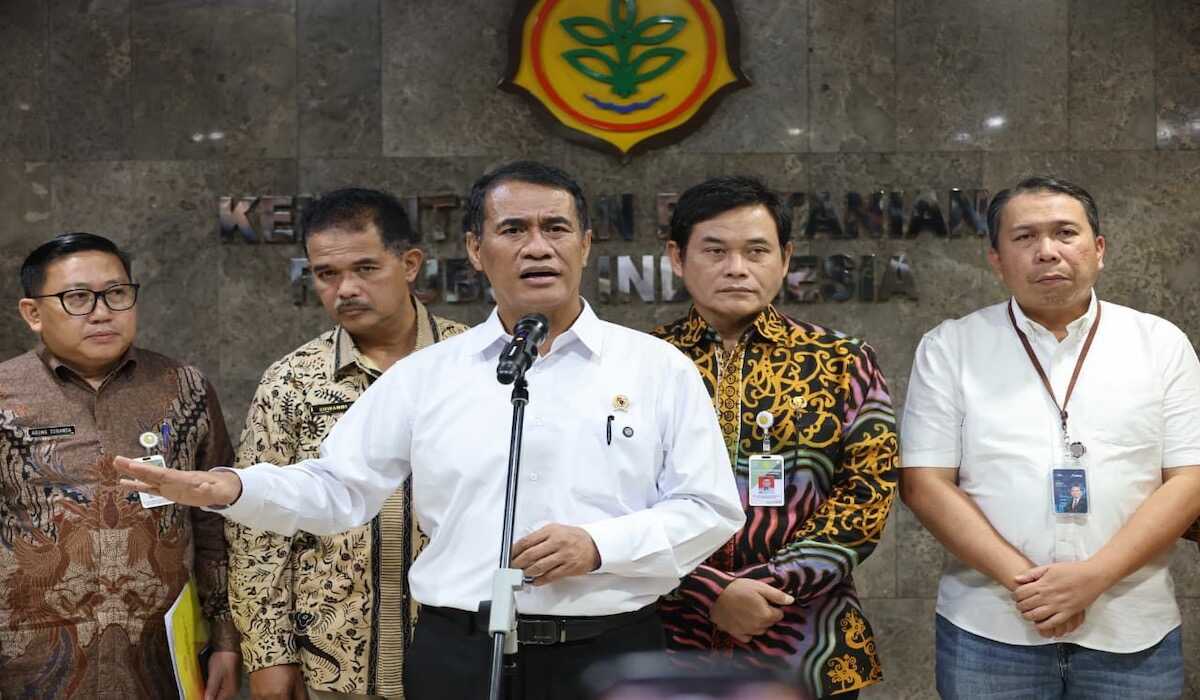
Agriculture Minister Andi Amran Sulaiman said the national food situation is safe and under control. Based on the latest data as of March 2026, food availability, particularly rice, is deemed more than sufficient to meet the public’s needs in the long term.
Amran said that national rice production ranges from 2.6 to 5.7 million tonnes per month, above the national average consumption of 2.59 million tonnes per month.
Total national rice stock currently stands at 27.99 million tonnes, comprising Bulog stock of 3.76 million tonnes, community stocks around 12.50 million tonnes, and standing crop or harvest-ready paddy of 11.73 million tonnes. In addition to ongoing production, the existing stocks are estimated to be able to meet needs for almost a year.
‘If we look at the data today, our food availability is very secure. The total national rice stock is sufficient for 324 days ahead or about 10.8 months, so the public need not worry,’ Amran said at a press conference at the Ministry of Agriculture Headquarters, Friday (6/3).
Amran explained that national rice production is also showing a very positive trend. In the period January to May 2026, rice production was recorded at around 16.92 million tonnes, with monthly averages ranging from 2.6 to 5.7 million tonnes.
Amran assessed that the high production serves as evidence that the national agricultural sector remains strong despite various global challenges.
‘Our production remains steady. In some months production can reach 5.7 million tonnes, so domestic supply is very strong,’ he said.
In addition, government rice stocks managed by Bulog are also rising. Currently, Bulog-controlled stock stands at 3.7 million tonnes, and is expected to exceed 5 million tonnes in the next two months as the harvest season yields come in in various regions.
‘We estimate that in the next two months Bulog stock could reach 5 million tonnes. This will further strengthen the government’s food reserves,’ he explained.
Amran also emphasised that the government has taken various anticipatory steps to face potential drought due to climate phenomena. One measure is a pumping irrigation programme for agricultural land of 1.2 million hectares, and this year another 1 million hectares will be added.
In addition, the government is preparing additional pump irrigation (irpom) for 1 million hectares to ensure water availability for rice crops amid potential dry seasons.
‘We have anticipated drought from the outset through pumping irrigation. Last year 1.2 million hectares, and this year we will add another 1 million hectares to keep production stable,’ he said.
On the other hand, the condition of other food commodities such as chicken and eggs is also in surplus, further strengthening national food stability.
Additionally, Amran noted that fertiliser availability is also safe, with fertiliser prices currently down by around 20%. The price drop is seen as a strong motivating factor for farmers to continue planting.
‘Fertilisers are adequate, and their prices have fallen by around 20 percent. This is a major motivation for farmers to keep planting,’ he said.
Furthermore, he stated that the national food situation remains stable even as the world faces geopolitical dynamics and potential climate phenomena such as El Niño and drought.
‘We are not greatly affected by global geopolitics or the potential El Niño. Our production is strong, our stocks are safe,’ he asserted.
Moreover, optimising rehabilitated swamp lands is also an important strategy to maintain production during dry seasons. Those lands are highly potential to continue producing rice even when water supplies in other areas are limited.
With these measures, Minister Amran ensures that the government continues to work to maintain national food stability while ensuring the people’s needs are met. ‘God willing, our food is safe. Production is strong, stocks are sufficient, and anticipatory steps have been taken,’ he concluded.