
Agriculture Minister reiterates commitment to continue cracking down on food mafias to protect Indonesian farmers
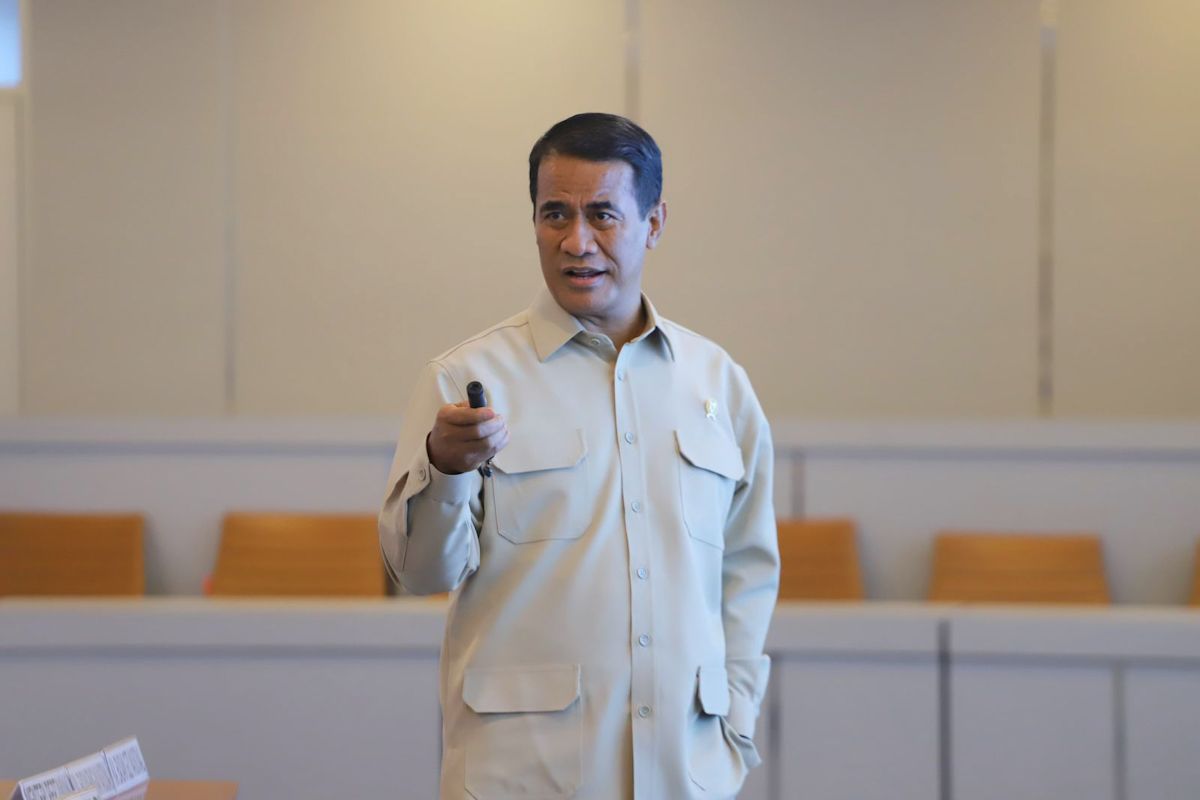
The government continues to intensify its war on food mafias, fertiliser mafias, distribution manipulation, and illegal land grabbing that have for years harmed the people and the state. Jakarta (ANTARA) - Agriculture Minister Andi Amran Sulaiman affirmed that the government continues to root out food mafias and corrupt actors in the agricultural sector to protect farmers, safeguard supply stability, and realise national food security. ‘The government continues to strengthen its war against food mafias, fertiliser mafias, distribution manipulation and illegal land grabbing that have for years harmed the people and the state,’ the minister said in a statement in Jakarta on Saturday. Enforcement is no longer limited to small-time players in the field, but goes deeper to dismantle cartel networks, price games, stock manipulation, internal corruption, and illegal forest area grabs. Amran cited data from the Police Food Task Force, noting two phases of enforcement with different characteristics. In the first period, 2017–2019, spanning three full years, a total of 784 cases were handled. These included 66 cases in the rice commodity, 22 in horticultural commodities, 27 in livestock, 13 in fertilisers, and 247 other cases in the agricultural sector. ‘From all these actions, authorities were able to name 411 suspects,’ he said. Meanwhile, in the 2024–2025 period, which has only been running for about two years, 94 cases in the agricultural sector have been handled, consisting of 46 rice cases, 27 fertiliser cases, 16 cooking oil cases, and 3 cases involving internal actors. A total of 77 people were named as suspects in these cases. The government also revoked 2,231 licences held by retailers and fertiliser distributors deemed problematic in 2024–2025. The move represents one of the largest corrective actions in fertiliser distribution governance. He stated that the 2024–2026 enforcement period would not stop at statistics, marked by the uncovering of several major cases that have burdened the public. The adulterated rice case was one of the largest disclosures. From testing 268 samples in 13 laboratories across 10 provinces, 212 brands of premium and medium rice were found not to meet quality, weight, or the Maximum Retail Price (MRP) standards. In other words, around 85.56 percent of circulating premium rice did not meet standards. Packaging practices for supply-stability and price-stabilising rice (SPHP) were also discovered and later sold as premium rice at higher prices. Potential consumer losses from these practices are estimated at Rp99.35 trillion per year. The Ministry of Agriculture subsequently reported the findings to law enforcement for follow-up. Similar practices were also found in the MinyaKita distribution. Cooking oil products that should have been sold under the HET Rp15,700 per litre were found sold at up to Rp18,000 per litre with quantities that did not match. In a February 2026 inspection, problematic MinyaKita residues were still found circulating. ‘We will isolate those who make things difficult for the country. From the exposure of the cooking oil cartel network overall, 20 suspects have been named,’ he asserted. In the fertiliser sector, the government found five counterfeit fertilisers that contained no nutrients at all. The contents of nitrogen, potassium and phosphate were recorded as zero, meaning farmers were effectively buying material with no benefit to crops. Farmer losses from these practices are estimated at Rp3.3 trillion. Many victims were smallholders receiving People’s Business Credit (KUR) who experienced crop failures and economic pressure. ‘A total of 27 suspects from upstream to downstream have been named, and 2,231 retail licences and fertiliser distributor licences deemed problematic have been formally revoked,’ Amran said. Earlier, on 28 May 2025, anomalies were also found at Cipinang Rice Main Market (PIBC). It was recorded that rice expenditure reached 11,410 tonnes in a single day, far exceeding the normal daily average of 2,000–3,000 tonnes. That extreme spike raised strong suspicions of stock data manipulation by middlemen to push prices at the consumer level. The Police Food Task Force was immediately deployed to investigate further. Enforcement has also been indiscriminate. Eleven Echelon II officials of the Ministry of Agriculture have been sanctioned, some of whom are now listed as Wanted Persons (DPO). ‘Not for show. The two-echelons suspects in our agency are now DPO,’ he said. It is known that President Prabowo Subianto has specifically appointed the Minister of Agriculture as a member of the Task Force for Accelerating Palm Oil Industry Governance and Optimising State Revenue (Satgas PKH). Satgas PKH notes a historic achievement, namely the seizure and return to the state of 4 million hectares of forest land that had been illegally occupied by palm oil companies. ‘This is the largest land-clearing operation in the history of Indonesia’s forest governance. It confirms that the era of tolerating encroachment of forest land for corporate interests has ended,’ he said. It is known that the Supreme Court found WG guilty in cases of corruption involving crude palm oil (CPO) export facilities and cooking oil. The company was required to pay a Rp1 billion fine and to hand over compensation to the state amounting to Rp11.88 trillion, funds which have all been seized by the Attorney General’s Office. Through Satgas PKH, the government also imposed fines for illegal palm planting in forest areas. PT MNA was fined Rp8.02 billion and PT SAP Rp3.37 billion. Total financial penalties imposed on WG exceeded Rp11.89 trillion, underscoring that no corporation is too big to be prosecuted. Amid a surge of narratives attempting to distort facts on social media, the Minister hopes all Indonesians will not be easily swayed by it. ’Do not misjudge your friends. I am on the side of the people. We are red and white. Let us fight together against the food mafias and