
Agriculture Minister: Food as a National Defence Tool, Indonesia No Longer Dependent on Imports
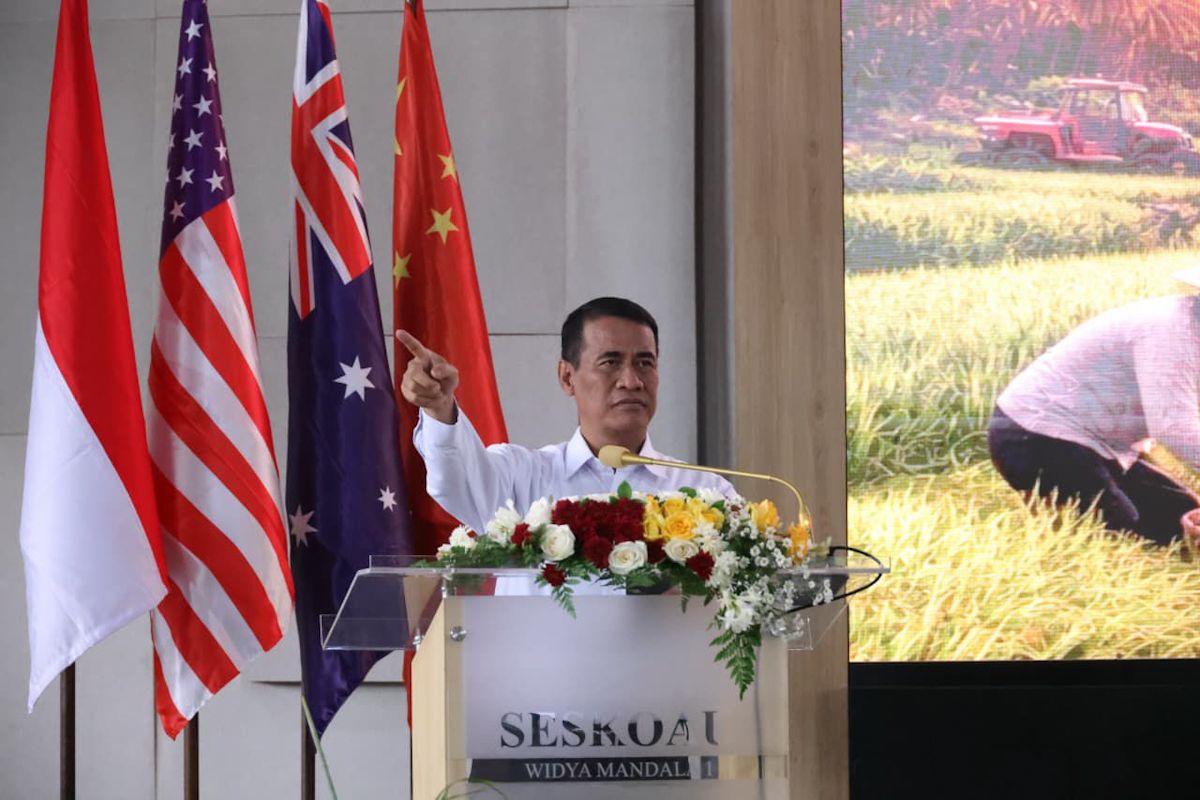
If we do not control food, the state can be pressured. But today we prove that production is rising, imports are falling, and Indonesia is growing stronger.
Jakarta (ANTARA) - Agriculture Minister (Mentan) Andi Amran Sulaiman has stressed that food is not merely a basic necessity but a strategic instrument in safeguarding national sovereignty and defence, enabling Indonesia to no longer depend on imports.
Amran stated that amid global crisis threats, Indonesia has become increasingly resilient after successfully boosting production and curbing dependence on food imports, particularly rice and several other commodities.
“If we do not control food, the state can be pressured. But today we prove that production is rising, imports are falling, and Indonesia is growing stronger,” the Minister said during the 64th General Lecture for SeskoAU Cadets Batch 2026, held at the Widya Mandala I Building of Sesko AU in Lembang, West Java, as per a statement in Jakarta on Wednesday.
The Ministry of Agriculture (Kementan) states that Indonesia has now achieved self-sufficiency in nine strategic food commodities, including rice, consumer sugar, large chillies, bird’s eye chillies, maize, cooking oil, chicken meat, chicken eggs, and shallots.
Therefore, the government is taking strategic steps to increase domestic production, gradually reduce imports, and strengthen the national food reserve.
“Based on international data, including from the United States Department of Agriculture (USDA), Indonesia’s food production shows a significant upward trend,” he said.
Kementan has also recorded a historic achievement with the national rice stock reaching 4.3 million tonnes, targeted to rise to 4.5 million tonnes in the near future. This accomplishment reinforces the strengthening position of national food security amid global dynamics.
This success has propelled Indonesia out of its position as an importing nation towards becoming a globally reckoned player. Indeed, Indonesia’s import control policies are said to be impacting global food price dynamics.
He mentioned that several countries, such as Malaysia, Australia, Japan, and Canada, are beginning to study Indonesia’s strategies in increasing production and maintaining supply stability.
“What sets us apart is the courage to make decisions and the speed of action,” said Amran.
As the world’s largest producer of crude palm oil (CPO) with more than 60 per cent of global production, Indonesia holds a strategic position to control the palm oil industry’s value chain through strengthening the downstream sector.
Through such optimisation, Indonesia is targeted to reduce energy import dependence in the coming years.
“If our food and energy are strong, no country can pressure us,” Amran stated.
Through strengthening cooperatives, distribution chains are shortened so that farmers enjoy greater benefits, while prices become more affordable for consumers.
“If villages move, the economy grows, and the nation will be solid,” said Amran.
With a combination of food security, energy independence, and downstreaming of strategic resources like nickel, Indonesia is seen to be on track towards becoming a new global power.
“Food security is the main fortress. If this is strong, Indonesia will not only be safe but also fully sovereign,” said Amran.