
Advanced! Bulog Plans to Build 100 New Warehouses Superior to Private Sector
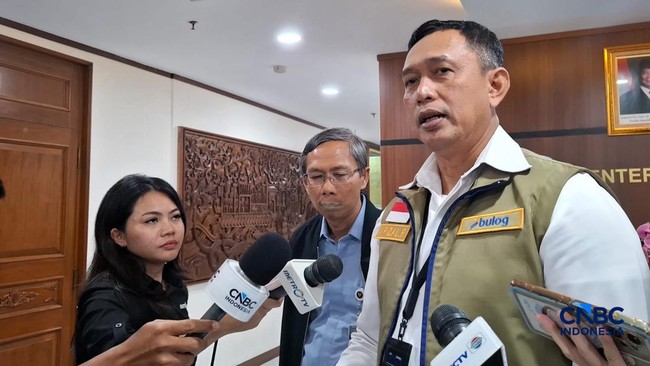
Jakarta, CNBC Indonesia - Bulog is accelerating a major transformation in the food processing and storage sector. Far from simply building warehouses, Bulog is now targeting the use of modern technology that is claimed to compete with, and even match, private industry standards.
Perum Bulog’s President Director, Ahmad Rizal Ramdhani, emphasised that they have begun adopting mechanisation and automation in rice processing facilities at several production centres.
“Later, among those rice processing production centres, some will already use mechanisation and automation. Just like not inferior to Wilmar’s factory. So we will also head in that direction. So yesterday we also learned about technological transformation, hopefully the state’s assets are no less competitive than those of the private sector,” said Rizal when met at the Office of the Coordinating Ministry for Food, Jakarta, on Wednesday (1/4/2026).
This modernisation step is part of Bulog’s major project to strengthen post-harvest infrastructure. The state-owned company is preparing a massive Rp5 trillion investment to build 100 new warehouse units in various regions.
From the total budget, around Rp4.4 trillion is focused on main infrastructure development. Meanwhile, the remaining Rp560 billion is allocated specifically to support mechanisation, automation, and information technology systems.
“The smallest capacity is 1,000 tonnes. Then the largest is 3,500 tonnes and the locations are in 92 districts,” he revealed.
Not only warehouses, Bulog will also build additional storage facilities in the form of silos. In total, 94 warehouse units, six rice silos, and eight corn silos will be constructed to increase commodity resilience.
“In the process later we build, yes, for storage facilities warehouses, we have 94 warehouse units, six rice silos, eight corn silos. If the silo is for storing unhulled rice, rice silo. Corn silo is for storing corn, so it lasts longer if using a silo,” he explained.
The construction of these facilities is also tailored to the characteristics of the regions. For island areas with minimal production, warehouses are focused as storage places. Meanwhile, in production centre areas, facilities will be equipped with dryers, rice milling units (RMU), and packaging.
Before construction begins, Bulog ensures all locations have undergone strict technical studies, including soil suitability tests and land slope to support logistics operations.
“We have to check first the soil test of that land. So the soil test of that land is approximately feasible or not to build Bulog warehouses or post-harvest infrastructure. Then also the land slope condition. The land slope must also be a maximum of 3 to 5 degrees,” Rizal concluded.