
Adding Additional Cigarette Tax Layers Assessed to Weaken Deterrent Effect Against Illegal Tobacco Violations
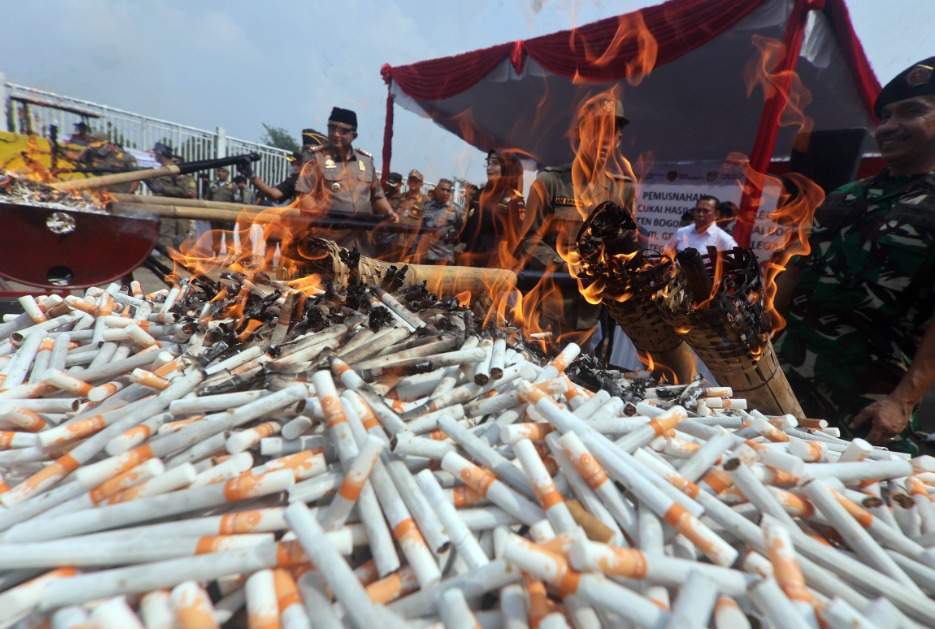
The Ministry of Finance’s proposed addition of a tax layer tier for Category III Machine-Rolled Kretek Cigarettes (SKM) to the excise duty structure for tobacco products has drawn criticism from legal scholars. Amid intensified efforts to combat illegal cigarettes and corruption allegations within the Customs Directorate related to excise stamp manipulation, the policy is viewed as raising questions about consistency in law enforcement and the effectiveness of deterrent measures against violations.
Ali Rido, legal expert at Trisakti University, contends that fiscal approaches cannot replace law enforcement against illegal tobacco. “In principle, it is inappropriate to use fiscal policy as a substitute for law enforcement. Fiscal policy (excise duty rates) should regulate legal economic activities, not serve as an instrument to address criminal or administrative law violations,” Ali stated on Wednesday (11 March).
He also cautioned against weakening the deterrent effect if legal violations are perceived as solvable through tariff policy. “This would potentially conflict because combating illegal cigarettes is part of law enforcement. Should legal violations be ‘accommodated’ through excise duty policy changes without clear separation from responsibility for previous violations, such policy could be perceived as weakening the deterrent effect and inconsistent with the spirit of law enforcement,” Ali emphasised.
Additionally, he highlighted the real risk of moral hazard if violations are deemed negotiable through policy changes. “The risk of moral hazard is substantial. If businesses see that violations can be ‘compromised’ through new policies, expectations will emerge that non-compliance today could be negotiated in the future.”
Meanwhile, the Corruption Eradication Commission (KPK) is investigating alleged corrupt practices within the Directorate General of Customs and Excise, suspected to be linked to the proliferation of illegal cigarettes in Indonesia. Responding to this, Ali stressed that state losses from illegal tobacco can fall within the scope of corruption offences if certain elements are met.
“If it involves abuse of authority, position, or unlawful conduct by state administrators or officials, then state losses from illegal cigarettes can be classified as corruption. State losses from tax evasion meet the element of ‘harming state finances’ if illegal tobacco practice occurs due to tolerance, protection, administrative manipulation, or collusion between business actors and officials,” he said.
Similar criticism was voiced by Muhammadiyah economist Mukhaer Pakkana. According to him, the primary step to suppress illegal cigarette distribution should focus on strengthening supervision and law enforcement.
“The core matter that must be addressed to suppress illegal cigarette distribution is strengthening supervision and law enforcement, transparency in tackling the illegal tobacco industry. So, it should not be a case of adding new layers to legalise what is illegal,” he said.
Mukhaer also reminded that within the framework of the four pillars of tobacco excise policy, consumption control must be balanced with strong oversight of illegal cigarette circulation.
“Efforts to control consumption must be the top priority, balanced with strong supervision and enforcement against illegal cigarettes to close the gap for cheap cigarette options (illegal cigarettes tend to be cheaper). This situation will also prevent revenue leakage from uncontrolled illegal cigarette proliferation,” he concluded.
Amidst excise contributions reaching hundreds of trillions of rupiah and involving millions of workers, the tobacco products industry faces increasingly complex policy pressures. Indonesian local tobacco tends to have high nicotine content, around 2 to 8 per cent.
The discussion of Jakarta’s proposed No-Smoking Area (KTR) Regional Regulation at the Jakarta Regional Parliament Plenary Session on Tuesday (23 December) attracted serious scrutiny.
Kudus Customs also recorded similar performance increases, with 164 enforcement actions against 22.1 million illegal cigarette sticks worth Rp 30.46 billion and potential state losses of Rp 21.18 billion.
Atambua Customs took action against the circulation of excise goods in the form of illegal tobacco products/cigarettes amounting to 11 million sticks.