
ADB Predicts Slower Economic Growth in Asia-Pacific Region in 2026
Jakarta (ANTARA) - The Asian Development Bank (ADB) estimates that economic growth in developing countries in the Asia-Pacific region will slow to 5.1 per cent in 2026 and 2027, down from 5.4 per cent in 2025.
According to ADB Chief Economist Albert Park, in a written statement received in Jakarta on Friday, the downward revision in the forecast is due to the conflict in the Middle East and the ongoing trade uncertainties.
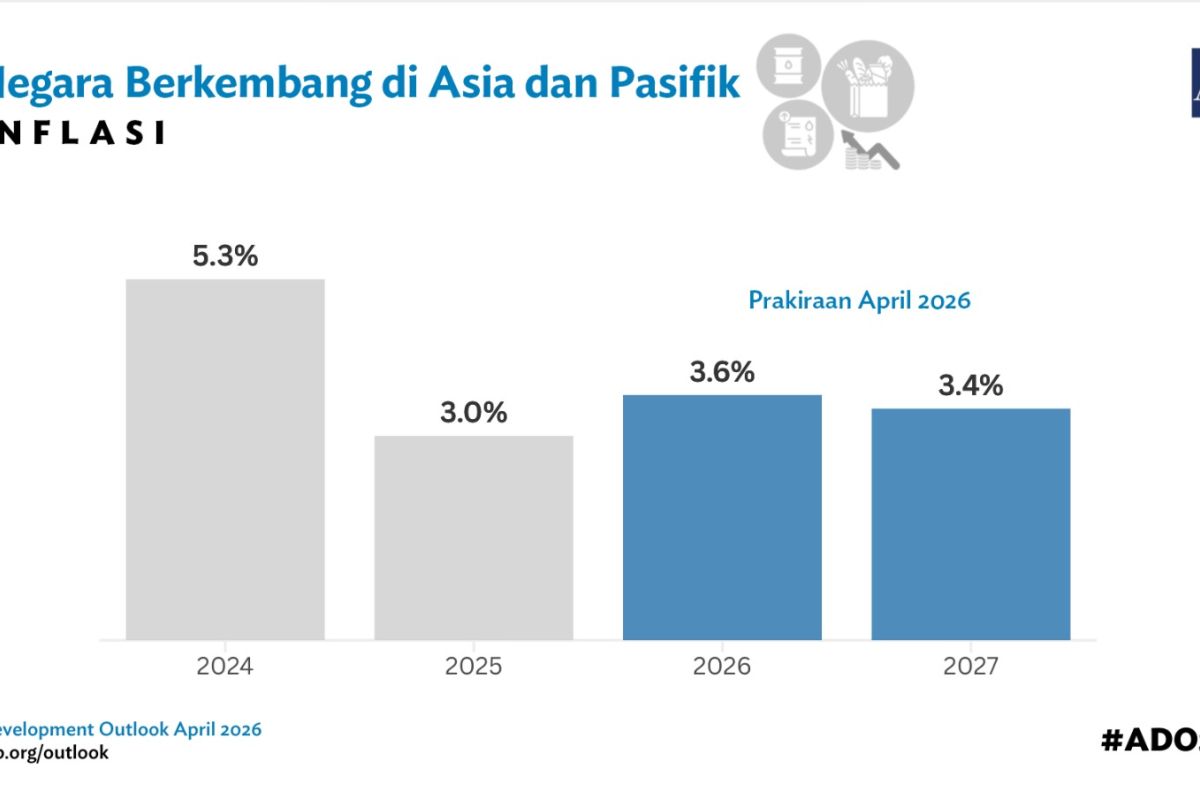
Regional inflation is projected to rise to 3.6 per cent in 2026 and 3.4 per cent in 2027, up from 3 per cent last year.
“This forecast uses a number of assumptions finalised on 10 March in a context of high uncertainty, which is a projection of an early stabilisation scenario related to the Middle East conflict. Developments so far indicate a greater likelihood of more persistent disruptions,” he said.
The Asia-Pacific region is said to face a challenging and uncertain global environment from a relatively strong position. This is considering the still robust domestic demand, stable labour markets, and higher public infrastructure spending, which support resilience.
According to the statement, the prolonged conflict in the Middle East represents the greatest risk to the Asia-Pacific region’s projections because the situation could lead to higher energy and food prices for longer periods, as well as tighter financial conditions.
In addition, the re-emerging trade policy uncertainties add to the risks, so governments in various countries need to pursue appropriate macroeconomic policies to maintain growth and contain inflation, through targeted policies to protect vulnerable households.
The April 2026 Asian Development Outlook (ADO) includes a section examining the impact of the conflict on various economies in the region based on a number of alternative scenarios. A prolonged conflict and escalation in the Middle East is assessed to impact economic activity through several channels, including price increases, shipping disruptions, and financial volatility.
Most developing country economies in the Asia-Pacific region are experiencing downward revisions in growth projections for 2026 and 2027, although household spending remains resilient and demand for artificial intelligence-related goods remains solid.
Growth in the People’s Republic of China (PRC) is projected to decline to 4.6 per cent in 2026 and 4.5 per cent in 2027, from 5 per cent in 2025, due to the ongoing decline in the property market and slowing export growth, which are holding back economic activity.
In India, the ADB predicts growth will slow to 6.9 per cent this year from 7.6 per cent last year, before rebounding to 7.3 per cent next year, thanks to resilience supported by domestic consumption.
The Pacific economy is forecast to experience a significant decline from 4.2 per cent in 2025 to 3.4 per cent in 2026 and 3.2 per cent in 2027.
For oil prices, they are projected to remain high in the near term but could gradually decline if geopolitical tensions ease.
“The recent sharp rise in energy prices and potential disruptions in fertiliser markets related to the Middle East conflict could exert inflationary pressure on global food prices,” said Albert Park.