
ADB and FTSE Russell Recognise Indonesia's Economic Resilience, Capital to Attract Investors
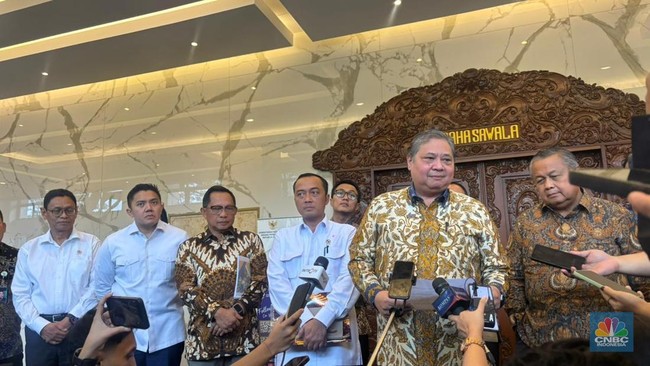
Jakarta, CNBC Indonesia - Indonesia’s economic resilience has received recognition from global market players and multilateral institutions. This acknowledgement comes amid pressures from escalating conflicts in the Middle East. This was stated by Coordinating Minister for Economic Affairs Airlangga Hartarto.
First, growth projections were presented by the Asian Development Bank (ADB), which forecasts Indonesia’s economy to grow steadily at 5.2% in 2026 and 2027, up from the 5.1% realisation in 2025, as outlined in the Asian Development Outlook April 2026: The Middle East Conflict Challenges Resilience in Asia and the Pacific report.
“On almost the same day, global index provider FTSE Russell on 7 April 2026 officially maintained Indonesia’s capital market status as a Secondary Emerging Market and explicitly stated that it would not consider Indonesia for inclusion in the Watch List for status downgrade,” explained Airlangga, quoted on Wednesday (15/4/2026).
The ADB’s projection for Indonesia is based on an early stabilisation scenario for the Middle East conflict and is significantly above the subregional Southeast Asia forecast of only 4.7% in 2026, reflecting structural strengths that distinguish Indonesia from most of its regional peers.
The ADB highlights resilient domestic demand, inflation controlled at around 2.5% within the government’s target range, and well-calibrated monetary policies as the three main pillars differentiating Indonesia’s performance from most of its regional peers.
From the driving factors perspective, the ADB notes that early 2026 growth momentum is supported by strengthening household consumption backed by increased agricultural productivity and seasonal Ramadan and Eid al-Fitr effects, ongoing public infrastructure development, and rising private sector participation in downstream investments.
Solid inflows of foreign direct investment also help finance external gaps while maintaining exchange rate stability. Targeted fiscal policies are deemed crucial in sustaining household purchasing power and investment momentum simultaneously.
On the other hand, FTSE Russell’s recognition directly reflects a series of consistently accelerated structural reforms in the capital market.
In its announcement, FTSE Russell acknowledges progress in implementing the eight Action Plans for Accelerating Capital Market Integrity Reforms, which include improving share ownership transparency, expanding investor classifications to 39 categories, setting a minimum free float of 15%, and applying the High Shareholding Concentration (HSC) mechanism as an early warning for investors.
Indonesia’s status, equivalent to that of China and India in FTSE’s classification, reinforces that Indonesia’s capital market continues to move towards world-class governance and transparency standards.
The Financial Services Authority previously welcomed the assessment positively as evidence that ongoing reforms “demonstrate positive and credible progress in the eyes of global index providers.”
Airlangga assured that the government views both international recognitions as validation of the consistent direction of macroeconomic policies pursued, namely by nurturing domestic demand, strengthening fiscal foundations, maintaining monetary credibility, and continuing structural reforms in the financial markets.
“In an external environment full of challenges, Indonesia proves that domestic fundamental stability is an effective anchor in maintaining long-term investor confidence,” he emphasised.
The government, continued Airlangga, is committed to continuing to accelerate reforms, including in preparation for the quarterly FTSE Russell review scheduled for June 2026, as well as the MSCI review in May 2026, to ensure inclusive, sustainable growth resilient to various external shocks.