
Acquitted of Incitement Case, Khariq Anhar Still Faces One More Charge
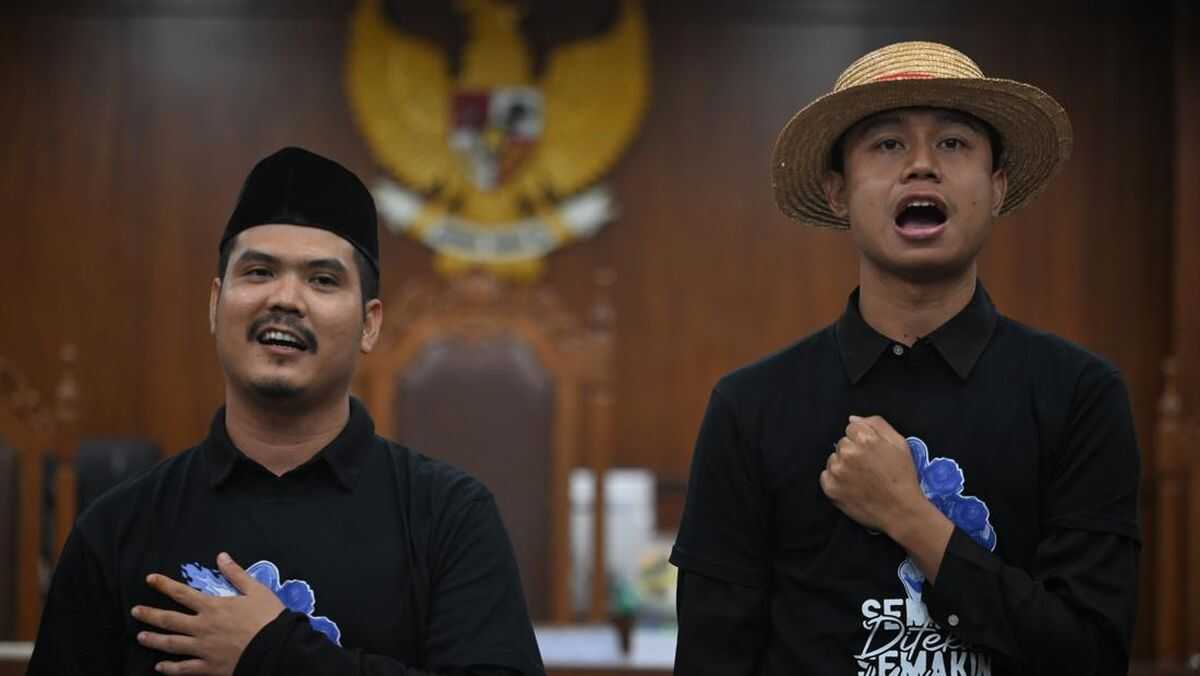
Acquitted of incitement, Khariq Anhar, a student at Universitas Riau and administrator of Aliansi Mahasiswa Menggugat, remains charged with violating the Electronic Information and Transactions Law (UU ITE) after he was acquitted in the case of alleged incitement connected to demonstrations last August. The hearing on the UU ITE case is set for Tuesday, 10 March 2026. ‘I was acquitted on two counts; I still have a hearing on Tuesday, but today we were acquitted and I can continue my studies. Alhamdulillah,’ Khariq said in the Kusuma Atmadja 4 courtroom of the Central Jakarta District Court (PN Jakarta Pusat) on Friday (6 March) afternoon.
Khariq thanked the panel of judges for delivering a verdict based on the legal facts presented at trial, noting that he and three colleagues were not found guilty of spreading false information, incitement, or recruiting youths to commit violence.
‘Young people should not be afraid. Why? Because those who are afraid now are those in power. They act arbitrarily, and when put on trial, we can be acquitted. So, stand up!’ Khariq exclaimed.
Earlier, the State Prosecutor’s Office (JPU) restructured the indictment against Khariq in relation to the alleged violation of the UU ITE during the demonstrations of 25-30 August 2025. ‘The Central Jakarta District Court has accepted the remitted case from the Jakarta Pusat State Prosecutor’s Office with new case number 57/Pid.Sus/2026/PN Jkt.Pst and it will be processed in accordance with the applicable criminal procedure rules,’ said Sunoto, the spokesman for PN Jakarta Pusat, in a written statement on Tuesday (3/2).
Sunoto explained that the procedural ruling announced on Friday 23 January 2026 was at the full discretion of the independent panel.
On that day, the panel of judges at PN Jakarta Pusat granted the defence’s objection or exception for the case number 757/Pid.Sus/2025/PN Jkt.Pst in the name of the defendant Khariq Anhar.
The judge stated that the indictment letter by the Public Prosecutor with the Register Number PDM-84/M.1.10/Eku.2/10/2025 dated 10 December 2025 did not hold up in law. The judge ordered the case file returned to the Public Prosecutor.
The case was heard and judged by the presiding judge Arlen Veronica, with members M. Arief Adikusumo and Abdullatip. ‘The defendant is to be acquitted from detention immediately as this ruling is read,’ the presiding judge said when delivering the interim ruling on Friday (23/1).
The judge found the Prosecution’s description of the act deemed criminal to be unclear. This concerns the wording ‘Canva Application or Other Applications’ as a predicate of the crime.
The ‘Canva or Other Applications’ phrase can be interpreted as tools or means used by the defendant in committing the alleged crime as described in the indictment.
‘After the panel considered that the phrase ’Canva or Other Applications’ contains a fundamental ambiguity, where Canva is a cloud-based graphic design application with features and digital footprints different from other applications such as Adobe Photoshop, Microsoft Paint, Microsoft Word, smartphone built-in screenshot-editing apps, or hundreds of other editing apps,’ the judge stated.
‘The phrase ’or other applications’ is too broad and unlimited, potentially covering thousands of apps that could be used to manipulate images or text, and the types of applications used have different technical and legal implications because they relate to digital forensics and electronic evidence, determine the metadata to be checked, influence the authenticity analysis of the file, determine the required expert testimony, and affect the defendant’s defence strategy,’ the judge added.
In information technology cases, the judge noted, technical specifications are not mere procedural details but the substance of the act itself.
The judge referred to Article 28D(1) of the 1945 Constitution, guaranteeing everyone the right to recognition, guarantee, protection, and fair and certain legal treatment.
Section 50 of the Criminal Procedure Code (KUHAP) states that a suspect or accused has the right to give statements freely to investigators or judges, but this right can be effectively exercised only if the accused clearly understands what he is charged with.
According to the judge, the lack of clarity about the application used results in legal consequences detrimental to the accused’s rights.