
Acid Attack on KontraS Activist and Warning Signal for Democracy
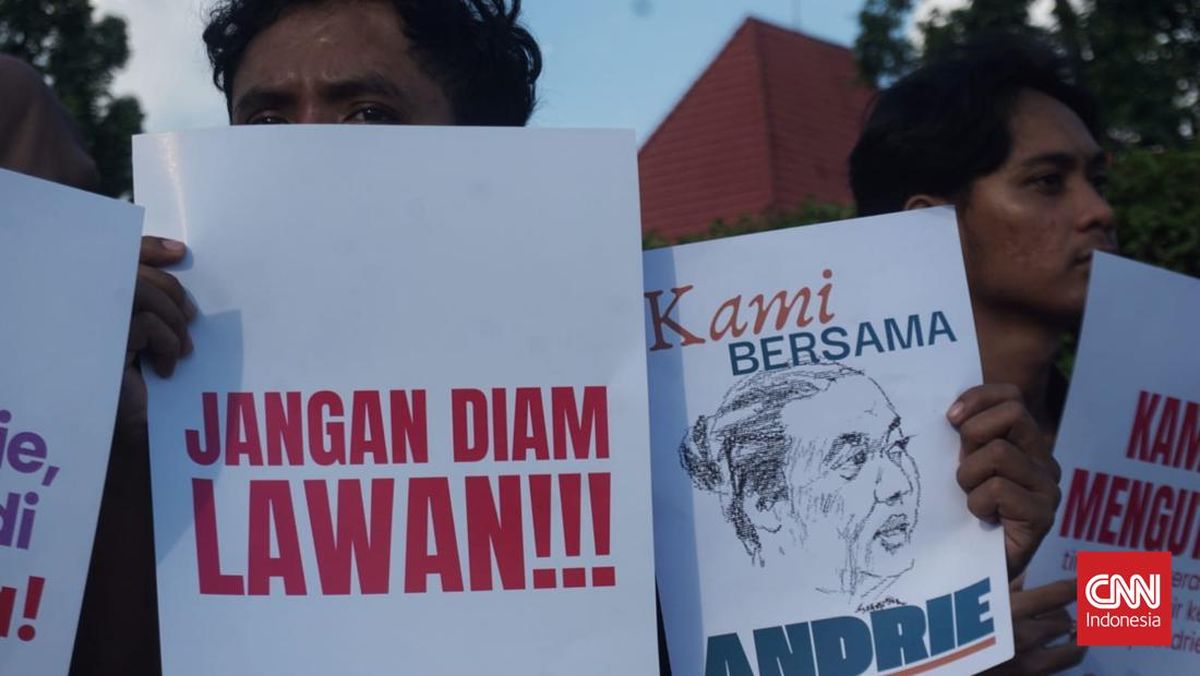
The acid attack on Andrie Yunus, Deputy Coordinator of the Commission for Missing Persons and Victims of Violence (KontraS), is seen as a warning signal for the danger posed to democracy.
The Institute for Criminal Justice Reform (ICJR) has stated that the attempted murder of Andrie should not be regarded as an ordinary assault. ICJR considers the attack to be an extremely serious act and can be prosecuted as attempted premeditated murder.
“The elements of premeditated murder consist of intent to end the life of another person preceded by planning. The perpetrator’s actions targeting Andrie’s face, which includes his respiratory system, could result in loss of life. This demonstrates that the perpetrator deliberately knew that their actions could result in loss of the victim’s life,” ICJR stated on their official website on Monday (16 March).
Under the new Criminal Code, Article 459 stipulates that premeditated murder carries the death penalty. Whilst attempted premeditated murder can be sentenced to a maximum of 15 years imprisonment in accordance with Article 17, paragraph 4.
“Therefore, the attack on Andrie should be regarded as a serious crime that must receive full attention from law enforcement officials,” ICJR said.
The Indonesian Centre for Law and Policy Studies (PSHK) and Indonesia Jentera Law School stated that the acid attack on Andrie constitutes an intolerable act of violence that must be thoroughly investigated by law enforcement authorities.
Rizky Argama, Executive Director of PSHK, stated that in the context of human rights defence and public advocacy work that has been carried out by the victim, the acid attack incident should be viewed as a threat to civic space and the rule of law principle that guarantees citizens’ freedom to express their opinions.
“In recent years, various indicators show a tendency towards the narrowing of civic space in Indonesia. Human rights defenders, journalists, academics, and other civil society groups are increasingly facing intimidation, criminalisation, and other forms of violence when conducting public advocacy work,” said Rizky in a written statement.
“The attack on Andrie Yunus strengthens concerns that human rights defence work is increasingly facing serious security risks,” he added.
From the perspective of the rule of law, Aria Suyudi, Chair of Indonesia Jentera Law School, said this situation cannot be allowed to continue. The state has a constitutional obligation to ensure that every citizen can exercise their civil and political rights safely, including the right to express opinions, to assemble, and to participate in oversight of the exercise of power.
When human rights defenders can be brutally attacked in public space without adequate protection, he said, what is at stake is not only individual safety, but also the integrity of the democratic system and public confidence in law enforcement.
As an organisation that has long worked to promote legal reform, PSHK together with Indonesia Jentera Law School views the protection of human rights defenders as an integral part of the agenda to strengthen the rule of law in Indonesia.
“Firm and transparent law enforcement in this case is an important test of the state’s commitment to protecting civil freedoms,” said Aria.
Meanwhile, SETARA Institute assessed that the acid attack by an unknown person against Andrie could produce extraordinary censorship. SETARA Institute strongly condemned the attack.
“This attack can create extraordinary suppression of public criticism through a widespread chilling effect,” said Ikhsan Yosarie, Human Rights and Security Sector Researcher at SETARA Institute, in a written statement on Sunday (15 March).
Ikhsan is concerned that the incident could set a dangerous precedent that damages civil freedoms if allowed to proceed without firm and transparent law enforcement response.
This is because the acid attack against Andrie can be read as a symbolic message aimed at the broader public: that voicing criticism can bring serious risks.
Ikhsan added that the acid attack constitutes an extremely serious act of violence and cannot be tolerated in a state that upholds the principles of democracy and human rights.
“This incident not only attacks an individual, but also threatens the safety of human rights defenders who have worked to ensure checks and balances on power, and to advocate for various violations of citizens’ constitutional rights,” he said.
Andrie Yunus became a victim of an acid attack by an unknown person that resulted in serious injuries across his body, particularly on his right and left hands, face, chest, and eye area.
The incident occurred shortly after Andrie completed a podcast recording at the offices of the Legal Aid Foundation (YLBHI) titled “Remilitarisation and Judicial Review in Indonesia” at approximately 23:00 WIB on Thursday (12 March).
Following the incident, Andrie was immediately taken to hospital for medical treatment. From examination results, Andrie suffered burns to 24 per cent of his body. His right eye was the most severely affected area.
President Prabowo Subianto has instructed the police to thoroughly investigate the acid attack case against Andrie Yunus.
National Police Chief General Listyo Sigit Prabowo stated that he would follow up on the president’s instruction by deploying police personnel to investigate the case thoroughly.
“Currently, I have received a direct order from the President to conduct a thorough investigation in a professional and transparent manner,” said Sigit to journalists in Surabaya, East Java, on Sunday (15 March).
Sigit stated that the police would use scientific crime investigation to fully uncover the acid attack terrorism incident.