
Accelerating MBG, Kopdes, and School Renovations, Prabowo Confident in 8% Indonesian Economic Growth!
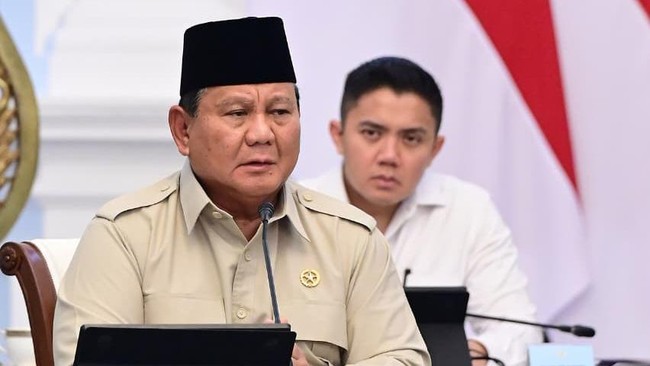
President Prabowo Subianto is confident that various priority programmes, such as free nutritious meals (MBG), Red and White Cooperatives (Kopdes), school infrastructure repairs, the construction of three million homes, and fishing village developments, can propel Indonesia’s economy to 8% growth by 2029. He stated that this growth could be achieved even though the Incremental Capital Output Ratio (ICOR), which indicates the investment required to generate economic growth, remains high at 6.3. However, the ICOR must still be reduced by minimising budget leakages. Prabowo made these remarks in response to questions from former Finance Minister and current National Economic Council (DEN) member Chatib Basri. He noted that achieving 8% growth would be difficult if budget wastage persists and societal productivity remains low, leading to Indonesia’s high ICOR. Chatib explained that the high ICOR means Indonesia’s investment needs reach 54% of gross domestic product (GDP), while the savings ratio to GDP is only around 35%. “The question is, if we really want to chase 8% growth, the human capital issue must be addressed. What do you plan to do about this? Because without it, even if the money comes, if we are wasteful, we won’t be able to achieve 8%,” said Chatib Basri to Prabowo during the “President Prabowo Answers” event aired on Prabowo Subianto’s YouTube channel, quoted on Wednesday (25/3/2026). In response, Prabowo initially explained that his administration is fully committed to addressing Indonesia’s human capital issues, particularly in education. He cited the school renovation programme, which realised 17,000 schools last year. This year, he targets 70,000 schools, rising to 90,000 next year, reaching a total of 300,000 schools by 2029. “And I send this directly to school principals with school committees and parents. Many principals cried; for the first time in history, they manage it themselves,” said Prabowo. He added that the renovations not only improve physical infrastructure but also strengthen digitalisation to help primary, junior high, and senior high school students learn more effectively and adapt to digital technology developments. One example is providing national interactive flat panels or Smartboards, already implemented in 288,831 schools. “These are children in villages and remote areas; now their interest in learning has increased, even starting to like mathematics. This year, from one interactive panel per school, I will add three, so in 2026, four classrooms will have interactive flat panels,” he explained. Regarding efforts to boost productivity, he said they are already underway alongside various priority programmes. For MBG, for instance, it will create 1.5 million jobs once 30,000 SPPG kitchens are fully operational, plus another 1.5 million jobs for farmers due to demand for food commodities from the MBG kitchens. “Each kitchen creates 5-10 supplier vendors, selling eggs, carrots, vegetables; each vendor empirically employs about 5 farmers, so that’s another 50, 1.5 million more jobs just from MBG,” he emphasised. From the Red and White Cooperatives programme, he said it will create no less employment. One cooperative requires 18 workers, with a target of 80,000 cooperatives, thus adding 1.44 million new jobs. For fishing village development, he said it is not aimed at creating new jobs but increasing the productivity of existing fishermen. One Red and White Fishing Village will manage 600-2,000 households, equipped with supporting infrastructure like cooling installations for catches and special diesel fuel stations for fishermen. “Previously, their boats could only go to sea for 24 hours; now we can make it three times, and in the Biak pilot project, fishermen’s income rose by an average of 60%-80%, which also generates economic growth. I will explain one by one; that’s why I’m confident. We haven’t even talked about downstreaming, which this year is the real value added,” he said. The fishing village development, now realised at 1,100 locations, is also strengthened by optimising shipyards to build 1,582 fishing vessels annually, from 150-2,000 GT capacity. “Because I don’t want our seas occupied by foreign ships; that’s not right. This will create jobs in about 30 shipyards; we have around 60 shipyards. One ship needs 20-30 crew, and the crew can rotate,” said Prabowo. Beyond that, additional productivity will come from the three million homes programme, with one million units focused on urban areas. He said one house in the programme requires at least 5 workers, plus ripple effects to around 72 related industries. Thus, in urban areas alone, there will be 5 million jobs from the one million homes programme. “And we plan one million towards, yes, maybe 10 years from now because our shortage is quite large, 12 million units short, so this will be a big booster to the economy. And finally, we can take the average; China didn’t grow 13% straight for 20 years. If we average over 10 years, I think it’s very easy to get 8%; I am very confident,” Prabowo stated.