
Accelerating Green Business, Katadata Launches KESGI Dashboard
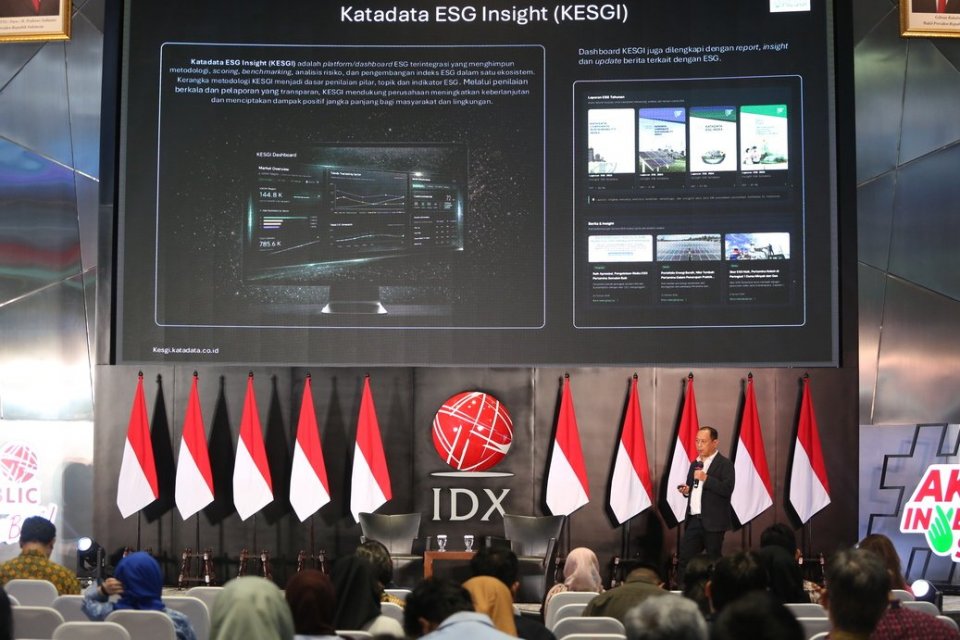
Katadata, through Katadata Green, has launched the KESGI (Katadata ESG Insight) Dashboard. This dashboard aggregates and analyses ESG data for companies listed on the stock market, strengthened by assessments from expert panels and artificial intelligence (AI) technology to support the implementation of ESG in Indonesian companies.
The launch took place at the Katadata ESG Forum themed “ESG for Accelerating Decarbonisation & Green Business,” held at the Main Hall of the Indonesia Stock Exchange, Jakarta, on Monday (6/4). The forum attracted more than 100 participants from regulators, company leaders, investors, and industry players.
Co-founder and Chief Executive Officer of Katadata, Metta Dharmasaputra, stated that the development of this initiative is based on the belief that the green economy can boost Indonesia’s economic growth to 8 percent.
“Without this sector as a new driver, it seems difficult to achieve that growth target,” said Metta.
Metta also added that in a 2024 survey by the Indonesia Stock Exchange together with Mandiri Institute on 150 companies, the main challenges faced were the lack of adequate quantitative data, limited human resources, and high costs of collecting ESG data. Co-founder and Chief Content Officer of Katadata, Heri Susanto, said that the KESGI Dashboard is an effort to make ESG data easier to understand and to underpin decision-making. Thus, the reading of ESG developments in Indonesia can be clearer, deeper, and faster.
“KesGI becomes a solution so that data can be turned into insights, from compliance to decisions, and from fragmentation to integration,” he said.
According to Heri, KESGI has a methodology developed from global standards and aligned with local standards and national regulations. The assessment framework in this dashboard consists of three ESG pillars, comprising 15 topics and strengthened by more than 100 indicators.
He added that in the future, KESGI will also develop the Katadata ESG-50 Leader Index. This stock index will identify 50 listed companies on the Indonesia Stock Exchange with the best consistent application of ESG standards.
“In the future, we will develop an ESG Index that can serve as a reference for investors, so they can see good ESG and financial performance of companies,” said Heri.
Deputy Head of Katadata Green, Jeany Hartriani, explained that there are several challenges in implementing ESG in the Indonesian context. Some of them include complex ESG standards and limited team experience. Building more mature ESG standards and procedures is an important step.
“ESG must be more than just reporting, becoming a leadership principle and underpinning company operations,” said Jeany.
She added that KESGI is an ESG platform that integrates intelligence, consulting, learning, communication, and sustainability activation in one ecosystem.
Acting Director of the Indonesia Stock Exchange, Jeffrey Hendrik, revealed that ESG Indices at the Indonesia Stock Exchange are increasingly becoming a reference in investment decision-making. This includes growing global investor attention to the renewable energy sector and energy transition.
Quoting data from the Financial Services Authority as of February 2026, Jeffrey stated that there are 72 passive mutual funds and exchange-traded funds based on stocks listed on the exchange with total managed funds reaching Rp15.83 trillion.
“The Indonesia Stock Exchange provides 6 ESG-based indices to encourage the creation of ESG investment products, platforms, ESG reporting guides, education programmes for investment players, as well as collaboration with regulators and strategic partners like Katadata,” he said.
At this event, Katadata Green also signed a memorandum of understanding with five strategic partners, namely East Ventures, Life Cycle Indonesia, Indonesia Carbon Capture and Storage Center, A+ CSR Indonesia, Rekosistem, and Jejakin. This cooperation aims to strengthen collaboration in the development and utilisation of KESGI, including strengthening data-based ESG ecosystems, developing data-based platforms, and expanding the adoption of sustainability practices across various sectors.