
Academics Criticise Source-Based Waste Management Policy for Lack of Tangible Action Examples
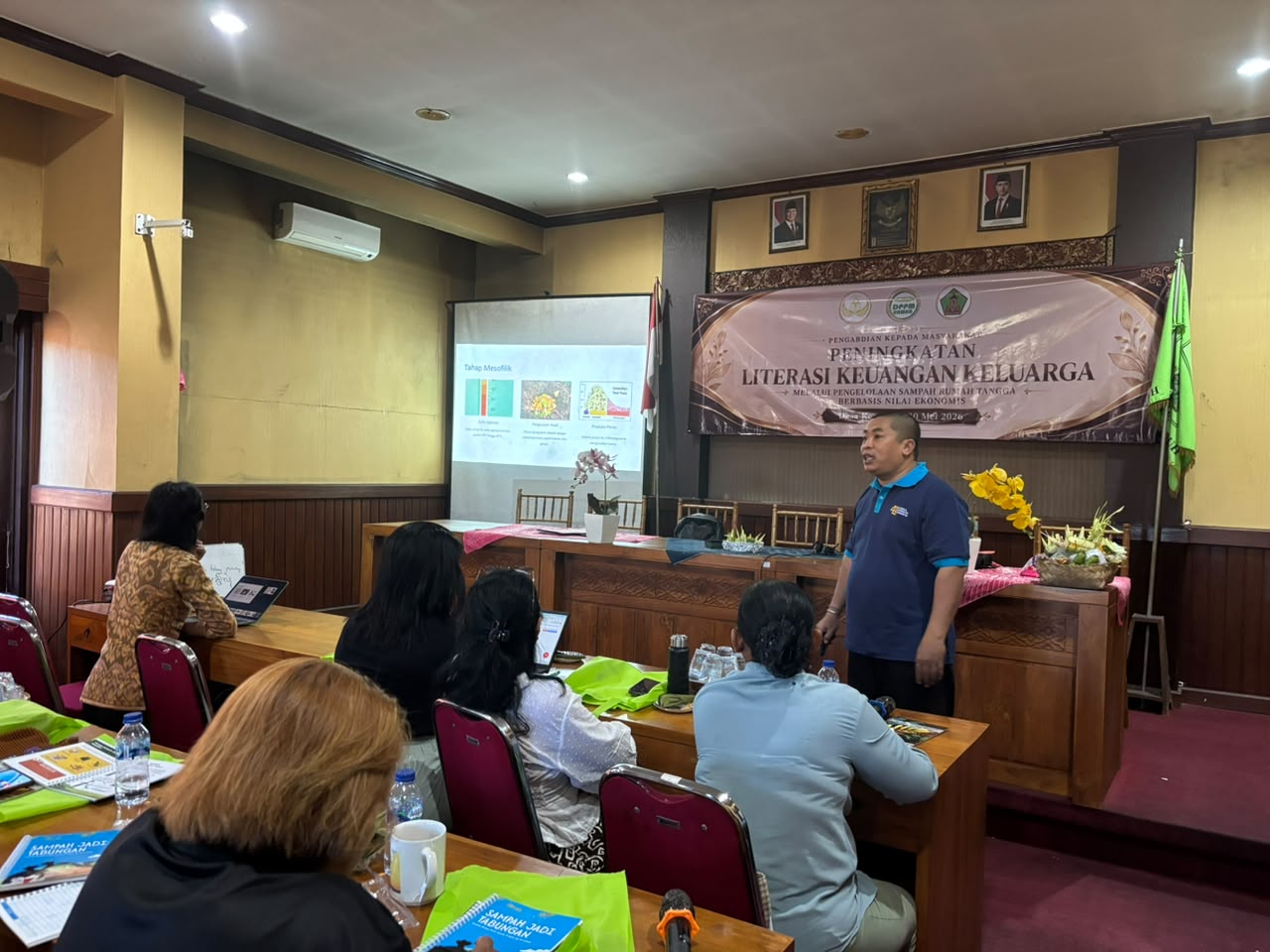
Source-based household waste management policies in Bali are stagnating and hitting a dead end. The root cause is not public resistance or unwillingness to sort waste, but rather community fatigue from top-down regulations, instructions, and awareness campaigns lacking tangible examples and practical demonstrations on the ground.
Dr I Nengah Muliarta, an academic from the Agrotechnology Study Program at the Faculty of Agriculture, Science, and Technology at Warmadewa University (Unwar), made the remarks while serving as a speaker at a Waste Management Techniques Training held in Kemenuh Village, Gianyar, Bali, on Saturday (30/5). The event was part of Unwar’s Community Service Programme (PKM) to provide on-the-ground support.
According to Muliarta, the public is now fatigued by mere commands to sort household waste or threats of penalties without sustained, tangible examples. ‘What people need now is consistent guidance and concrete role models, not just theoretical rhetoric,’ he stressed.
Muliarta added that source-based waste management often fails due to one-size-fits-all programs that ignore daily household needs. When residents are asked to make compost, they often face the stigma that it is complicated, requires large plots of land, emits foul odours, and takes months to complete.
Scientifically, agricultural and environmental experts recognise numerous organic waste composting methods, from conventional techniques like pit digging, Takakura, biogreen reactors, to large-scale modern composting. However, not all these scientific methods are adaptable for mass adoption by communities busy with domestic and cultural activities.
‘Many composting methods work well in labs but fail utterly when brought into homes. Adapted methods must meet four essential criteria: speed, low cost, ease of use, and high-quality end results,’ said the former VOA journalist.
Muliarta emphasised the importance of using natural decomposers available in home gardens, such as livestock manure, fertile soil, or mature compost. This approach helps households avoid reliance on commercial decomposer products that increase domestic costs.
Through proper and controlled composting methods, the time typically taken months to produce compost can be significantly reduced. When correctly managed with weekly turning, decomposition can mature in just 30 days. The key lies in consistently maintaining three parameters: moisture levels, temperature stability, and pH balance of the composting system.
During the event, Unwar academics also equipped Kemenuh Village residents with basic knowledge on physical indicators of mature compost. Residents were taught to identify ready-to-use compost by its stable room-temperature, dark brown soil-like colour, crumbly texture, and the replacement of foul odours with a characteristic humus smell.
‘This physical understanding is crucial to prevent residents from applying immature compost, which can damage garden plants,’ he said.
On another note, Muliarta corrected the misconception that household compost can easily be sold for quick profits. He said excessive commercial expectations often lead to disappointment and abandonment of waste processing when products prove difficult to market.
‘It is essential to understand that the primary goal of source-based waste management is resolving environmental issues at the source, not quick business opportunities. Selling organic fertiliser widely requires strict legal regulations. Products must meet Indonesian National Standard (SNI) benchmarks and obtain official distribution permits to ensure consumer safety and plant suitability,’ Muliarta stressed.