
Academics and the Business Sector Urge Development of Multi-Enterprise Forestry in Lampung
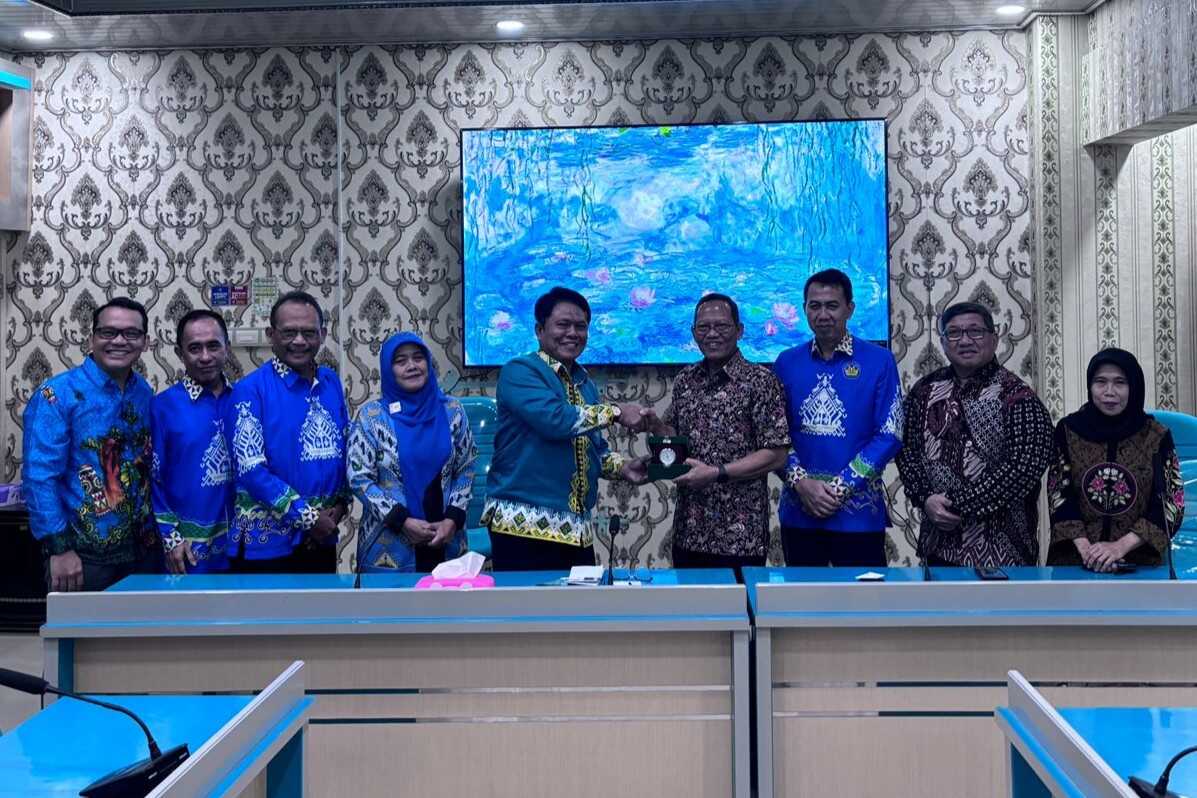
Efforts to accelerate the development of multi-enterprise forestry (MEF) in Lampung Province are being strengthened through collaboration between the business sector and academia. Cross-sector synergy is deemed essential to increase the added value of forest areas while strengthening the forestry sector’s contribution to regional and national economies. The commitment emerged in a meeting in Bandar Lampung on Thursday, 5 March between APHI Chairman Soewarso and Kuswanta Futas Hidayat, Dean of the Faculty of Agriculture at Universitas Lampung (Unila).
The meeting discussed various cooperation opportunities, ranging from research development and the creation of site-based management models to plans for developing demplots or pilot MEF projects in Lampung, which is considered to have adequate natural and human resources potential.
APHI Chairman Soewarso stressed that the development of multi-enterprise forestry requires close collaboration among industry players, the government, and academia to ensure implementation is measurable and yields broader economic impacts.
“Multi-enterprise forestry development must be carried out through collaboration with various parties, including academia, so that an industrial-scale MEF model can be realised that provides a multiplier effect for the national economy while increasing the added value of forest areas,” Soewarso said.
He noted that MEF practices have already been operating in several areas of Lampung, with activities that utilise forest areas. The experience is an important asset for developing more integrated and landscape-scale sustainable management models.
Soewarso also noted that Lampung has a number of advantages to accelerate MEF development, including relatively flat and fertile natural resources, adequate regional infrastructure, and a workforce already experienced in managing forestry and agricultural commodities. With these potentials, MEF development in Lampung will focus on strengthening governance of enterprises toward the principles of Sustainable Forest Management (SFM).
“MEF development in Lampung will focus on intensifying governance of enterprises toward sustainable forest management, while also strengthening governance and the supply chain from upstream to downstream to the market by increasing production factors including quantity, quality, and continuity,” he said.
As an initial step, the development of demplots or pilot MEF projects is seen as important as a basis for research and shared learning for various parties. Through this development it is hoped to formulate a forest enterprise management model that fits Lampung’s characteristics, while supporting the development of area-based flagship commodities.
Meanwhile, Kuswanta Futas Hidayat, Dean of the Faculty of Agriculture at Universitas Lampung, said his faculty welcomed collaboration with the business world to accelerate MEF development in the region.
“We warmly welcome APHI’s efforts to collaborate with higher education institutions to accelerate MEF development in Lampung. The region has several flagship commodities such as coffee, cocoa, candlenut, and nutmeg, which have great potential for development,” he said.
He explained that piloting MEF in Lampung can take place in several potential locations, such as Tahura areas or Integrated Area Development (IAD) zones that already have an economic base in the area.
Kuswanta added that Lampung also has significant potential in the non-timber forest products (HHBK) sector, particularly the coffee commodity, much of which is produced from forest areas.
“We note that around 60 percent of Lampung’s HHBK production is coffee from forest areas, and its potential remains very large to be developed further through sustainable management approaches,” he said.
According to him, the Department of Forestry at the Faculty of Agriculture of Universitas Lampung has several relevant research areas to support MEF development, including Social Forestry and Forestry Science and Technology.
These two fields are seen as capable of supporting stronger governance of community-based forestry enterprises while promoting the use of technology and innovation in forest management. In addition, this approach can be an important instrument in helping resolve tenure conflicts through a more inclusive and collaborative forest-area management model.
Through collaboration between APHI and the Faculty of Agriculture at Universitas Lampung, it is hoped to create stronger integration between academic research and field implementation in the development of MEF models based on regional flagship commodities. The synergy is expected to drive forest management that is productive, inclusive, and sustainable, delivering economic, social, and ecological benefits to communities and the region.