
Academics and Researchers Discuss Civil Governance and National Development
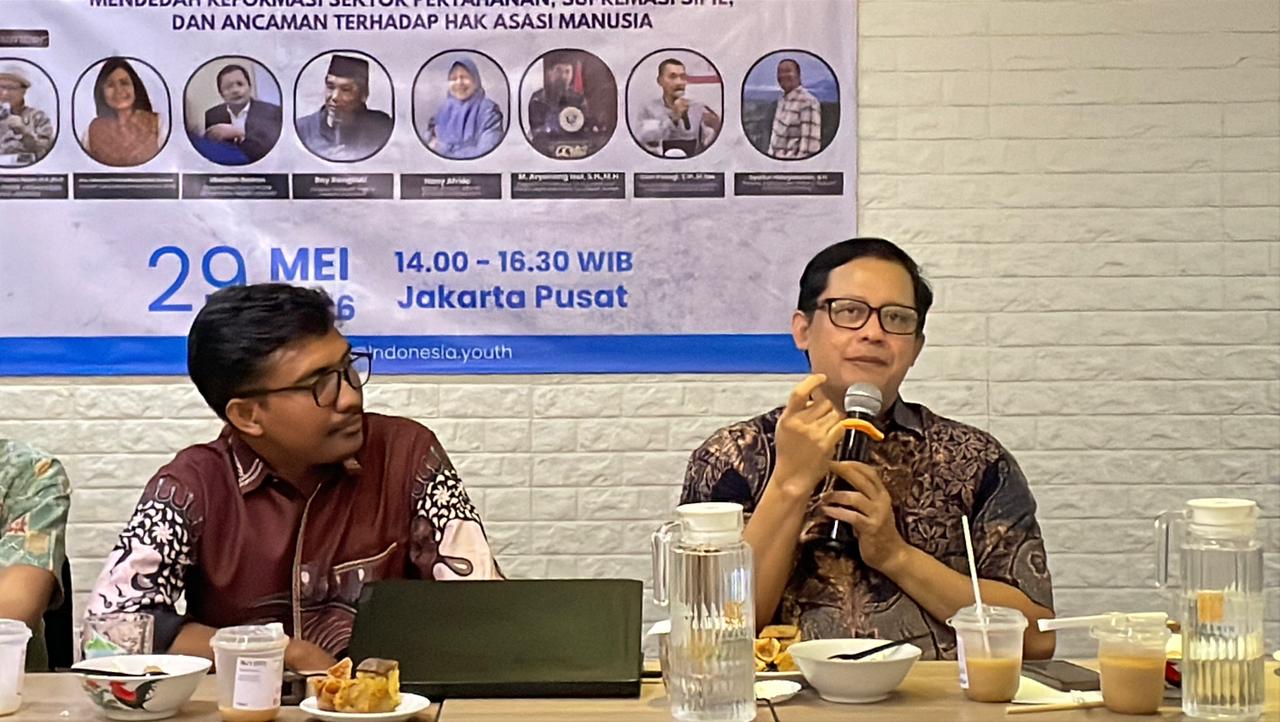
Ubedilah Badrun, a social-political academic at Jakarta State University (UNJ), highlighted the military’s role in civil governance and national development during a discussion titled ‘Remilitarisation and Indonesia’s Democratic Future: Unpacking Defence Sector Reform, Civil Supremacy, and Threats to Human Rights’ in Jakarta on Friday (29 May).
Ubedilah argued that the military’s involvement in civil domains, which should be democratically managed, poses a serious challenge to democracy and human rights. He attributed this trend to sociological backgrounds and political imaginaries of power elites rooted in past cultures.
‘Remiliterisation stems from social cognition of the past interpreted subjectively by power elites,’ Ubedilah stated.
He also noted that critical dialogue spaces are increasingly constrained, compounded by national economic challenges including fiscal and monetary pressures across regions.
M. Aryanang Irsal, IGJ Programme Manager, pointed out the dominant security approach in safeguarding civil projects, including National Strategic Projects (PSN). He said foreign investment and international corporations entering national projects often clash with agrarian and social conflicts affecting indigenous communities and local residents.
‘Post-World War II human rights violators are no longer solely state actors. International corporations and foreign investments are funding government programmes like PSN,’ Aryanang said.
Strategic Litigation and Law Researcher Syaiful Hidayatullah specifically criticised two new government programmes: the Territorial Development Battalion (BTP) and the Red and White Village Cooperatives. He argued that deploying the military for civil functions such as crime, agriculture, and livestock management is inappropriate as it blurs the police’s core duties and the TNI’s primary role in safeguarding national sovereignty.
Syaiful added that military-style authoritative officers risk instilling fear in civilian society rather than providing security. He also raised concerns about the TNI’s leading role in the Village Cooperatives programme, which he believes requires evaluation to preserve democratic climate.
‘Military personnel are hard to engage in discussion, they hide behind military law instead of civilian law. Yet it’s odd when they’re involved in civil affairs but don’t abide by civilian law,’ Syaiful concluded.