
Academic reminds Polri officers not to create "tombstone" projects
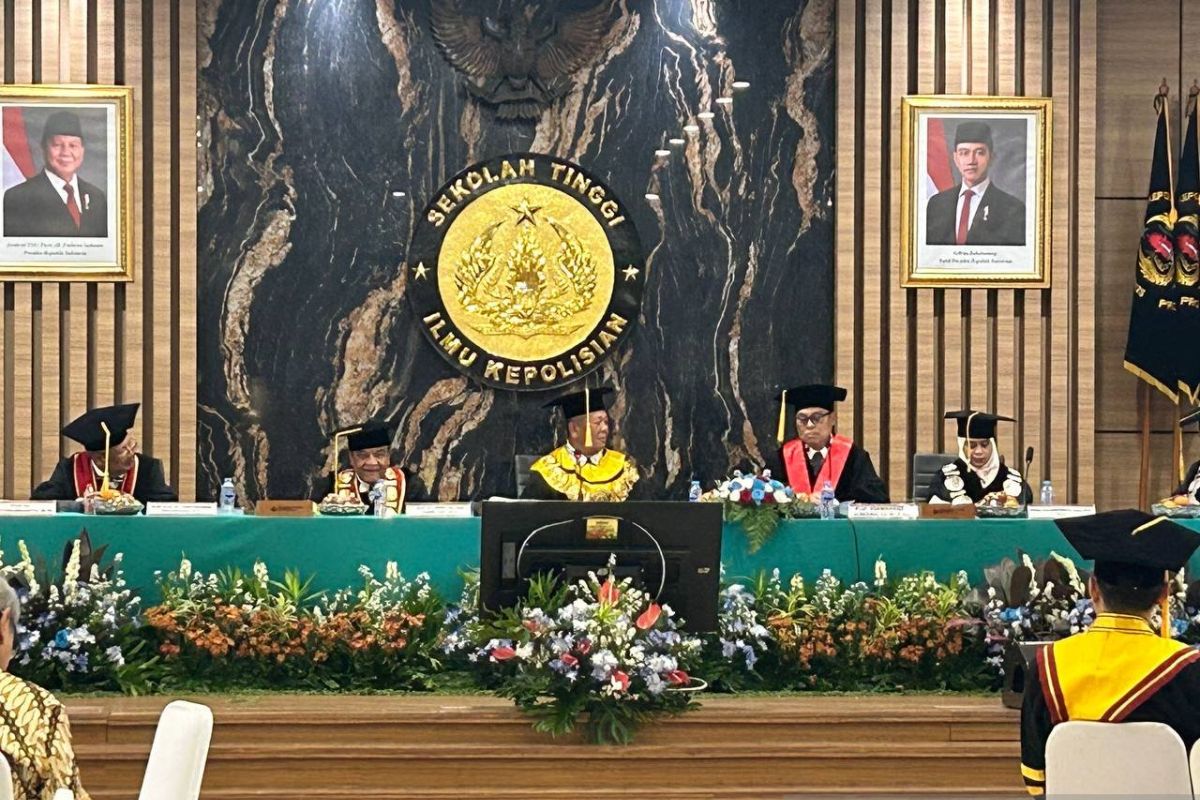
Jakarta (ANTARA) - Professor Hikmahanto Juwana, from the Faculty of Law at the University of Indonesia, has reminded Polri officers pursuing doctoral studies not to create “tombstone” projects in their research. Hikmahanto hopes that the dissertation research conducted by Polri officers will be beneficial to the academic world and policymakers. “I always remind them, the police, when they become doctors, not to just create a tombstone project. The meaning is, if they die, on the tombstone it will be written with the title of doctor. Don’t do that,” said Hikmahanto during the open doctoral promotion session at the Indonesian Police College (STIK) Polri, Jakarta, on Tuesday. He specifically conveyed this message to Inspector General of Police Chaidir, who was undergoing the open doctoral promotion session in the field of police science. Hikmahanto served as the supervising lecturer (promotor) for Inspector General Pol. Chaidir’s dissertation research titled “International Police Cooperation between Indonesia and Malaysia (Nodal Governance) in Combating Transnational Organised Crime”. As a supervising lecturer, the international law expert hopes that the Polri officers he supervises will prioritise scientific knowledge in every action and statement. He praised several high-ranking Polri officers who base their policies or information dissemination on scientific knowledge, one of whom is Commissioner General of Police Prof Chryshnanda Dwi Laksana, as well as the lecturers and professors at STIK Polri. “I always say that if I differ in view with the government, I cannot just speak casually, but my basis must be what the data says, what the science says,” he explained. According to him, there are many Polri officers from the thinker category, although in general, the Polri environment has more operational than thinkers. There are also high-ranking Polri officers who have achieved the highest ranks and been appreciated by the state because their thoughts and ideas were used during their service. Hikmahanto also emphasised that the doctoral degree obtained by a Polri officer is a weapon to navigate the world based on research. For a doctor, dissertation research is a key element. In various countries, for doctoral programmes, lectures are not important; even at one campus in the UK, lectures are not emphasised. “What is most important is the research,” he added. Therefore, Hikmahanto hopes that the research conducted by Inspector General Pol. Chaidir in his dissertation on international police cooperation in combating transnational organised crime will be developed to the level of stakeholders. He views the dissertation as having novelty and being crucial in the current ASEAN economic community era. According to him, there are two important pillars that have not yet been implemented at the ASEAN regional community level, namely the security pillar and the political and cultural pillar. In the context of the security pillar, he continued, the research produced by Inspector General Pol. Chaidir is very important to realise a safe ASEAN regional environment from organised crime that still persists. He also hopes that the results of this research can be conveyed to various related parties, including hopefully the research results can be discussed nationwide, included in journals, and read by academics and stakeholders. “So that what I questioned earlier, whether we can build cooperation to combat crime without being burdened by bureaucracy, can be realised,” said Hikmahanto. “Hopefully one day, the results of this dissertation, whether the researcher in his capacity as a police officer or academic, can realise cooperation that is not burdened by bureaucracy in combating organised crime,” he added.