
A Thousand Red Crosses in the Land of Papua: What Do They Signify?
The documentary film ‘Pesta Babi’, which spotlights the rejection by the people of state projects in the land of Papua, has been banned from screening in several regions. What is the actual situation in the land of Papua? What is the meaning of the red cross symbol used by residents in their rejections?
The documentary film ‘Pesta Babi’ spotlights the rejection by residents of plantation projects on customary land in South Papua, covering Merauke, Boven Digoel, and Mappi. The film depicts the struggles of the Marind, Awyu, Yei, and Muyu tribes who have lost their living spaces due to these projects.
The Head of the Papuan Representative Office of the National Human Rights Commission (Komnas HAM), Frits Ramandey, explained that what is happening in several regions of Papua currently is the presence of projects that then reduce the living spaces of communities.
“The rejection is more like this: the presence of these projects is not participatory. Then they take the customary rights spaces of the communities blindly, marginalising them from spaces for earning a livelihood. Not only that, there is the mobilisation of the TNI to repress the communities,” he told Republika on Tuesday.
In the implementation of these projects, said Frits, the TNI transforms into farmers and takes job opportunities and income from local residents. “So you have to check the TNI: you work twice, get paid twice,” he said.
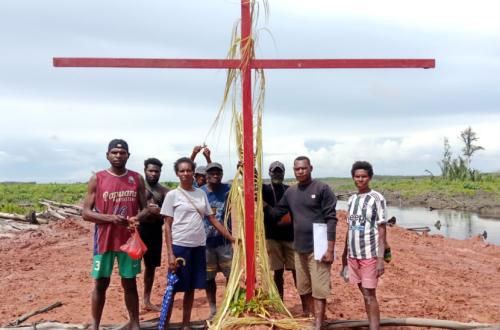
In the residents’ rejections, large wooden stakes in the shape of crosses painted red are then used. “That is a large cross signifying their prayers. A sign that they are asking God to save them from the threat,” he said.
“There are hundreds of red crosses in hundreds of places. They no longer know who to ask. They carry that cross as a symbol of hope in God alone. Red is a symbol of resistance and also a symbol of blood.”
Cited from the Yayasan Pusaka Bentala Rakyat (Pusaka), which is active in advocating for the protection of customary land, it records that the recent use of the red cross by the Awyu tribe in Boven Digoel is to defend a customary area of 36,094 hectares claimed by PT Indo Asiana Lestari (PT IAL). Awyu tribal figure, Hendrikus Woro, officially challenged the issuance of the plantation permit but it failed all the way to the Supreme Court.
Referring to Pusaka’s records, the red cross planting movement known as the Red Cross Movement has been ongoing since 2014 as a response to large-scale projects that seize customary land and damage the forests, living spaces of indigenous communities, and biodiversity in the land of Papua.
Up to 2024, it is estimated that more than 1,800 poles and red crosses have been installed throughout the land of Papua, from Boven Digoel, Mappi, Merauke, to Jayapura. This Red Cross Movement combines Christianity and long-rooted Papuan customs in that land.