
A Slim Guide to Challenging Tyranny
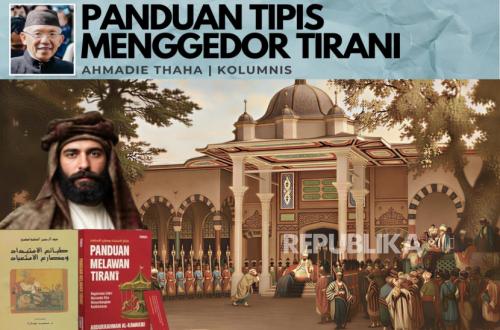
A slim booklet can sometimes be more powerful than a thick tome. Such is the case with Abdurrahman al-Kawakibi’s work “Watak-Watak Tirani dan Jalan Kehancuran Perbudakan” (The Characteristics of Tyranny and the Paths to the Destruction of Servitude), recently published in Indonesian by Turos Pustaka under the provocative title “Panduan Melawan Tirani” (A Guide to Resisting Tyranny).
Al-Kawakibi (1855–1902) was a reformist thinker from Aleppo, Syria, who wrote during the declining Ottoman Empire’s struggle with the classical malady of absolute power. Unlike someone writing from an academic tower, al-Kawakibi wrote from the midst of political turmoil. He was imprisoned, silenced, and ultimately chose to live in exile in Egypt. His observations on tyranny stem from lived experience rather than theoretical seminar discussion.
At its core, al-Kawakibi’s work presents a deceptively simple yet often overlooked insight: tyranny never stands alone. It is always accompanied by two loyal companions: public fear and cultivated ignorance. He argues that tyrants fear three things above all—knowledge, public consciousness, and freedom of thought. Consequently, authoritarian rulers constantly attempt to keep populations preoccupied through meaningless rituals, trivial factional conflicts, or propaganda that discourages critical thinking.
Al-Kawakibi’s analysis reveals that tyranny extends far beyond palace walls. It conceals itself in political institutions that have lost their oversight function, in religious scholars too close to power, and in societies made complicit through manufactured fear. He contends that tyranny corrupts all institutions: religion, science, public morality, and economics. In such systems, honesty becomes dangerous whilst excessive praise of rulers is deemed patriotic.
The book was repeatedly banned during al-Kawakibi’s lifetime; authoritarian rulers recognised that such publications posed greater danger than street demonstrations. Demonstrations can be dispersed, but books endure for centuries.
The recent Indonesian publication and public discussion of this work have attracted scholars examining it from different perspectives. Constitutional expert Feri Amsari approached it from a modern constitutional framework, whilst students like Tiyo Ardianto read it as a call for civic courage. Notably, Amsari emphasised that resistance to tyranny does not necessarily begin in streets or courtrooms, but often in something quieter: critical literacy—the tradition of reading, understanding, and debating ideas, protected by law yet underdeveloped in Indonesian political culture.
Amsari also observed that tyranny rarely appears as a frightening giant. Rather, it emerges in banal forms: institutions stripped of oversight functions and elites protecting one another.