
A Severe Blow to Trump: Making China Suffer Was in Vain
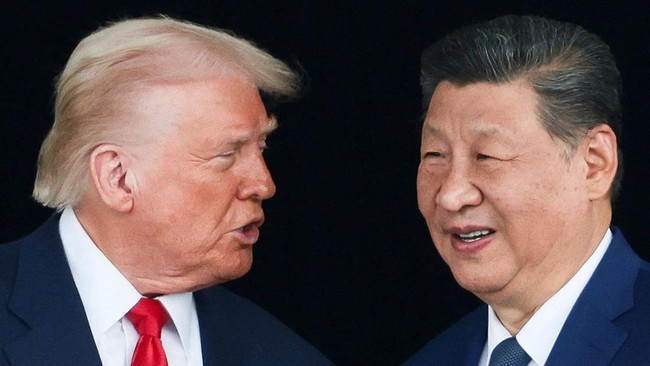
US President Donald Trump shook the world when he first announced massive global tariffs on 2 April 2025. The policy immediately sparked a new trade conflict between the US and China, as well as the US with some of its allies.
Trump’s tariff disaster was proclaimed to restore the glory of US manufacturing and break dependence on China. Trump’s priority was to address the US trade deficit with Asia, which stood at US$760 billion.
However, Trump’s high tariffs also hit US tech giants that rely on supply chains in Asian countries. Thanks to strong lobbying from tech CEOs, Trump eventually exempted consumer electronics produced across Asia. Only goods made in China were subject to a separate tax related to fentanyl, up to 20%.
A year later, Trump’s unpredictable tariff policy has reshaped supply chains. Yet, the outcome has not met Trump’s expectations. The high tariffs that brought global havoc have not succeeded in bringing prosperity to the US manufacturing industry.
Bloomberg’s analysis of customs data on shipment levels shows a shift in manufacturing to Vietnam. Last year, Vietnam surpassed China as the main supplier of laptops and gaming consoles to the US for the first time.
How China Faces Trump’s Uncertainty
A more surprising fact from Bloomberg’s findings is that core electronics production still occurs in China. This demonstrates China’s rapid adaptability in facing repeated US sanctions and regulatory uncertainty from the Trump administration.
Faced with unpredictable tariffs, Chinese producers found a cost-saving solution: moving final assembly lines with low-skilled labour to Vietnam, where they face lower import duties, according to Bloomberg on Wednesday (1 April 2026).
Vietnamese factories that assemble China-made components and ship them further contribute less than 8% of export value in some cases, per Bloomberg’s analysis.
Shipments of goods from China to the US dropped by US$51 billion in 2025. However, this did not correspond to an increase in US domestic manufacturing, as Trump had envisioned.
The US instead recorded larger imports from Vietnam. The value rose from US$13.4 billion in 2024 to US$29.8 billion in 2025. Overall, the cumulative increase in US imports by US$49 billion came from several countries, including Vietnam, India, and Mexico, according to Bloomberg’s data analysis.
That data also shows that the US still bought seven expensive electronics products worth US$130 billion from abroad last year, down only slightly more than 1% compared to 2024.
Demand for Labour in Vietnam Surges
Demand for labour in Vietnam’s northern Bac Ninh province industrial zone is so high that novice factory workers are bused in from remote villages to fill 1,000 job openings advertised since Lunar New Year, recruiters told Bloomberg News.
“The bonuses companies offer to new workers show how urgently they need staff,” said Nguyen Van Dai outside the Foxconn Technology Group factory.
“Last year, Foxconn held five rounds of recruitment where they gave bonuses to workers of 15 million dong (US$570), the highest amount so far, to meet orders and expansion plans,” he added.
Bloomberg’s analysis of 2025 data found that Fukang Technology Co., a Foxconn subsidiary, exported MacBooks, iPads, and motherboards worth US$8.6 billion for products and servers. They also imported various components worth US$7.9 billion from China, South Korea, and Taiwan. That means at most 7.8% of that export value was generated in Vietnam, if all finished products at Fukang were exported.
BYD Co., though better known for electric vehicles, also produces iPads for Apple Inc. and follows a similar strategy. From its factory in Phu Tho, 100 kilometres (62 miles) outside Hanoi, the company exported iPads and other products worth US$5.1 billion, and imported components worth US$4.9 billion, generating only 4.5% of export value in Vietnam. Imports from China accounted for 61% of its incoming shipments, nearly matching Foxconn’s share.
BYD and Foxconn did not respond to requests for comment. Vietnam’s Foreign Ministry did not immediately respond to requests for comment outside regular working hours.
Trump’s ‘Made in USA’ Ambition Fails
The recruitment wave in Vietnam delivers a severe blow to Trump’s ‘Made in USA’ agenda. In reality, Trump’s dream of returning manufacturing and ‘blue-collar’ jobs to the US is in vain.
When Trump raised high tariffs, one of the main reasons he cited was the US’s inability to produce many goods.
“We import almost all our computers, phones, televisions, and electronics,” he said at the White House, when announcing high tariffs for more than 180 countries.
Trade flows with added value through third countries have helped China manage geopolitical risks while exposing the limitations of tariffs in curbing its export machine.
“Chinese companies are far better at controlling costs. They are much more efficient because they have a very large supply chain, from upstream, midstream, to downstream, making it easier to control costs in every segment,” said Dan Wang, China director at Eurasia Group.
“Vietnam, in particular, is a very strategic location for Chinese producers,” he added.
As a severe blow to Trump’s flagship policy, the Supreme Court overturned most of his tariffs earlier this year, including fentanyl duties on China. The White House quickly launched a trade investigation.