
A Realistic Palm Oil Bioenergy Business Model in Indonesia - InfoSAWIT
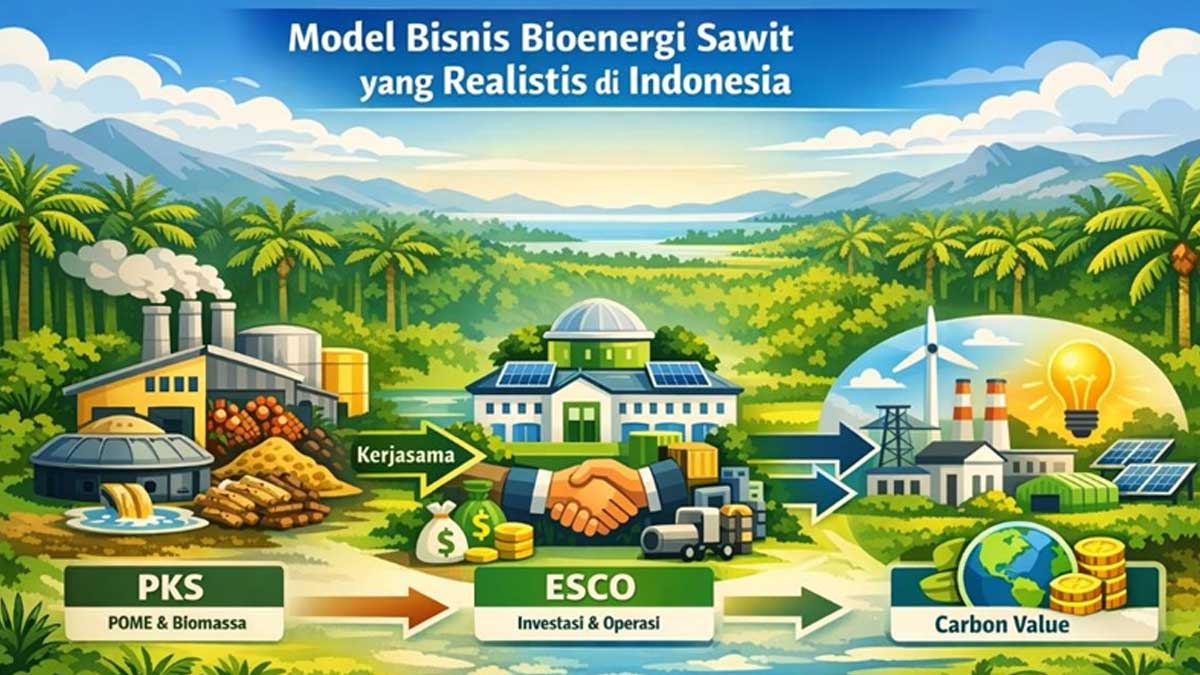
InfoSAWIT, Jakarta – There is a recurring irony in the discourse on palm oil bioenergy in Indonesia. Its potential is substantial, the technology is available, and parts of it have even been proven to work. However, when pulled into industrial reality, its momentum seems restrained—more often stopping as feasibility studies rather than evolving into living business practices.
At this point, the issue is no longer about “whether it can or cannot be done.” We have passed that phase. What is holding it back is something more quietly discussed: how to make it make sense as a business.
When Technology Is No Longer the Problem
For years, the discourse on palm oil bioenergy has been dominated by technical approaches. How large is the POME potential, how efficient is biogas conversion, what technology is most optimal. All of that is important, but in industrial logic, it is not the final determinant.
In the management meeting rooms of palm oil factories, decisions are not born solely from technological sophistication. They rely on cooler calculations: how large is the investment, how quickly it returns, and what risks must be borne.
This is where bioenergy often loses its momentum. The initial investment is large. The benefits are not always immediately visible in the short term. And more crucially, it sits on the periphery of the main business—not the core of palm oil production itself.
As a result, bioenergy is often positioned as a complement: good if present, but not urgent if absent. A “nice to have”, not a “must have”.
Perhaps the problem is not with the technology itself, but with how we frame the investment.
This is where the Energy-as-a-Service approach begins to find its relevance. This model, run through energy service company (ESCO) schemes, offers a simple yet fundamental change: shifting the investment burden from the factory to another party specialised in the energy sector.
Instead of building biogas facilities themselves with large capital expenditure, factories simply purchase the energy produced—like buying electricity or fuel. Investment, construction, and operations become the responsibility of the investor.
Under this framework, bioenergy is no longer seen as an additional project, but as a service that can be accessed without ownership.
From Waste to Value
If pulled to the numbers, this picture becomes more concrete. At a medium-scale palm oil factory, the utilisation of liquid waste and biomass can generate economic value of up to tens of billions of rupiah per year.