
A Portrait of a Street Shoe Repairman: Unstable Income, Required Payments to Local Organisations
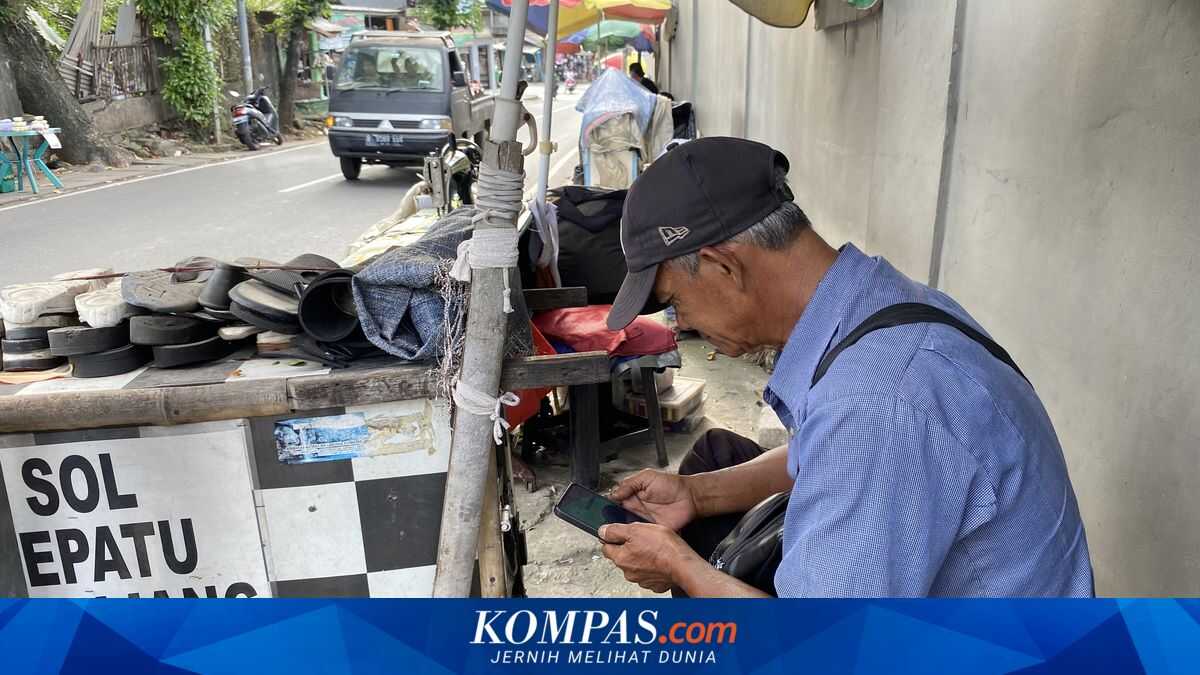
JAKARTA, KOMPAS.com - Amidst the rapid pace of modernisation and the proliferation of shopping centres in the capital city, the profession of street shoe repairmen continues to survive in the corners of the streets.
They work in the cramped space of the pavement, equipped with a wooden cart, hammer, glue, and piles of rubber soles. However, behind this resilience, there is a story of unstable income, evictions, and contributions to local organisations.
Tuhaya (51), one of the travelling shoe repairmen in the Lenteng Agung area, South Jakarta, admits that he has been working in this profession for many years.
There is no guarantee of how many shoes he will repair each day. Sometimes he only gets one customer, sometimes more.
“Sometimes I earn Rp 20,000 a day, sometimes more, sometimes it’s quiet. The important thing is to earn something,” Tuhaya told Kompas.com on Wednesday (25/2/2026).
The cheapest shoe repair service costs Rp 20,000–25,000. For shoes with larger sizes or more severe damage, the price can reach Rp 30,000.
Meanwhile, for a complete replacement of the shoe sole, the cost ranges from Rp 100,000 to Rp 150,000, depending on the quality of the material chosen by the customer.
However, these figures do not necessarily mean a stable net income. In a month, there are busy days, but there are also days when there are no customers at all.
“It’s enough for daily expenses. But it’s not certain,” he said.
The unstable income forces him to be good at managing his finances.
He usually collects money little by little before sending it to his wife and children in his hometown in Java. Usually, he returns home every two months.
“I collect it first, then send it weekly or whenever there is money,” he said.
In Jakarta, Tuhaya lives in a rented house with several friends from his hometown. The rental costs are shared to make it more affordable.
“Often. You could say it’s a regular thing,” he said.
In fact, he once lost his identity card (KTP) during an eviction. To get it back, he had to pay Rp 150,000. Now, he admits that he no longer has a KTP.
The lack of official identification certainly makes it difficult if there are administrative needs. However, Tuhaya admits that he does not have many choices other than to continue working.
“It’s difficult, but I just have to deal with it,” he said.
To work in that location, he also does not have official permission from the government. However, he said that there are contributions paid to the local organisation.
“There is no official permit, but there is an organisation,” said Tuhaya.
He admits that he pays around Rp 200,000 per month. For Tuhaya, this amount is quite large compared to his fluctuating daily income.
However, he says that this payment is part of the consequences of surviving in the location.
Read also: Failed Motorcycle Theft in Depok, Caught While Having Difficulty Starting the Vehicle