
A Century of Memories: Grandmother Sharifah's Naked-Eye Ramadan Crescent Sightings from the Peaks of Maysan
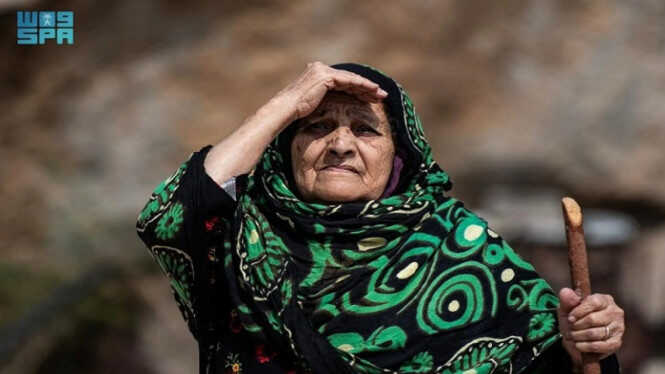
In the mountain villages of Maysan Province, east of Mecca, time seems to move more slowly. Wind sweeps between great boulders, and the evening sky stretches vast and unobstructed. It was here, decades ago, that the start of Ramadan was not announced through official broadcasts or mobile phone notifications, but through the gaze of eyes trained on the western horizon, filled with hope.
For the elderly in this region affiliated with the Thaqif Centre, memories of the hilal are not mere stories of the past. They are fragments of life that preserve collective joy, cooperation, and deeply rooted spirituality.
Sharifah binti Atiyah Al-Thaqafi, nearly a century old, still vividly remembers the nights when the start of Ramadan was determined more than nine decades ago. From her home in the village of Lykah, perched among rocky mountain formations, she speaks softly of a time when the naked eye was the sole “official instrument” for confirming the arrival of the holy month.
As the sun set, the village men and their children would walk to the highest points — including the peak of Mount Shahdan — to search for the thin arc of the crescent moon in the twilight sky. Meanwhile, the women remained at home. They waited in a silence laden with prayer, whilst preparing dishes for the first iftar and sahur, as though Ramadan’s arrival was already certain.
When the hilal was finally sighted, the news was not conveyed by loudspeaker or television broadcast. Bonfires were lit on the mountain peaks. Takbir was chanted aloud, echoing from one hill to the next. Congratulations and poetic verses were recited, carrying the joyous message to neighbouring villages. In the glow of fire and the resonance of voices, the entire community seemed to become one.
This tradition was not merely a sky-watching ritual. It was a social event that strengthened the bonds of kinship. The announcement of the hilal marked the beginning of a series of Ramadan evenings filled with family gatherings, communal sahur meals, and warm togetherness amid the mountain air.
Times have now changed. Madis Al-Thaqafi, spokesperson for the Majardah Thaqif Astronomical Observatory, explained that methods of hilal observation have undergone significant transformation. From relying solely on direct sight, observers now employ astronomical telescopes, digital imaging, and specialised computational applications to enhance the accuracy and scientific tracking of crescent moon formation.