
A 70-Year Trail in the Iran–US–Israel Conflict: Coups, Betrayals and War
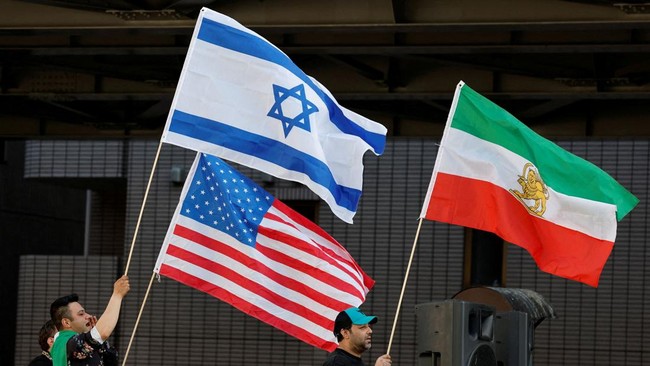
Jakarta, CNBC Indonesia - The Middle East is once again on the cusp of a major crisis after the United States (US), together with Israel, launched a significant strike against Iran exactly a week earlier, on Saturday, 28 February 2026.
That attack also killed Iran’s Supreme Leader Ayatollah Ali Khamenei, a development that immediately propels the escalation to a far more dangerous level.
In response, Iran launched retaliatory attack with missiles and drones against Israel as well as targets in Gulf states linked to US military facilities. American intelligence has also warned of potential further attacks by Iran and its proxy groups, including via cyber channels.
This latest crisis shows that the ongoing conflict cannot be understood as merely a single new event. Behind the war that is now well underway lie two long-standing hostilities that are interconnected: the historical Iran-US conflict rooted in the 1953 coup and the 1979 Revolution, and the Iran-Israel conflict which in recent years has shifted from a proxy war into open confrontation.
Therefore, to understand the magnitude of the escalation, we need to understand the history of Iran’s conflicts with the US and with Israel.
The Trajectory of the US-Iran Conflict
Relations between Iran and the US have long been marked by ups and downs. In the era of Shah Mohammad Reza Pahlavi, Iran was in fact a primary ally of Washington in the Middle East.
The turning point came in 1953, or 73 years ago, when a CIA-backed coup toppled Prime Minister Mohammad Mossadegh and restored the Shah’s power. From then, Iran leaned more towards the West, receiving economic, military, and technological support, including civilian nuclear cooperation through the Atoms for Peace program.
However, that relationship collapsed completely after the 1979 Revolution. The Shah’s regime fell, Ayatollah Ruhollah Khomeini took power, and Iran became an Islamic Republic openly hostile to the West.
Not stopping there, the hostage crisis at the US Embassy in Tehran from 1979 to 1981 culminated in 52 Americans being held hostage for 444 days. Since then, Washington-Tehran relations shifted from mere political rivalry to enmity.
In the 1980s, the US and Iran did not engage in direct full-scale war, but they confronted each other on multiple fronts. Washington supported Iraq in the Iran-Iraq War, while Gulf tensions produced direct clashes such as Operation Praying Mantis in 1988. Thereafter, the hostilities continued through embargoes, economic sanctions, and accusations that Iran supported armed groups threatening US interests and those of its Gulf allies.
Their relations briefly improved in 2015 with the JCPOA nuclear deal. But that moment was short-lived. In 2018, President Donald Trump pulled the US out of the JCPOA and reinstated stringent sanctions against Iran. Tensions rose again in 2020 when the US killed General Qassem Soleimani, the most influential military figure in the IRGC, an act Tehran responded to with attacks on US bases in Iraq.
Not long before the February 2026 US-Israel strike on Iran, Washington had conducted an operation code-named Midnight Hammer aiming to disrupt Iran’s nuclear programme, delivering a stern warning not to re-develop its nuclear capabilities.
From Tel Aviv to Tehran: The Long Arc of the Bilateral Conflict
Unlike the deep-rooted Iran-US relationship, the Iran-Israel relationship did not always harbour hostility. Before the Islamic Revolution, Iran was among the Middle East states with open ties to Israel.
But after the revolution, the Tehran regime deemed Israel as its principal ideological foe, and since then hostility has grown, particularly through Iran’s support for groups such as Hezbollah and Hamas. For years, the Iran-Israel conflict largely unfolded as a shadow war. Israel accused Iran of building military networks and arms supplies in Syria, Lebanon, Iraq and other regions to threaten Israel from multiple directions. Iran, on its part, positioned itself as the ‘axis of resistance’ against Israel. In this phase, cyberattacks, sabotage, assassinations of scientists, and intelligence operations became central to the escalations, though both sides had not yet engaged in open direct warfare.
A major escalation occurred in 2024 when Iran and Israel finally engaged in direct attacks. Iran launched hundreds of drones and missiles at Israel in April 2024 in retaliation for an attack on Iran’s diplomatic building in Damascus. Israel responded by striking Iran’s air defence systems. This sequence marked the shift from a shadow war to direct confrontation.
The conflict intensified further in June 2025, when Israel launched an operation named ‘Rising Lion’—a major campaign targeting nuclear facilities, military sites and strategic infrastructure in Iran. Israel said the strikes were necessary to prevent Iran from building nuclear weapons, while Iran retaliated with missile strikes against Israel. Since then, the relationship between the two countries has entered a broader phase of open warfare.