
8-Point Policy on National Work Culture Transformation and Energy Policy
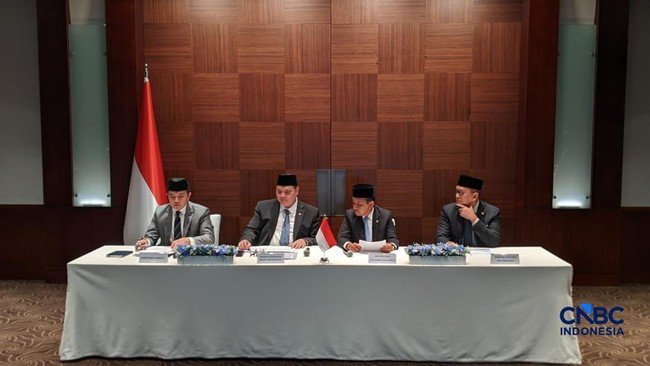
The government on Tuesday (31/3/2026) announced eight new policies as steps to save energy amid the global crisis due to geopolitical conflicts in the Middle East.
Coordinating Minister for the Economy Airlangga Hartarto stated that these eight policy points represent mitigation measures against global dynamics as well as momentum for transformation and change.
“This policy programme is called the 8 Pillars of National Work Culture Transformation Policy and Government Energy Policy,” said Airlangga during a live press conference from Seoul on Tuesday (30/3/2026).
Here are the complete eight points of the policy:
- Amid global dynamics that test the world’s supply chain, Indonesia shows itself as an adaptive, resilient, and tough nation.
“This situation is not an obstacle, but rather momentum for us to accelerate modern and efficient change. It needs to be emphasised to the public that the national economy remains stable with solid fundamentals. National fuel stocks are safe and fiscal stability is maintained,” Therefore, the following policies are taken so that the public remains calm and positive.
- As an adaptive and preventive step to face global dynamics, the government establishes a work culture transformation policy that encourages more efficient, productive, and digital-based work behaviour changes. This policy includes several main steps as follows:
- Implementation of work from home (WFH) for ASN (civil servants) in central and regional agencies, carried out for one working day per week, namely every Friday, regulated through circulars from the Minister of State Apparatus Empowerment and Bureaucratic Reform (MenpanRB) and circulars from the Minister of Home Affairs (Mendagri), including in the work from home scheme regulated as follows:
Encouraging digital-based government governance transformation,
Efficiency in mobility, including a 50% restriction on the use of official vehicles, except for operations and electric vehicles, and encouraging the use of public transport, thus reducing official vehicles and maximising the use of public transport.
Efficiency in domestic official travel by up to 50%, and overseas by up to 70%.
Specifically for regions, there is a recommendation to increase the number of days, time, and coverage of roads in car-free days, according to each region’s characteristics, and this will be regulated by a circular from the Minister of Home Affairs.
Implementation of work from home for the private sector, further regulated through a circular from the Minister of Manpower (Menaker), while still considering the characteristics and needs of each business sector. The regulation through the Minister of Manpower’s circular also covers the movement for energy efficiency in the workplace.
There are sectors exempted from WFH and still working from the office or in the field, namely public service sectors such as health, security, cleanliness, as well as strategic sectors such as industry or production, energy, water, basic goods, food/drinks, trade, transportation, logistics, and finance.
The education sector continues face-to-face learning activities, offline normally at all levels of primary to secondary education for five days a week, and there are no restrictions on sports activities related to achievements or other extracurriculars.
Meanwhile, for higher education, semesters 4 and above, adjust to circulars from the Ministry of Education, Culture, Research, and Technology (Kemendikbudristek).
- General recommendations to the public regarding:
Regarding energy efficiency, the public is urged to practise energy-saving habits in daily activities, both at home and at work, which
Smart mobility, namely prioritising the use of public transport,
The public is asked to remain productive and run the economy as usual.
This policy will take effect from 1 April 2026 and will be evaluated after two months of implementation, and the technical arrangements will be set out in circulars from the State Apparatus Empowerment and Bureaucratic Reform, the Minister of Home Affairs, and the Minister of Manpower.
The potential savings from the Work from Home policy directly to the state budget is Rp6.2 trillion, in the form of fuel compensation savings. Meanwhile, the total fuel expenditure for the public has the potential to be saved by Rp59 trillion.
The government is also taking strategic steps in managing state finances, through prioritisation and refocusing of ministry and agency expenditures. Budget reallocation is carried out from less priority expenditures, such as official travel, meetings, non-operational expenditures, and ceremonial activities towards more productive expenditures that directly impact the public, including rehabilitation and reconstruction of the Sumatra disaster.
The government is also continuing to encourage acceleration of ministry and agency expenditures, as well as sharpening expenditures through budget optimisation. The potential for prioritisation and refocusing of ministry and agency budgets is in the range of Rp121.2 trillion to Rp130.2 trillion.
- As part of efforts for energy independence and energy efficiency, the government is implementing the B50 policy. This will take effect from 1 July 2026. Pertamina is ready to implement the blending. This has the potential to reduce the use of fossil-based fuel by 4 million kilolitres and this in one year. Of course, in 6 months, there are savings from fossils, there are savings from biodiesel subsidies estimated at Rp48 trillion.
To ensure fuel distribution, the government will regulate purchases using My Pertamina barcodes with a reasonable limit of 50 litres per vehicle. But this does not apply to public vehicles and for details it will be announced later.