
8 Constitutional Court Justices Question Mobile Operators on Expiring Internet Quotas
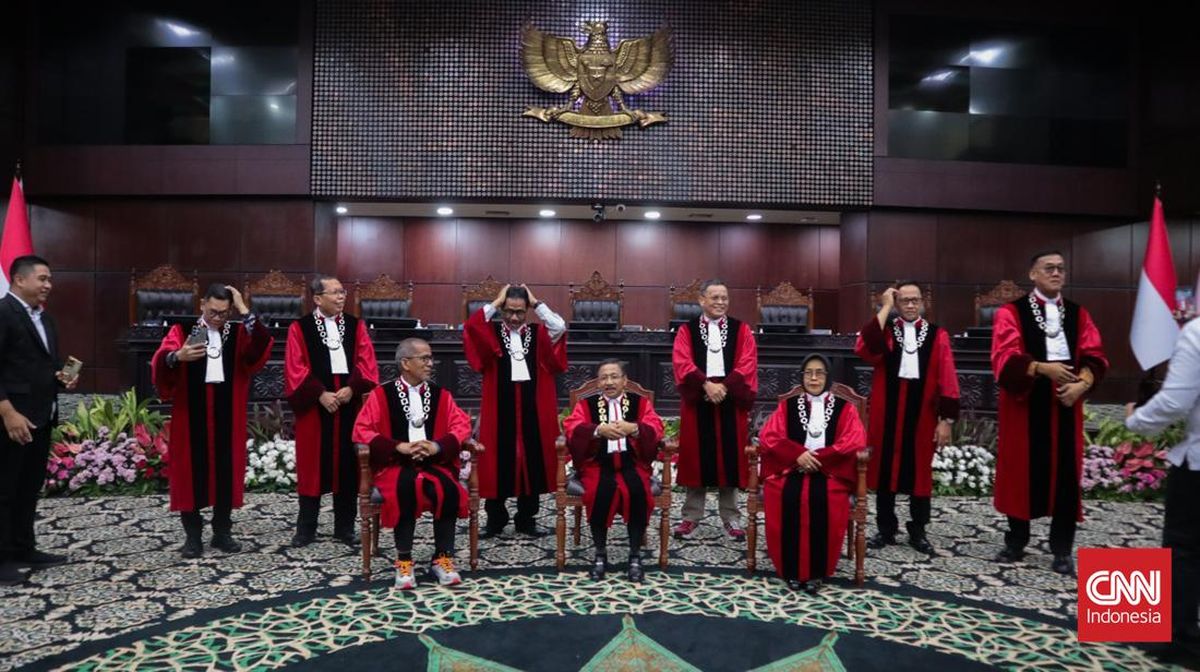
Eight Constitutional Court justices unanimously questioned mobile operators Telkomsel, XL, and Indosat as related parties in the application for judicial review of the Job Creation Law concerning the controversy over expiring internet quotas. Constitutional Justice Adies Kadir initially pressed the All-Indonesia Cellular Telecommunications Operators Association (ATSI) regarding their statement that unused quotas represent a financial burden for providers. “Please simulate what is meant by that burden, so that it results in losses due to unused quotas,” Adies asked in the courtroom at the Constitutional Court building in Jakarta, as quoted by Antara on Thursday (16/4). He also requested additional information from Telkomsel about access rights, noting that unused quotas up to the expiry date do not benefit providers. According to him, managing internet services must surely be profitable, so it is necessary to explain the sources of profits to allow the court to decide carefully. Adies also inquired about what happens to leftover quotas that are not used up but have expired, and whether the internet services provided by PLN are the same as those from other providers. Meanwhile, Justice Asrul Sani asked the providers what the losses would be if the applicant’s request regarding expiring internet quotas were granted by the Constitutional Court. Asrul observed that there are product variants from each provider that accumulate leftover quotas with applicable terms and conditions. “So when there are product variants like this, it means there is an opportunity for accumulation,” said Asrul. On the other hand, Justice Ridwan Masyur stated that internet needs have become a basic requirement for all society members, from young to old, for work, education, business, and more. However, according to him, regulations that cause quotas to expire just like that when the validity period ends result in harm to users of internet services. Ridwan emphasised the importance of sitting together to find solutions to the expiring quota problem and conducting socialisation, so that the norms being tested are not merely about right and wrong. Justice Guntur Hamzah emphasised the principle of justice in the acronym for tariffs (transparency, accountability, responsiveness, independence, and fairness/justice). According to him, where is the justice if internet quotas bought by the public with a certain amount and validity period—for example, bought for 30 days but used up in 28 days? He alluded to the regulation of a 28-day limit, meaning the public must buy 13 times a year. “Do providers understand what tariffs mean? It’s not just price, but an abbreviation for good governance principles and good corporate principles. So this fairness issue needs to be explored deeply,” said Guntur. Meanwhile, Justice Daniel Yusmic P Foek requested the parties to explain the internet network infrastructure needs mentioned in their statements, that the costs incurred are also related to building large-scale internet network infrastructure. Daniel wanted to know how large the infrastructure development costs are, thus the government-regulated upper and lower quota price limits are set accordingly. “I imagine that in the future, prices (for internet quotas) will certainly be cheaper; if now it’s because building infrastructure requires quite expensive costs, so roughly from these expenditures, the main factor is infrastructure, what percentage does the infrastructure account for,” he asked. In agreement, Justice Enney Nurbaningsih also posed the same question she had previously directed to the government as regulator in the previous hearing, regarding where the accumulated money from paid quotas is allocated by each provider. A firm question was put forward by Justice Saldi Isra, emphasising that the internet has become a matter of public concern, not a commodity but a service. Even though providers do not gain profit from expired leftover quotas, there are citizens who are disadvantaged by the expiration of internet quotas. He asked providers to explain what innovations could be made so that service users are not harmed. “So the matter of public concern binds you brothers (providers) not to freely determine everything. That must be considered,” said Saldi. Finally, Chief Justice Suhartoyo asked about the source of the regulatory reference, whether sectoral or domestic. That the practice of selling quotas is not the sale of goods (internet quotas) and does not fall under cluster book 2 of civil law. It was explained that the sale of internet quotas is the sale of access rights, and its framework is contractual (contract agreement). Regarding this, where is the best mark (reference), whether Indonesia has ratified an international agreement or this is domestic regulation, and who determines it. “Where does this regime come from? Please provide the international reference if there is one. So we don’t buy a ‘cat in a bag’, so to speak. So it’s clear, that it’s not only applicable in Indonesia,” he said. After hearing the statements from the providers, the Constitutional Court still scheduled a hearing to listen to additional statements from the association, providers, and PLN on Monday (4/5). The court held a continuation hearing to listen to statements from the association, providers, and PLN for application number 33/PUU-XXIV/2026. In addition, the parties for application number 273/PUU-XXIII/2025 were also present in the trial.