
7 Points of US-Iran Negotiations in Islamabad Today: Will the War End?
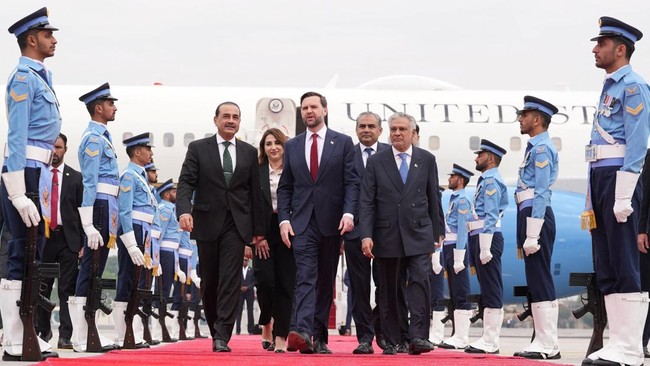
Senior leaders from the United States and Iran have arrived in Pakistan’s capital, Islamabad, on Saturday for negotiations to end the war that has lasted six weeks.
The US delegation, led by Vice President JD Vance and including President Donald Trump’s special envoy Steve Witkoff and Trump’s son-in-law Jared Kushner, landed with two US Air Force planes at an airbase in Islamabad on Saturday morning. They were welcomed by Pakistan’s Army Chief, Field Marshal Asim Munir, and Foreign Minister Ishaq Dar.
Meanwhile, the Iranian delegation, led by Parliament Speaker Mohammad Bagher Ghalibaf and Foreign Minister Abbas Araghchi, arrived on Friday.
Citing Reuters, this meeting will be the highest-level talks between the US and Iran since the 1979 Islamic Revolution. If both sides engage in face-to-face negotiations as hoped, it will be the first direct talks since 2015, when they reached an agreement on Iran’s nuclear programme.
Trump cancelled that nuclear deal in 2018 during his first term. In the same year, Iran’s Supreme Leader at the time, Ayatollah Ali Khamenei, who was killed at the start of the six-week war, banned further direct talks between US and Iranian officials.
Ghalibaf stated on X that Washington had previously agreed to reopen Iran’s assets. Additionally, to approve a ceasefire in Lebanon, where Israeli attacks on Iran-backed Hezbollah militants have killed nearly 2,000 people since the fighting began in March. He said talks would not begin until those promises are fulfilled.
Meanwhile, Israel and the US stated that the campaign in Lebanon is not part of the US-Iran ceasefire.
Iranian state media said the Iranian delegation would meet Pakistani Prime Minister Shehbaz Sharif around midday to determine the timing and mechanism for “possible negotiations”.
A senior Iranian source told Reuters that Pakistan would convey the US’s initial response to Iran’s demands, and if Tehran accepts, direct talks would begin.
The White House did not immediately comment on Iran’s demands, but Trump wrote on social media that the only reason Iran is still alive is to negotiate a deal.
Vance, en route to Pakistan, said he expects positive results but added that if Iran tries to toy with them, they will find the negotiation team less receptive.
Initial discussions have been held separately by Pakistani officials with advance teams from both sides, according to Reuters sources in Islamabad.
Pakistan’s Foreign Minister Ishaq Dar said he hopes the US and Iran will hold constructive talks to achieve a “lasting and sustainable solution to the conflict”, according to a statement from the Pakistani foreign ministry.
A Pakistani source said it is too early to confirm if talks will conclude on Saturday, and there is no deadline for the negotiations.
Trump announced a two-week ceasefire on Tuesday, which halted US and Israeli airstrikes on Iran.
However, it has not ended Iran’s blockade of the Strait of Hormuz, which has caused the largest disruption in history to global energy supplies, nor has it eased the parallel war between Israel and Hezbollah in Lebanon.
Islamabad, a city of just over 2 million people, is under an unprecedented lockdown ahead of the talks, with thousands of paramilitary personnel and soldiers deployed on the streets.
Meanwhile, attacks in southern Lebanon continued on Saturday morning, according to Lebanese state media. Reuters journalists heard Israeli reconnaissance drones flying over Lebanon’s capital, Beirut, from Friday night to Saturday morning, and fighter jets broke the sound barrier twice over the city.
Hezbollah announced it had conducted several military operations against Israeli positions on Saturday, both in Lebanese territory and northern Israel.
Israeli and Lebanese officials will hold talks in Washington on Tuesday, amid differences over the scope of those discussions.
The Lebanese presidency said officials from both countries spoke by phone on Friday and agreed to discuss the ceasefire announcement and set a date for the start of bilateral talks mediated by the US. However, the Israeli Embassy in Washington said the talks would be the start of “formal peace negotiations” and Israel refuses to discuss a ceasefire with Hezbollah.
For the talks to succeed, it is important for the US and Iran to represent their allies’ views, said Bilawal Bhutto Zardari, chairman of the Pakistan People’s Party and former foreign minister.
As a reminder, Israel and the US attacked Iran on 28 February. Iran’s regional allies, Hezbollah in Lebanon and later the Houthis in Yemen, responded by launching missiles at Israel.
“This negotiation framework must ensure not only Iran and the United States, but also all their allies are under the ceasefire umbrella so there is room for meaningful dialogue,” said Bhutto Zardari.
Tehran’s agenda also includes ending sanctions that have crippled its economy for years, as well as recognition of its authority in the Strait of Hormuz, where Iran wants to collect transit fees and control access.
Iranian ships sailed through the strait without hindrance on Friday, while ships from other countries remain stuck.
The energy supply disruption has driven inflation and slowed the global economy, with impacts expected to last months even if the strait reopens.
Iran’s leaders’ hardline stance ahead of the negotiations follows a defiant message from Iran’s new Supreme Leader, Ayatollah Mojtaba Khamenei, on Thursday. Khamenei, who has not been seen in public