
6 Recommendations from the Polri Reform Team Submitted by Jimly and Associates to Prabowo
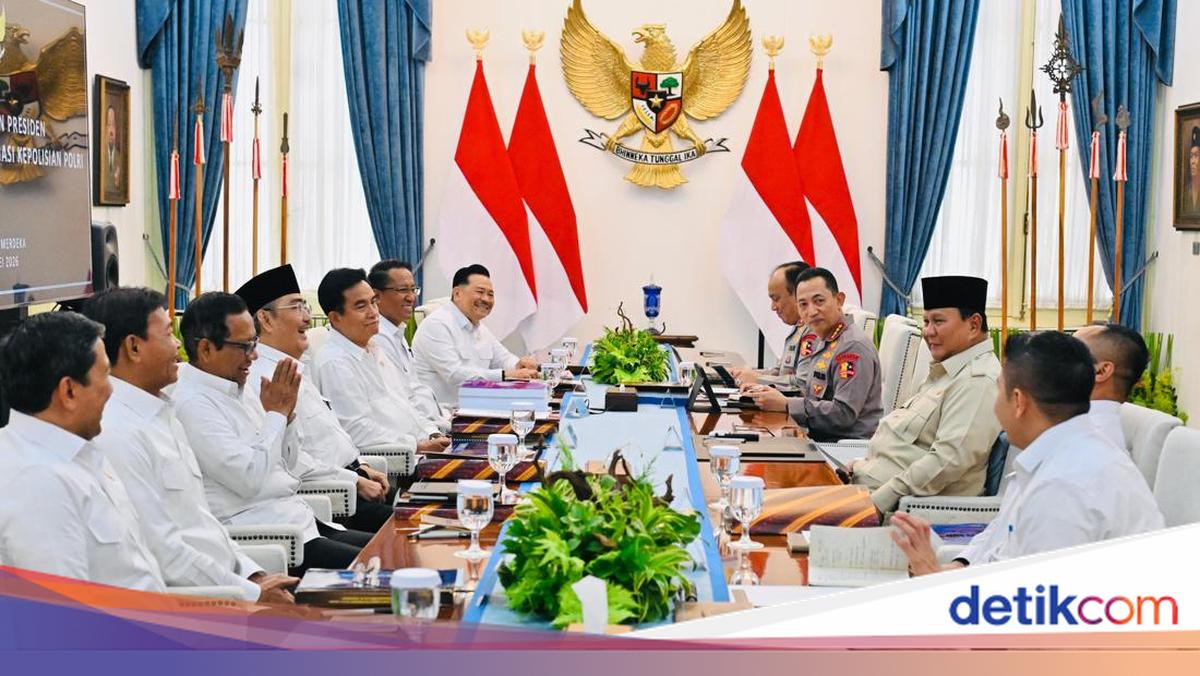
The final report was submitted by the Commission for the Acceleration of Polri Reform to Prabowo at Merdeka Palace, Jakarta, on Tuesday (5/5/2026). Jimly Asshiddiqie, as the team chairman, handed it over directly to Prabowo.
In addition to Jimly, the submission was attended by other commission members, including Coordinating Minister for Law, Human Rights, and Immigration Yusril Ihza Mahendra and his deputy Otto Hasibuan, Minister of Law Supratman Andi Agtas, National Police Chief General Listyo Sigit Prabowo, President’s Special Advisor on Security and Public Order Ahmad Dofiri, former Coordinating Minister for Political, Legal, and Security Affairs Mahfud MD, and former National Police Chief Idham Azis.
Since its establishment on 7 November 2025, Jimly and all commission members successfully completed the formulation of police reform policies over three months. They held various meetings with stakeholders, including state institutions, civil society organisations, and internal police entities, as well as visits to several regions to gather public aspirations.
The results of this work were compiled into 10 report books containing six comprehensive reform policy recommendations. These recommendations include proposals for revising the Polri Law and drafting derivative regulations to support reform implementation.
“We reported earlier 10 books concerning the overall policy reform and policy alternatives to be implemented by the government or internally by Polri,” said Jimly after submitting the recommendations to Prabowo at Merdeka Palace, Jakarta, on Tuesday (5/5/2026).
Additionally, the commission proposed an internal reform agenda that includes changes to several regulations within Polri. These reforms are targeted to proceed until 2029 as part of the medium-term agenda.
Here are the complete six recommendations submitted by Jimly and associates to Prabowo:
- Position of Polri
From the aspiration gathering, several inputs highlighted the position of Polri within the state structure, whether it should remain under the President as currently or form a new ministry to oversee Polri administratively. Although this discussion was not primary and the percentage was relatively small, the issue attracted public attention, necessitating clarification to avoid counterproductive debates in the Polri reform agenda.
Considering the benefits and harms through various experiences and practices to date, as well as the Indonesian context (geographical conditions and regional and societal characteristics), all KPRP members agreed not to propose a new ministry and to maintain Polri’s current position, with the note that the existence of an external overseer, namely the National Police Commission (Kompolnas), must be strengthened with an expanded mandate of authority.
- Strengthening the National Police Commission (Kompolnas)
As a consequence of Polri’s position under and directly accountable to the President, this must be balanced by strengthening Kompolnas as an independent institution to ensure that Polri carries out its main duties, functions, and authorities effectively and efficiently, in line with legal provisions and public expectations.
The strengthening of Kompolnas is intended so that in carrying out its duties, it is not limited to providing strategic advice on Polri administration and input on the dismissal and appointment of the National Police Chief, but also conducts oversight on governance in the areas of Polri development and operations, as well as investigations into the enforcement of the Polri professional code of ethics.
Therefore, Kompolnas must undergo fundamental improvements, including its position, membership composition, appointment mechanisms, duties and authorities, and budget management. This positions Kompolnas as a fully independent institution that performs a “check and balances” function against Polri with binding decision-making authority.
- Appointment of the National Police Chief
The mechanism for appointing the National Police Chief through DPR approval has been noted with several inputs suspecting it as an entry point for politicisation in the practice of Polri duties. On the other hand, the DPR’s oversight function and sharing the responsibility burden between the President and DPR in appointing the National Police Chief provide relevant reasons why the mechanism must go through DPR approval.
All commission members provided balanced opinions because both sides have strong arguments, considering the advantages and disadvantages.
Therefore, the review between the two is worthy of consideration by Mr President to determine the appropriate choice with the arguments mentioned.
- Assignment of Polri Members Outside the Police
Following the issuance of Constitutional Court Decision No. 114/PUU-XXIII/2025 dated 13 November 2025 and Constitutional Court Decision No. 223/PUU-XXII/2025 dated 19 January 2026, controversies and debates have arisen regarding the assignment of active Polri members to positions outside the police. This impacts the legal and administrative positions as well as the validity of decisions by officials falling under those MK decisions.
The impact of this issue affects not only the Polri institution but also other ministries/institutions with active Polri assignments. Therefore, there needs to be clarification and regulation that limitatively specifies in the Law or its derivatives in Government Regulations which ministries/institutions can be occupied by Polri members for positions outside the police.
- Institutional Aspects and Managerial Aspects
In addition to the four main focuses that form the substance of Polri reform discussions, the KPRP also recommends substantive matters regarding the organisation of Polri’s main duties and functions that align with the principles of good bureaucracy governance “good governance and clean government” as outlined in institutional and managerial aspects.
Institutional Aspects