
6,000 East Java Workers Present 21 Demands to Governor, from Affordable Housing to Minimum Wage
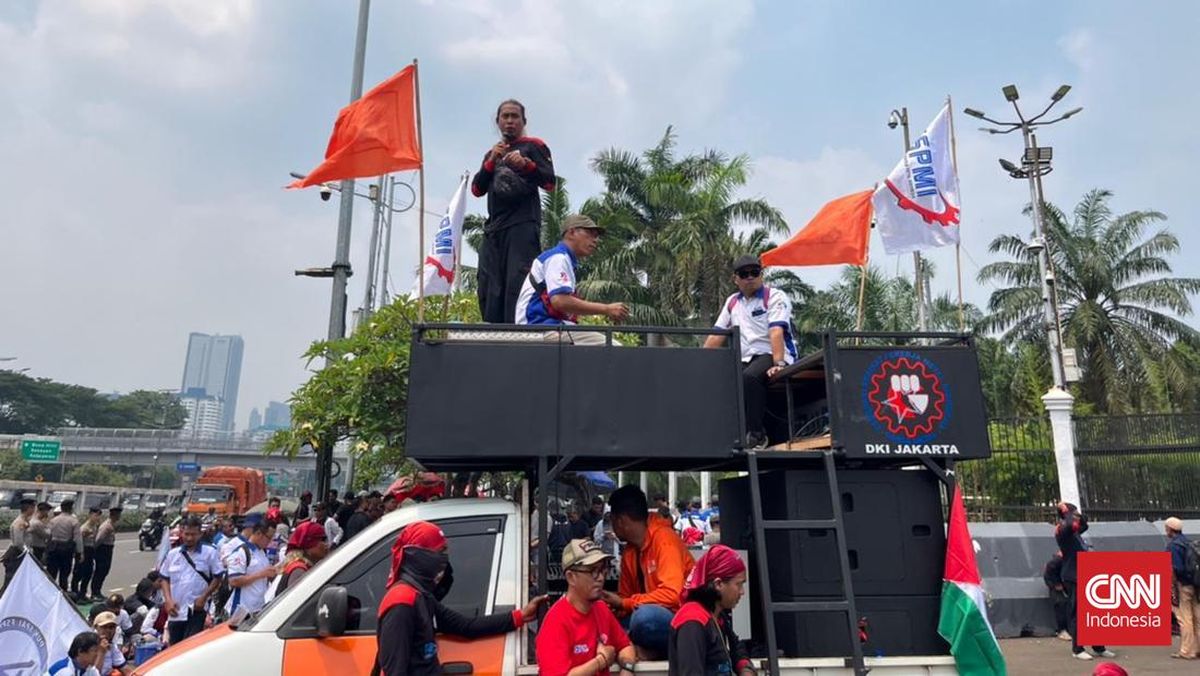
Thousands of workers affiliated with various labour union alliances are scheduled to take to the streets to commemorate International Labour Day or May Day 2026, with the main concentration point in front of the East Java Governor’s Office.
Deputy Secretary of the East Java DPW of the Indonesian Metal Workers’ Federation (FSPMI) Nuruddin Hidayat revealed that this large-scale action is part of the consolidation of the East Java Workers’ Union Movement (GESPER).
At least, the masses will fill strategic points from Surabaya to supporting industrial areas such as Sidoarjo, Gresik, Mojokerto, up to Jember and Tuban.
“This action is estimated to involve around 6,000 masses from FSPMI from various Industrial Estates in East Java, namely Surabaya City, Sidoarjo, Gresik, Mojokerto, Pasuruan, Probolinggo, Jember, Lumajang, and Tuban,” said Nuruddin.
“To support the mass mobilisation, FSPMI is deploying around 50 buses, 10 command trucks, and a convoy of thousands of motorcycles,” he added.
The masses will begin their movement by performing Friday prayers at three main points, namely Al-Akbar Mosque, the East Java High Prosecutor’s Mosque, and Al-Falah Mosque on Jalan Raya Darmo. Some other masses are planned to pray along Jalan Pahlawan.
After that, the group will gather in front of BG Junction Mall before conducting a long march to the Governor’s Office, targeted to arrive at 3:00 PM WIB.
This year’s May Day action is not merely an annual ceremonial event, but serves as a platform for workers to demand fulfilment of promises from the East Java Provincial Government that are considered still pending since last year.
Crucial issues, such as oversight of outsourcing practices, provision of affordable housing for workers, and certainty of severance pay guarantees, are the main points being pressed.
“This May Day 2026 action is a form of consolidation of the strength of East Java workers to fight for social justice, welfare, and legal certainty for all workers,” Nuruddin emphasised.
He also stressed that the government must act concretely and promptly, not just stopping at sweet promises, but realising them in policies that favour the fate of workers.
Here are the workers’ demands at both national and regional levels in the action in Surabaya.
National Demands
Enact the Manpower Law in accordance with the recommendations of KSP-PB.
Abolish outsourcing and reject low wages (HOSTUM).
Halt layoff threats due to the impact of global wars.
Reform the tax system by eliminating taxes on THR, JHT, and pensions, and increasing PTKP.
Eradicate corruption through the enactment of the Asset Seizure Bill.
Immediately ratify ILO Convention 190.
Provide protection for digital platform workers.
Improve occupational safety and health standards.
Guarantee access to health services for PPU BPJS Health participants whose contributions are not paid by employers.
Cap ojol tariff deductions at a maximum of 10 percent.
East Java Demands
Recommendations for strategic policies to the central government and DPR RI regarding revisions and formation of labour regulations.
Evaluation of several Supreme Court Circulars deemed detrimental to workers.
Provision of affordable houses and flats for workers.
Drafting of a Regional Regulation on the Severance Pay Guarantee System.
Strict oversight of outsourcing practices.
Enforcement of UMK and UMSK policies.
Establishment of a PHK Prevention Task Force.
Mandatory active participation in BPJS Health and BPJS Employment as a requirement for business permits.
Imposition of sanctions on companies that do not register their workers with BPJS.
Improved access to education for workers’ children through affirmative pathways.
Study on tax exemptions for two-wheeled vehicles and PBB for low-income communities.