
55 Pilot Whales Stranded in Rote, NTT: Sensor Damage Due to Noise Pollution?
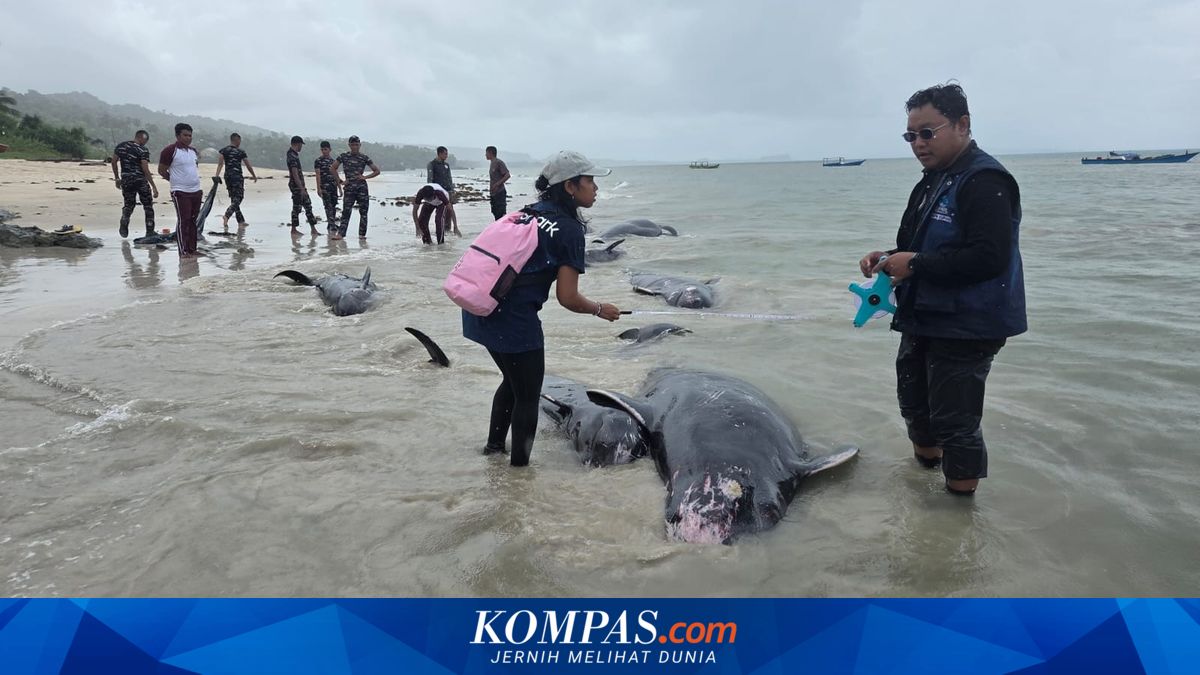
The stranding of dozens of pilot whales on the shores of Mbadokai Beach, Rote Ndao, East Nusa Tenggara (NTT), on Monday (9/3/2026) has drawn public attention.
This incident involved a total of 55 pilot whales, of which 21 were found dead, while the remaining 34 were successfully herded back into the sea.
A lecturer from the Faculty of Biology at Universitas Gadjah Mada (UGM), Akbar Reza, S.Si., M.Sc., expressed deep concern over the event.
Pilot whales are animals under full conservation protection, yet their global population data remains mysterious.
Akbar emphasised that this recurring incident serves as an “alarm” for ecological disturbances in the surrounding waters. Similar events have been recorded previously, such as in Alor (2024) with 50 whales, Sabu Raijua (2020) with 11 whales, and in Madura with 52 whales.
“Indeed, this has happened several times, but just because it occurs frequently does not mean it is natural,” he explained.
The NTT region, particularly the Savu Sea and the western part of Kupang, is an annual migration route. From early to mid-year, these whales migrate from cold waters south of Australia to warmer tropical waters.
To determine the exact cause of death, necropsy procedures or autopsies on the carcasses are required. Based on previous research, one key finding is damage to the echolocation organs—the whales’ navigation system that relies on sound wave echoes.
Several factors are suspected to trigger this organ damage, from parasites to overlapping human activities such as:
“Regarding damage to the echolocation organs, this can certainly worsen the situation, because if it is damaged when the pilot whale or similar species moves into shallow areas, it won’t know whether it’s shallow or still deep. It’s like the sensor is broken,” Akbar stated.
Akbar urged the public to follow handling protocols if they encounter stranded whales, such as not sitting on the animals, not taking selfies, and not covering their blowholes.
“If covered, it will cause them to die faster, become more lethargic, and overheat, as they have a lot of fatty tissue and need plenty of water. Those protocols are important,” he stressed.
To date, the biggest challenge in uncovering the exact causes of whale deaths in Indonesia is the limited equipment and number of veterinarians with specialised capacity to perform necropsies on large marine mammals.