
5 Key Expectations from the Fed: Bye Powell, the World Could Change Drastically
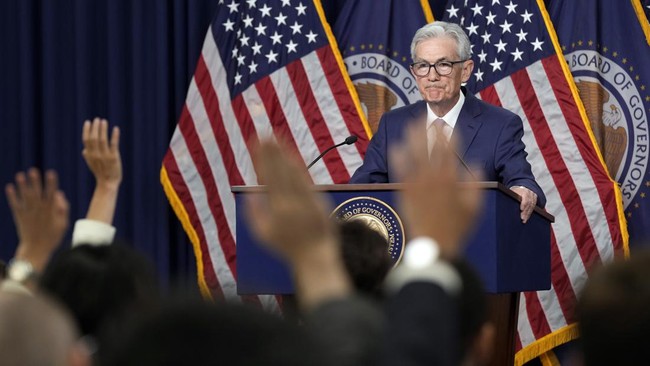
Jakarta, CNBC Indonesia - The world is awaiting the outcome of the Federal Open Market Committee (FOMC) meeting of the United States (US) central bank, which will also be the last time Chair Jerome Powell leads the meeting.
The US central bank, or the Federal Reserve (the Fed), is scheduled to announce the FOMC results on Wednesday (29 April 2026) US time, or early Thursday (30 April 2026) Indonesian time.
This Fed decision is crucial because the markets are in a challenging situation. On one hand, the US economy remains relatively strong. On the other, inflationary pressures are resurfacing after global energy prices surged due to the war in the Middle East.
According to the CME FedWatch Tool, 100% of market participants are confident that the Fed will hold its benchmark interest rate at the current level of 3.50% - 3.75%.
This means the upcoming decision is expected to mirror the last meeting in March 2026, when the Fed also maintained rates at that level.
Here are some of the most anticipated aspects from this FOMC meeting by market participants:
- Interest Rate Decision
The first point of focus remains the interest rate decision. However, for this FOMC, the market largely agrees that the Fed will not change its benchmark rate.
The federal funds rate (FFR) is expected to remain in the 3.50%-3.75% range. The still solid US economic conditions give the Fed room to wait longer before taking new steps.
For the Fed, holding rates is the safest option. Inflation has not yet been fully tamed, while the impact of the Iran war on energy prices and the US economy remains unclear.
If rates are cut too soon, the risk of inflation rising again could increase significantly. However, raising them could heighten pressure on economic growth. Therefore, the most realistic option at present is to keep rates on hold.
- Will 2026 Rate Cuts Become More Difficult?
Although this interest rate decision is almost certainly a hold, markets are more curious about the direction of Fed rates after April.
Expectations for rate cuts in 2026 are now being questioned following the latest US inflation data showing persistent price pressures. In March 2026, US consumer inflation (Consumer Price Index/CPI) rose 3.3% year-on-year, higher than February 2026’s 2.4%.
Month-on-month, US CPI also increased by 0.9% in March 2026, much higher than the 0.3% rise in February 2026. This surge was primarily driven by energy price increases, which rose 12.5% year-on-year.
Meanwhile, core US inflation, excluding food and energy components, remains above the Fed’s target. Core CPI was recorded at 2.6% year-on-year in March 2026, slightly higher than 2.5% in February 2026.
The inflation measure more closely watched by the Fed, Personal Consumption Expenditures (PCE), has also not fallen to target. In February 2026, PCE inflation was 2.8% year-on-year, while core PCE stood at 3.0%.
This situation narrows the Fed’s room to cut rates in the near term. Inflation persists above the 2% target, and the energy price spike due to the Middle East war risks prolonging price pressures.
Currently, market participants see a strong likelihood that the Fed will hold rates throughout the year. On the other hand, some still hope the Fed can continue its rate-cutting cycle if inflationary pressures ease.
Thus, this FOMC will be a key forum to gauge whether the Fed still leaves room for rate cuts or begins signalling that high rates will persist longer.
If the Fed sounds more hawkish, expectations for rate cuts could be pushed further back. The impact could see the US dollar remain strong and renewed pressure on risk assets.
- The Fed’s Response to the Iran War and Energy Prices
The Iran war is one of the most critical factors in this FOMC. The conflict has driven sharp oil price increases and added uncertainty to inflation trends.
Rising energy prices could complicate the Fed’s task. High oil prices can spill over into transportation costs, logistics, production, and ultimately consumer goods and services prices.
Typically, the Fed might view energy price spikes as temporary disruptions. However, a prolonged war could make price pressures more persistent and widespread.
This is what markets will scrutinise. Will the Fed see the energy price surge as a short-term risk, or as a threat that could alter monetary policy direction?
If the Fed deems the inflation risk from energy as growing, the chances of rate cuts could diminish further. Even though a rate hike is still considered highly unlikely, that risk is not entirely absent if the war continues and the US labour market remains robust.
- Changes in Language in the Fed’s Official Statement
Beyond the interest rate decision, market participants will also parse every word in the FOMC’s official statement.
One of the most watched aspects is whether the Fed retains language signalling the possibility of further rate adjustments, or shifts to more neutral wording.
So far, the Fed’s language has suggested that the next steps lean towards rate cuts. However, with sticky inflation and rising energy prices, markets are questioning whether that bias remains relevant.
If the Fed shifts to more balanced language, the message to markets is that future rate direction could go both ways: down if the economy weakens, or staying high longer if inflation proves hard to bring down.
Language changes