
340 Landfills in Indonesia Still Use Open Dumping Method
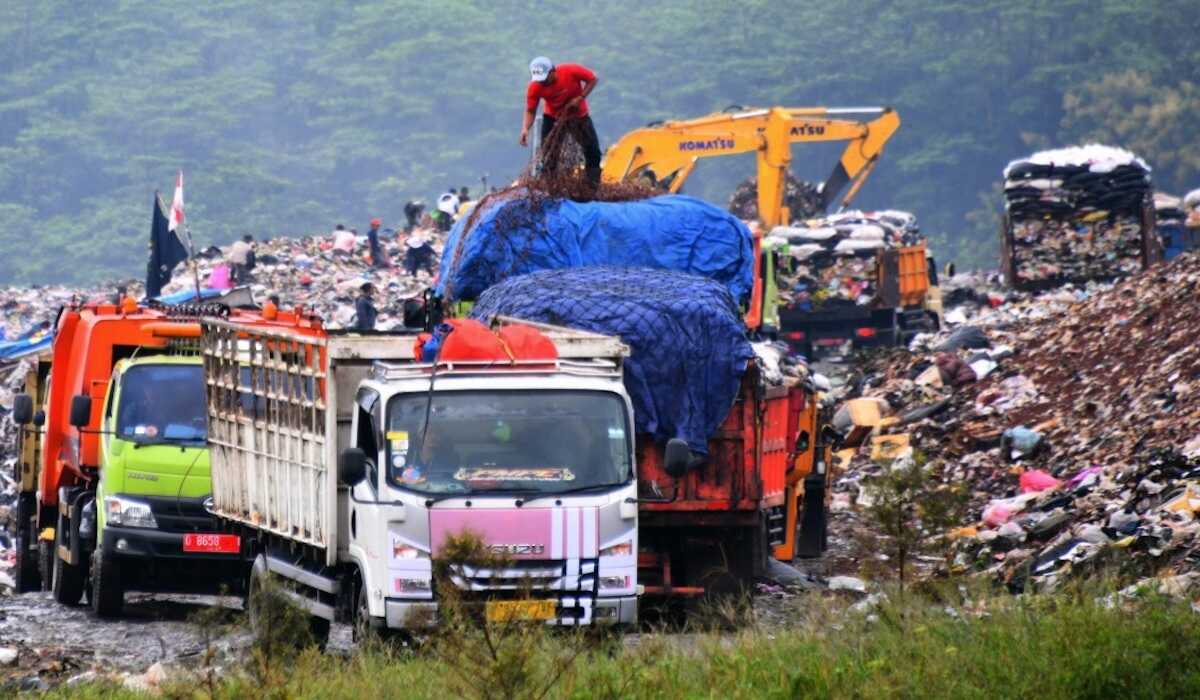
More than 340 landfills in Indonesia still use the open dumping method, even though it is prohibited by law.
The Director of Waste Reduction and Circular Economy Development at the Ministry of Environment (KLH), Agus Rusly, stated this when met in Cimahi.
“So, more than 340 landfills still use open dumping. This is a challenge for all of us to encourage waste management starting from home, so that only a small amount of waste is disposed of in landfills,” said Agus at the former Leuwigajah landfill, Wednesday (February 25).
According to Law Number 18 of 2008 concerning Waste Management, the concept of waste management should be changed to sanitary landfills.
According to him, the government has targeted that by 2029, all waste in Indonesia will be managed 100% in accordance with the direction of the central government.
This policy is outlined in Presidential Regulation (Perpres) Number 109 of 2025. The target of 100% waste management by 2029 is also part of the program that has been included in the 2025-2029 National Medium-Term Development Plan (RPJMN).
“According to the direction of the 2025-2029 RPJMN, in 2029, 100% of waste will be managed. This means that all waste can be controlled,” he said.
He explained that the waste generated and managed throughout Indonesia reaches 140 thousand tons per day. Meanwhile, only about 25% has been managed.
“Of the 140 thousand tons, all cities and regencies can only manage about 25%. This means that only about 35,000 tons can be managed,” he said.
Agus added that the central government and local governments are working together and preparing various steps to realize waste management in 2009. The Indonesian ASRI (Safe, Healthy, Clean and Beautiful) movement is also continuously promoted among the community.
“Our program is how to optimize existing facilities. Then, secondly, activate facilities that are not working and thirdly, rebuild facilities that do not yet exist in many cities, villages, regencies, and so on,” he explained. (Z-10)
More than 340 landfills in Indonesia still use the open dumping method, even though it is prohibited by law.
Local governments that still implement open dumping practices at final processing sites (landfills) beyond the deadline set in 2026 will be subject to sanctions.
The government states that there are still about 40 final processing sites (landfills) in Indonesia that fully carry out open dumping practices.
If the waste problem is not immediately resolved, a number of landfills are projected to reach their maximum capacity by 2028.
The waste problem in Bali has reached a high level of vulnerability and can no longer be handled with the old pattern that relies on landfills.
The government is accelerating the development of micro-scale waste processing technology based on campus research to be applied to the kelurahan (village) and desa (village) levels.
He said that there are many things about waste management that can be implemented and replicated by Toba Regency.
Waste that is not useful can become something of high economic value. Among them, it can be processed into animal feed, pellets, bioethanol, briquettes and others.
“There is only a letter of direction from the Minister stating that incinerators must meet strict requirements, especially regarding permits and emissions produced.”
Waste processing activities are part of the efforts to control and manage waste that are continuously carried out by the DKI Jakarta Provincial Government.