
3 Geopolitical Analysts: Why the World is Targeting Iran's Uranium But
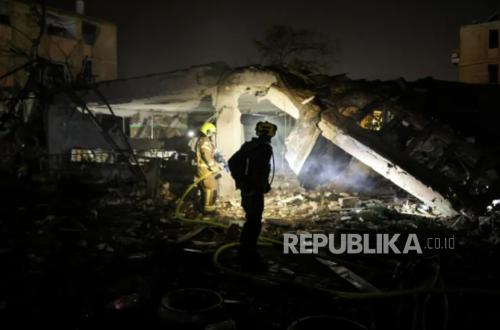
REPUBLIKA.CO.ID, JAKARTA – When Iranian missiles targeted Dimona, Israel’s most secretive nuclear facility in the Negev Desert, the world realised that this war has entered a dimension no longer merely about conventional military power.
A boundary that has been carefully guarded for decades, separating ordinary armed conflict from the threat of nuclear catastrophe, suddenly appears fragile and vulnerable.
Amid the smoke of the unresolved conflict, three analysts from three different backgrounds—an academic from Turkey specialising in nuclear policy, an Iranian-American political scientist focused on regime transitions, and an Arab columnist reinterpreting the meaning of regional solidarity—offer differing yet complementary readings.
Taken together, they form a larger argument than the sum of its parts: that this war is not just about Iran, not just about America, and not just about the Middle East. It is about a world order in the process of redefining itself.
Nuclear Paradox: Who is the Real Threat: Israel or Iran?
Merve Suna Ozel Ozcan, a security policy researcher writing in Daily Sabah, begins her analysis with a seemingly provocative but actually very valid question: in this conflict, who is truly the greater nuclear threat, Iran or Israel?
That question is not rhetorical. It is rooted in a legal asymmetry that has rarely been openly discussed in mainstream Western discourse. Iran, as a signatory to the Nuclear Non-Proliferation Treaty since 1968, operates within a clear though debated framework of international law. Israel, on the other hand, not only refuses to sign the NPT but actively builds “nuclear opacity,” a doctrine that maintains deterrence without ever officially acknowledging possession of nuclear weapons.
“Israel’s doctrine of ‘nuclear ambiguity’ maintained outside the NPT reveals the structural contradiction of the international nuclear order,” writes Ozcan. And that contradiction can no longer be hidden behind diplomatic abstractions.
SIPRI data estimates that Israel possesses around 90 nuclear warheads, although some analyses suggest the figure could reach 300. Meanwhile, Iran, with uranium enriched to 60 percent and reserves of about 440 kilograms, theoretically has the capacity to produce several nuclear weapons but has never officially declared possession.
Ozcan identifies a new logic emerging in this conflict: “Actors prefer to render their enemy’s energy and environmental systems inoperable rather than destroying them directly.”
The implications of this logic are very serious. Rosatom Director General Alexei Likhachev has warned that the Bushehr nuclear facility alone contains 72 tons of fissile material and 210 tons of spent nuclear fuel.