
3,500 US Troops Arrive in the Middle East!
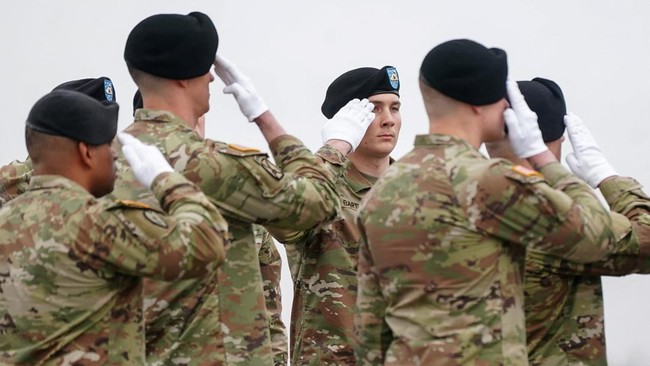
More than 3,500 United States (US) troops, including the aircraft carrier USS Tripoli carrying around 2,500 Marine personnel, arrived in the Middle East on Saturday (28/03/2026). This large-scale military reinforcement comes amid increasingly intensive attacks in the escalating Iran war in the region.
The US Central Command (CENTCOM) stated in a social media post that the USS Tripoli, serving as the flagship for the Tripoli Amphibious Ready Group / 31st Marine Expeditionary Unit, has arrived in its area of responsibility. This amphibious warship is the most advanced version of the “big deck” type, providing more space for stealth F-35 fighter jets, Osprey aircraft, and other combat planes.
The vessel was previously based in Japan before receiving deployment orders to the Middle East nearly two weeks ago. CENTCOM explained that, in addition to carrying Marines, the Tripoli also transports transport aircraft and attack fighter jets, as well as amphibious assault assets, while the USS Boxer and two other ships along with other Marine expeditionary units have been ordered to the region from San Diego.
Escalation of airstrikes has also been reported to be sharply increasing since the start of major military operations. According to a fact sheet released by CENTCOM on Saturday, more than 11,000 targets have been bombed since Operation Epic Fury officially began on 28 February.
US Secretary of State Marco Rubio issued a statement on Washington’s military strategy last Friday. Rubio emphasised that the United States can achieve its objectives in the region without involving direct ground troop deployments.
“The United States can meet its goals without any ground forces. However, President Trump must prepare for various possibilities, and American forces are available to provide maximum options for the president and the maximum opportunity to adapt to emerging possibilities if they occur,” Rubio said.
This troop deployment is a response to previous Iranian attacks that injured American personnel. At least 10 US troops, including two with severe injuries, were wounded when Iran fired six ballistic missiles and 29 drones at Prince Sultan Air Base in Saudi Arabia.
The ongoing war has disrupted global civil aviation, interrupted oil exports, and triggered surges in fuel prices. Iran’s blockade of the Strait of Hormuz, a strategic waterway, has worsened the global economic impact.
The situation has become more complicated after Iran-backed Houthi rebels announced their joining of the war on Saturday. The group claimed to have launched a missile attack on Israeli territory, which local authorities said was successfully intercepted.
Houthi military spokesman, Brigadier General Yahya Saree, stated in a recorded message broadcast on Al-Masirah television that they had launched a second attack on Israel. Saree described the attack on southern Israel as occurring simultaneously with strikes from Iran and Hezbollah, though he did not specify the exact location.
Houthi involvement is feared to damage global shipping routes if they resume targeting vessels in the Bab el-Mandeb Strait. Senior Yemen analyst at the International Crisis Group, Ahmed Nagi, warned that increased attacks on commercial shipping would drive up oil prices and disrupt overall maritime security stability.
“The impact will not be limited to the energy market alone,” Nagi said.
Due to the closure of the Strait of Hormuz, many countries are now scrambling to find alternative routes for commodity shipments. The Bab el-Mandeb Strait at the southern tip of the Arabian Peninsula has become a crucial route for ships heading to the Suez Canal, where Saudi Arabia now sends millions of barrels of crude oil per day via that path.
For context, around 12% of world trade and 10% of global seaborne trade—including 40% of container ship traffic—passes through the Suez Canal annually. The Houthi threat is very real, given that between November 2023 and January 2025, they attacked more than 100 merchant vessels and sank two of them.
To date, political tensions between Washington and Tehran remain at an impasse. President Donald Trump has given Iran a deadline until 6 April to reopen the Strait of Hormuz, but the Iranian side insists it will not engage in any negotiations.
Trump’s envoy, Steve Witkoff, revealed that Washington has conveyed a 15-point “list of actions” to Iran for a ceasefire, including restrictions on its nuclear programme. However, Tehran rejected the proposal and instead put forward five counter-demands, including reparations payments and recognition of Iranian sovereignty over the waterway.