
22-Year Delay: PPRT Bill Registers the Longest Stoppage in DPR History
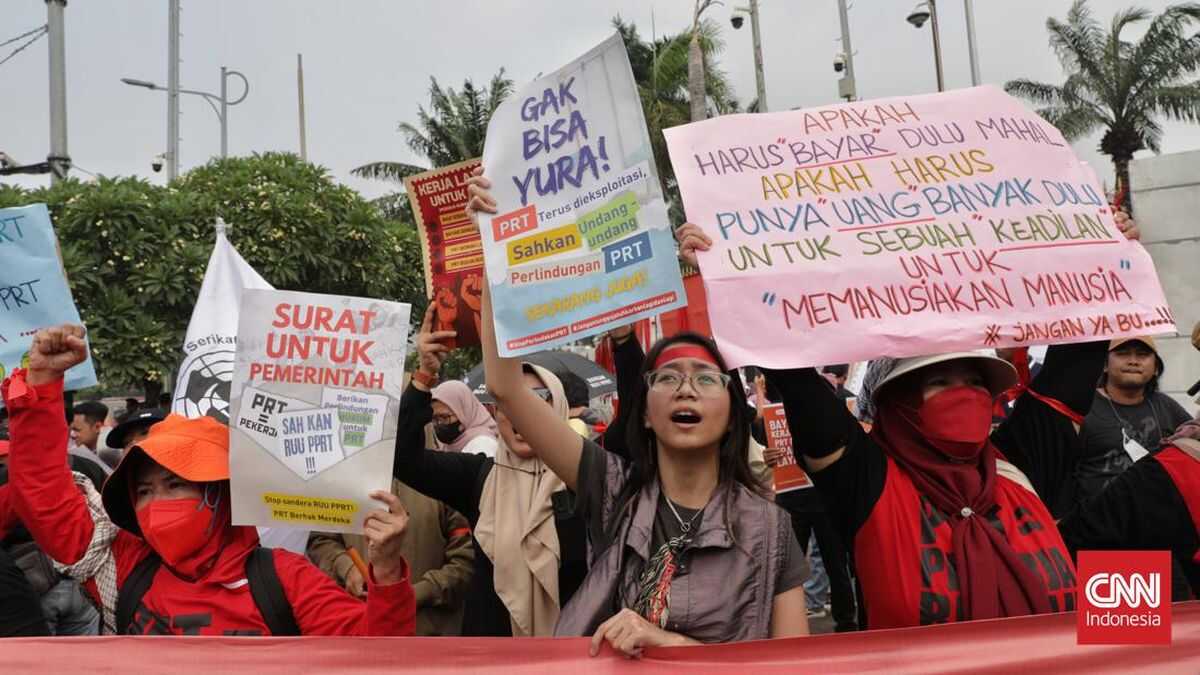
The Draft Law on Protection for Domestic Workers (PPRT Bill) is said to make history as the longest-running bill in the DPR. Lita Anggraini, National Coordinator of the National Advocacy Network for Domestic Workers (JALA PRT), said the bill has been stalled for 22 years since its inception in 2004. ‘Just imagine, this is the longest and most hampered history of a bill,’ Lita said at a public hearing in Baleg DPR, on Thursday, 5 February. ‘I’ve been waiting 22 years; if I were to put it metaphorically, it’s as if Mr Bob [Chair of Baleg] has been there from birth through to university and now into work,’ she added. Rieke Diah Pitaloka, Chairperson of the Confederation of Indonesian Workers’ People and a member of the DPR from the PDIP faction, explained that the state has a constitutional obligation to protect every citizen. The obligation is stated in Article 27, Paragraph 2 and Article 28, Paragraph 2 of the 1945 Constitution. Therefore, she said, worker protection is not only a social policy but a constitutional mandate. ‘Currently, she continued, Indonesia has around 5.2 million migrant workers abroad, of whom about 2.5-3 million work as domestic workers, and the number increases by around 100,000 each year.’ That figure makes domestic workers (PRT) one of the largest sectors of Indonesia’s labour migration. Bank Indonesia data show Indonesian migrant workers’ remittances in 2024 reaching around USD 15.7 billion, or about IDR 253 trillion, roughly 10 percent of gross domestic product. ‘In other words, migrant workers, including millions of domestic workers, are a pillar of the national economy as well as drivers of family economies in migrant regions across the country,’ she said. Ironically, he added, they are under the weakest legal protection. In fact, Indonesia has not yet ratified ILO Convention No. 189 on decent work for domestic workers. In addition, domestic workers within the country are not fully recognised within the national labour law system. ‘We once again ask for your support, ladies and gentlemen. Migrant domestic workers contribute around IDR 253 trillion in foreign exchange annually for the country, and that foreign exchange ends up as part of the salaries and allowances we, in the DPR, receive,’ she said. DPR’s Baleg ensures the PPRT Bill will be enacted this year. Chairman of the Legislative Body (Baleg) of the DPR, Bob Hasan, meanwhile said that they target the PPRT Bill to be completed and enacted into law in 2026. He said this after holding a follow-up discussion on the bill with a number of civil society organisations. ‘If this year is certain, it’s this year. But I can’t forecast by month.’ The Gerindra Party politician said the progress of the PPRT Bill is still in the stage of preparing the academic paper and the Bill. At the same time, the DPR will continue to absorb external public input. Bob hopes the process of absorbing public input will be completed before the sitting period starting on 10 March, so that the DPR and the government can immediately begin deliberations in the session. ‘Therefore, continuous public hearing meetings (RDP) are required to fulfil the meaning of public participation,’ he said. The process of resolving disputes between domestic workers and employers is being studied. The DPR is opening the option of dispute resolution involving the Ministry of Manpower down to the regional level. ‘Well, mediation—whether that process will be solved at each province, but there are institutions, in this case the ministry, that will attend and be responsible,’ said Bob.