
2026 Lebaran Exodus: Public Works Ministry Prepares 10 Operational Toll Road Sections
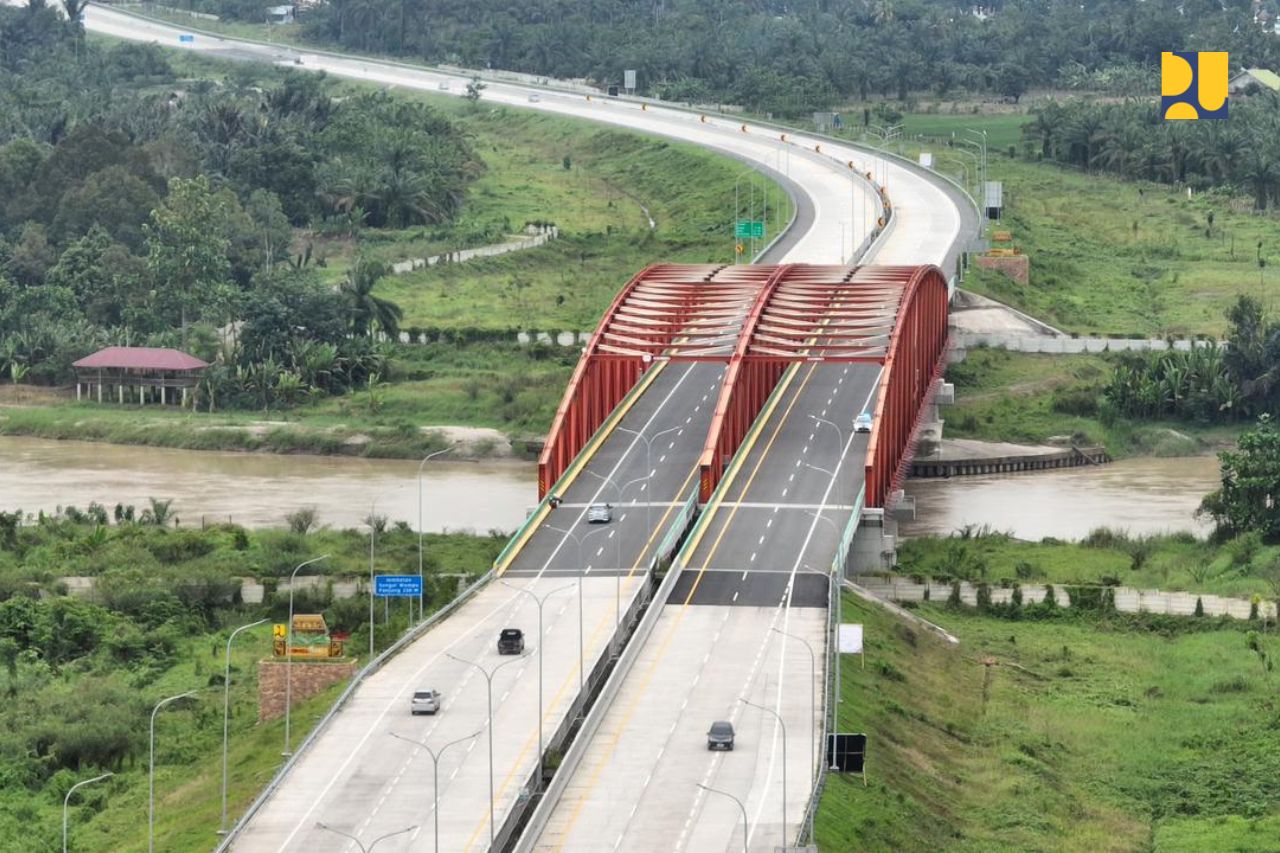
To support the smooth flow of the exodus and return traffic during Lebaran 2026, the Ministry of Public Works (PU) through the Road Toll Regulatory Agency (BPJT) and Road Toll Business Entities (BUJT) is preparing 10 functional toll road sections spanning approximately 291.13 kilometres.
Additionally, 15 rest and service areas (TIP) are being provided at various strategic locations. The operation of these functional toll road sections and service areas is expected to help relieve potential congestion on main exodus routes whilst improving traveller comfort.
Public Works Minister Dody Hanggodo stated that the ministry, together with BUJT, continues to accelerate the completion of construction on several strategic toll road sections to enable limited operation during the Lebaran exodus period.
“This measure is being taken to increase toll road network capacity whilst alleviating potential congestion on main routes,” he said in an official statement on Wednesday (11 March).
In total, there are 10 toll road construction sections with potential for operation. The total length of these sections reaches approximately 291.13 kilometres, distributed across Sumatra, Java, and Kalimantan.
In Sumatra, there are three toll road sections with potential for operation totalling approximately 90.73 kilometres. One of them is the Sigli–Banda Aceh section spanning approximately 24.67 kilometres, with construction progress reaching approximately 94.25%. This section is planned to be operated using a two-lane two-way scheme (A and B) and can be used by all vehicle categories.
Meanwhile, the Palembang–Betung section spanning 53.20 kilometres with construction progress of approximately 90%–91% will also be operated using a two-lane two-way scheme. However, its operation will be restricted to Class I vehicles (non-bus vehicles).
The Kuala Tanjung–Tebing Tinggi–Parapat section spanning 12.86 kilometres with 100% progress is ready for full two-lane two-way operation for all vehicle categories.
On Java island, there are six toll road sections with potential for operation totalling approximately 148.03 kilometres. These include the Probolinggo–Banyuwangi Sections 1 and 2 spanning 24.08 kilometres, which have reached 100% progress and can operate two lanes in both directions for all vehicle categories. Meanwhile, Section 3 spanning 25.60 kilometres with 95.98% progress will be operated under the same scheme, but exclusively for Class I vehicles (non-buses).
For the Serang–Panimbang Section 2 spanning 24.17 kilometres with approximately 98.10% progress, it will be operated with a single lane one-way arrangement through Lane A for Class I vehicles (non-buses).
The Ciawi–Sukabumi Section 3 to Karangtengah access spanning approximately 4.97 kilometres with 71.95% progress will be operated with a single lane one-way arrangement exclusively for Class I vehicles (non-buses). The Jakarta–Cikampek II South section spanning 52 kilometres with progress between 72% and 94% will be operated exclusively for return traffic from Sadang to Jakarta for Class I vehicles (non-buses).
Additionally, the Solo–Yogyakarta–NYIA Kulonprogo Section 1 Package 1.2B spanning 12.23 kilometres with 93.30% progress, and the Yogyakarta–Bawen Section 6 spanning 4.98 kilometres with 89.93% progress, will each be operated with a single lane one-way arrangement for Class I vehicles (non-buses).
In Kalimantan, the IKN Toll Access spanning 52.37 kilometres with progress varying up to 100% will be operated with two lanes in both directions (A&B) exclusively for Class I vehicles (non-buses).
Head of the Road Toll Regulatory Agency (BPJT) Wilan Oktavian stated that the operational scheme for functional toll road sections will be flexible and situational according to traffic conditions on the ground.
He noted that traffic management and schemes, whether one-way or limited two-way, will be applied according to police discretion including operational timing.
“These functional toll road sections are intended for Class I vehicles (non-buses),” he explained.
In addition to toll road sections, the Public Works Ministry through BPJT and BUJT is also preparing 15 Rest and Service Areas (TIP) in the construction phase proposed as functional service areas to support road user comfort during the exodus period.
Several service areas are already ready for use with basic facilities such as parking areas, modular petrol stations, prayer rooms, toilets, and MSME tenants.
Among them are the Sigli-Banda Aceh TIP at KM 37+000 A/B and the Kuala Tanjung-Tebing Tinggi-Parapat TIP at KM 99+800 A/B, both 100% ready. The Palembang–Betung TIP at KM 71+000 A/B with approximately 95% progress is also being prepared with similar facilities.
Additionally, a temporary service area is available at the Cipali section KM 77B, utilising the former Cikopo Toll Gate with minimal facilities comprising parking, prayer rooms, toilets, and limited MSME tenants.
In West Java, the Cileunyi-Sumedang-Dawuan TIP at KM 203+000 A/B with 34% progress is also being prepared. Meanwhile, in Central Java, the Semarang-Solo TIP at KM 439+000 A and KM 444+000 B is 100% ready with more complete facilities including workshops, health posts, lactation rooms, and ATM centres.
Next, the Solo-Yogyakarta-NYIA TIP at KM 19+000 A is being prepared with temporary facilities, and the Pasuruan–Probolinggo TIP at KM 844 A/B with 30.96% progress is equipped with petrol stations, EV charging facilities, and other supporting facilities. The Probolinggo–Banyuwangi TIP at KM 888 A is also being operated with basic facilities comprising parking areas, prayer rooms, and toilets.
The operation of functional toll road sections and service areas will be conducted situationally during the 2026 Lebaran exodus and return period, taking into account traffic conditions on the ground and results of cross-sector coordination. All facilities are provided to support smooth travel for the public whilst alleviating potential congestion on major routes.