
2026 Crisis Worsens as Large-Scale Labour Strikes Demand Salary Increases
Jakarta — The global memory chip shortage crisis has rippled throughout the industry. Several electronic device manufacturers have announced price increases for products due to rising production costs stemming from expensive components.
This shortage has also affected the artificial intelligence (AI) technology industry, as demand for high-performance chips or HBM (high-bandwidth memory) has surged amid limited supply.
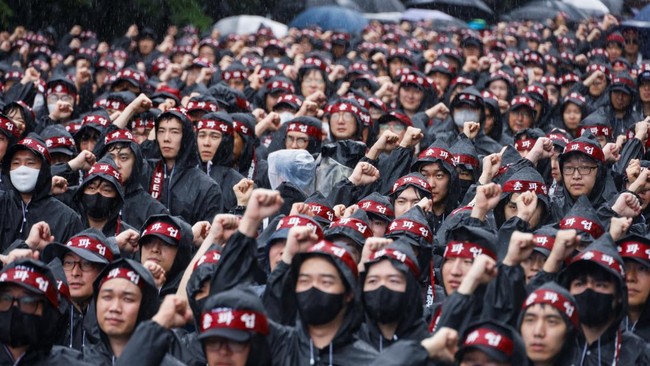
Amid the crisis that has persisted since late 2025, problems have emerged at one of the world’s largest chipmakers. The trade union at Samsung Electronics in South Korea has threatened to stage massive demonstrations in May 2026.
These strikes, which would impact chip production, could exacerbate the ongoing crisis.
“I predict there will be disruptions to [chip] production,” said Choi Seung-ho, leader of the Samsung Electronics Labour Union (SELU), last week, according to Reuters.
Approximately 90,000 union members out of Samsung’s total 125,000 workers are eligible to vote in a ballot lasting until Wednesday, 18 March.
If workers fail to reach an agreement, they plan to stage demonstrations for 18 days beginning 21 May 2026, according to Choi. He stated that large-scale strikes could affect roughly half of production at Samsung’s expansive semiconductor complex in Pyeongtaek, south of Seoul, the capital.
A Samsung official who requested anonymity said that production shutdowns caused by even a single strike could damage customer trust and take years to recover from.
A Samsung spokesperson said the company would continue dialogue with employees on the matter.
Workers Share No Benefits Despite Company Profits
Samsung workers have highlighted wage disparities with employees at competing companies. Union membership at Samsung has grown significantly following SK Hynix’s acceptance of union demands regarding compensation reform in September 2025.
“The chip industry is booming, but those business profits are not flowing to us. That is why we are fighting,” said a union representative.
Over the past three months, more than 100 union members have left Samsung to join other companies such as SK Hynix. Choi said SK Hynix agreed to plans to remove bonus caps and allocate 10 per cent of operating profits to bonus funds.
Samsung union members are demanding a 7 per cent increase in base salary, elimination of performance-based payment caps set at 50 per cent of annual base salary, and introduction of a bonus fund based on operating profits.
The Samsung union views the 50 per cent bonus cap criterion as outdated and lacking transparency.
Samsung recorded record fourth-quarter profits in 2025, and analysts estimate that annual operating profits will increase more than fourfold to over 200 trillion won this year.
In an internal memo to employees earlier this month, Samsung stated it was attempting to reach a 2026 wage agreement by offering a compensation proposal described as “unprecedented”.
The proposal includes a 6.2 per cent salary increase and a special bonus for memory chip division employees equivalent to 100 per cent of base salary for every 100 trillion won of annual operating profit.
“Because the semiconductor business experiences significant profit fluctuations depending on market conditions, Samsung allocates operating profits in a balanced manner for future investment, shareholder returns, and employee compensation,” the spokesperson said.