
20 Years Since Yogyakarta Earthquake: Mapping Megathrust Potential for Disaster Mitigation
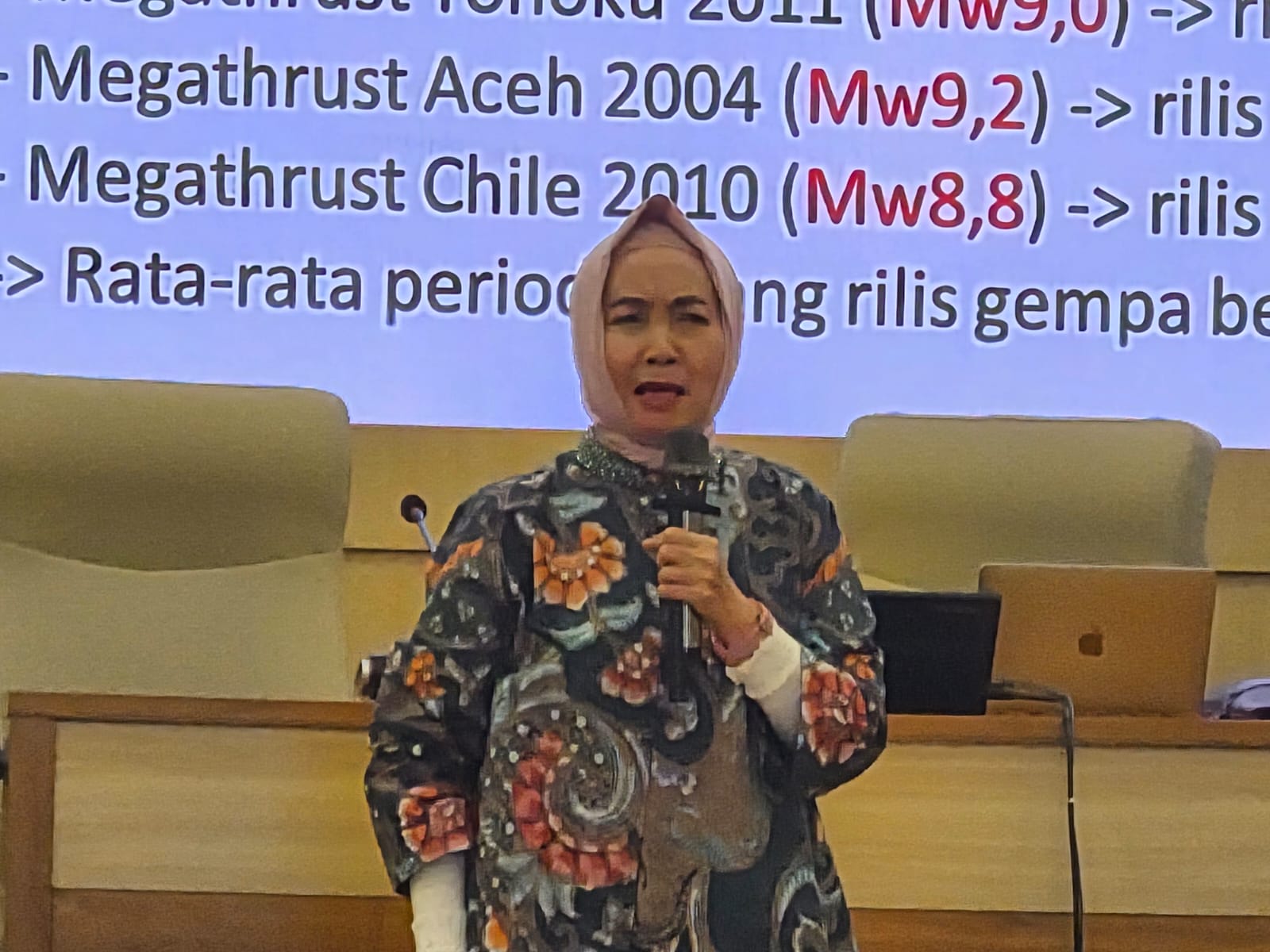
Academic research-based disaster preparedness is urgently needed. Former Head of BMKG, Prof Dwikorita Karnawati emphasised the importance of disaster preparedness, public education without causing alarm, and robust physical infrastructure to withstand disasters.
“Predictions shared by experts and BMKG are not meant to frighten, but to build scenarios for when disasters occur. Without scenarios, disaster mitigation strategies cannot be formulated,” she said during the 20th Anniversary of the 2006 Yogyakarta Earthquake and Megathrust Earthquake Anticipation Seminar on Saturday (30 May) at UGM Central Building.
She noted that BMKG and disaster experts continuously stress the need for vigilance regarding potential major earthquakes in Indonesia’s megathrust zones. Current monitoring focuses on two regions classified as seismic gaps—the Sunda Strait and Mentawai-Siberut areas.
A seismic gap is defined as an active earthquake zone that has not experienced a major quake for decades to centuries. These areas are believed to be accumulating massive tectonic energy continuously.
Based on compiled earthquake and tsunami catalog data, two critical regions have had prolonged gaps in major quakes.
The first is Southern Banten and Sunda Strait: this area has not recorded a major quake since 1757, a gap of 267 years.
The second is Mentawai and Siberut, which has not had a major quake since 1797, a gap of 227 years. The extended duration indicates that the tectonic energy stored beneath the subduction zone is substantial and ready to release at any time.
Reviewing global megathrust earthquake history, the average recurrence period for major quakes is typically under 200 years. For example, the 2011 Tohoku Megathrust in Japan (Mw 9.0) had a previous major quake in 1835 (cycle of 176 years). Another example is the 2004 Aceh Megathrust (Mw 9.2), with a previous major quake in 1907 (Mw 7.8, cycle of 97 years). The 2010 Chile Megathrust (Mw 8.8) followed a 1960 quake (Mw 9.5, cycle of 50 years). Given that the Sunda Strait (267 years) and Mentawai (227 years) have exceeded the average 200-year cycle.
A magnitude 6.4 tectonic earthquake centered in Pacitan, East Java, was felt in Yogyakarta Special Region and Central Java, temporarily halting some train services.
Several houses reported damage after a magnitude 4.5 earthquake struck Bantul, Yogyakarta, on Tuesday (27 January).
Two earthquakes were felt by residents in Southern Java on Tuesday (27 January).
Sleman Geophysics Station recorded the Bantul M4.5 earthquake on Tuesday, 27 January 2026 at 13:15:32 WIB, followed by hundreds of aftershocks.
BMKG confirmed the sequence posed no tsunami risk, and as of now, there are no reports of damage from the quakes or aftershocks.