
20 Komodo Dragons from NTT Smuggled to Thailand, Valued at Rp10 Billion
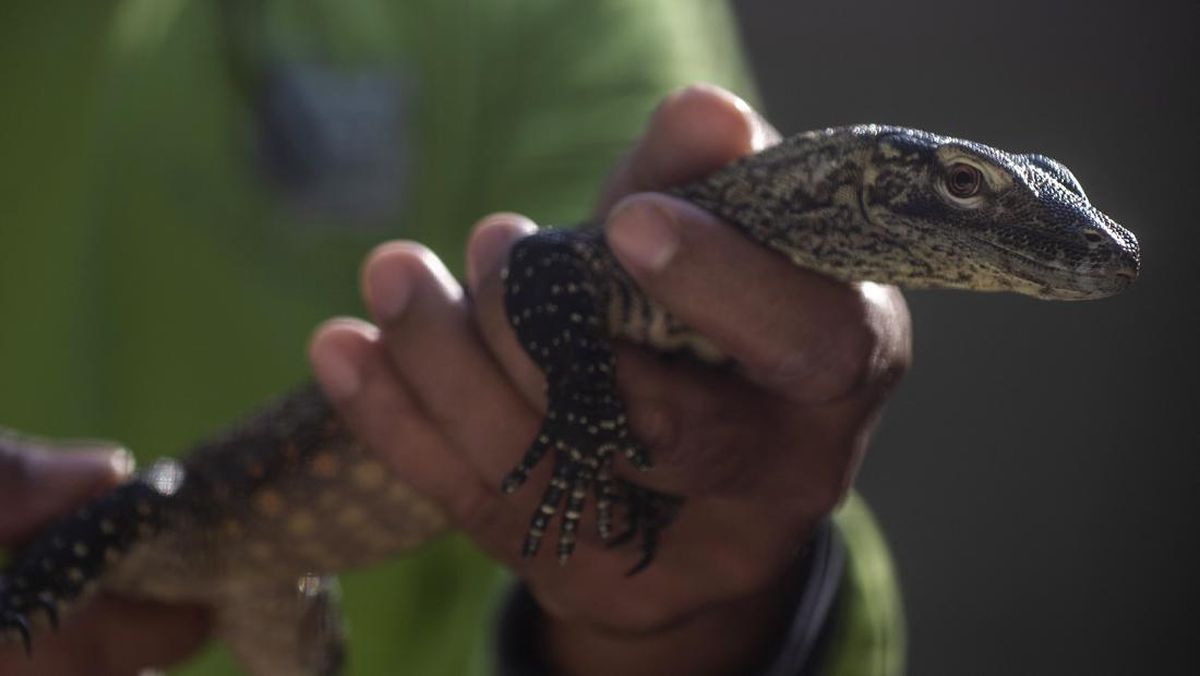
The Directorate of Special Criminal Investigation (Ditreskrimsus) of the East Java Regional Police has successfully dismantled an international syndicate involved in the trade of protected wildlife, including Komodo dragons, cuscus, and hundreds of kilograms of pangolin scales, resulting in state losses worth billions of rupiah.
Ditreskrimsus of East Java Police, Commissioner Roy HM Sihombing, stated that the bust was divided into several crime clusters. The first and primary cluster involved the theft of protected wildlife, specifically Komodo dragons (Varanus komodoensis), taken directly from their natural habitat in East Manggarai Regency, Nusa Tenggara Timur (NTT).
“The suspects are alleged to have engaged in the trade of protected wildlife in live condition, consisting of three Komodo dragons or Varanus komodoensis, sourced from suppliers or hunters in Sambi Rampas Subdistrict, East Manggarai Regency, NTT Province,” Roy said at East Java Police Headquarters on Wednesday (15/4).
Deputy Head of Subdirectorate IV for Wildlife Crime of Ditreskrimsus East Java Police, AKBP Hanif Fatih Wicaksono, explained that the bust began with intelligence information about the shipment of protected animals from NTT to Surabaya via sea route. Officers then made arrests at Tanjung Perak Port, Surabaya, when suspects BM and SD disembarked from the ship.
“We uncovered and secured the individuals carrying three Komodo dragons at Tanjung Perak when they disembarked from the Pelni ship bound from NTT to Surabaya. We successfully apprehended two people at that time with evidence of three suspected Komodo dragons,” Hanif said.
To smuggle the Komodo dragons to Surabaya, the suspects used PVC pipes to conceal the protected reptiles, as the Komodos were juveniles.
Police then verified the authenticity of the animals through scientific testing in a laboratory. DNA test results confirmed that the seized animals were not ordinary monitor lizards but genuine Komodo dragons protected by law.
“We were able to conduct tests using forensic equipment, namely DNA samples from the three Komodo dragons, in collaboration with Gadjah Mada University (UGM), and the DNA test results confirmed that the three Komodo dragons we uncovered and seized are identical to the Varanus komodoensis category with 100 per cent accuracy. So they are not ordinary monitor lizards,” Hanif emphasised.
Hanif then dissected the chain of the protected wildlife trade. Initially, suspect SD from NTT requested local residents or illegal hunters in NTT to capture juvenile Komodo dragons. Each juvenile Komodo was priced at Rp5.5 million.
SD then sold the juvenile Komodos to a collector in Surabaya, initialled BM, at Rp31.5 million per dragon. The price did not stop there, surging several times over when reaching international markets such as Thailand or Malaysia.
“The hunters sold their catches to the collector, brother SD, for Rp5.5 million. The collector sold them to the seller in Surabaya (BM) for Rp31.5 million per dragon,” he said.
“From this seller, they were sold again to seller two in Sukoharjo, Central Java, where the price specification is Rp41.5 million. A juvenile or small Komodo dragon is valued at USD$35,000 in Thailand or Malaysia, or approximately Rp500 million per dragon when converted to rupiah,” Hanif continued.
Based on further investigations, besides BM and SD, police also arrested four suspects RDJ, RSL, JY, and VPP, suspected of involvement in the syndicate from hunting to selling Komodo dragons.
These suspects had been involved in Komodo sales since the period from January 2025 to 2026. At least 20 Komodo dragons were illegally sold by them, with a total value of Rp565.9 million.
However, the economic value of the Komodo sales continued to increase and multiply from one seller to another, up to abroad. The estimate even reached Rp10 billion.
“The estimated value from [the sale of 20 Komodo dragons] could reach Rp10 billion or USD$700,000,” Hanif explained.
In addition to Komodo dragons, in the second cluster, police uncovered the illegal sale of other endemic animals at the home of one suspect initialled BM in Surabaya. There, authorities found dozens of cuscus from Sulawesi.
“We also uncovered the sale of Talaud cuscus, 13 individuals, and Tembung cuscus, three individuals,” he said.
The animals were kept and traded alive, with plans to smuggle them abroad, valued at a total of Rp400 million. At least four suspects were named in this cluster: BM, MIF, CS, and MSN.
In the third cluster, police uncovered another protected wildlife trade, including four green tree pythons, an endemic species from Papua, one Brahminy kite, and eight monitor lizards. In this case, one suspect initialled MIF was arrested. He is suspected of storing, keeping, and trading the animals.
In the fourth cluster, authorities found evidence consisting of 140 kilograms of pangolin scales (Manis javanica) valued at Rp8.4 billion. The evidence was stored in a house in the Surabaya area and suspected to be illegally traded.
“For the fourth cluster, it concerns pangolins. We secured two suspects, brother FS and brother AK. We found 104 kg of pangolin scales at his house. If 140 kg, that equals 980 pangolins killed. Materially valued, 140 kg of pangolin is worth Rp8.4 billion,” Hanif detailed.
Meanwhile, in the fifth cluster, Ditreskrimsus East Java Police uncovered a case of animal, fish, and plant quarantine violations. In this case, two suspects were secured with evidence of 89 animals consisting of adult and juvenile sailfin lizards, Sulawesi spiny lizards, and ring-necked snakes. Two suspects were named in this case: CS and MSN.
In total, East Java Police have