
11 Million Illegal Cigarettes from China Seized at Indonesia-Timor Leste Border
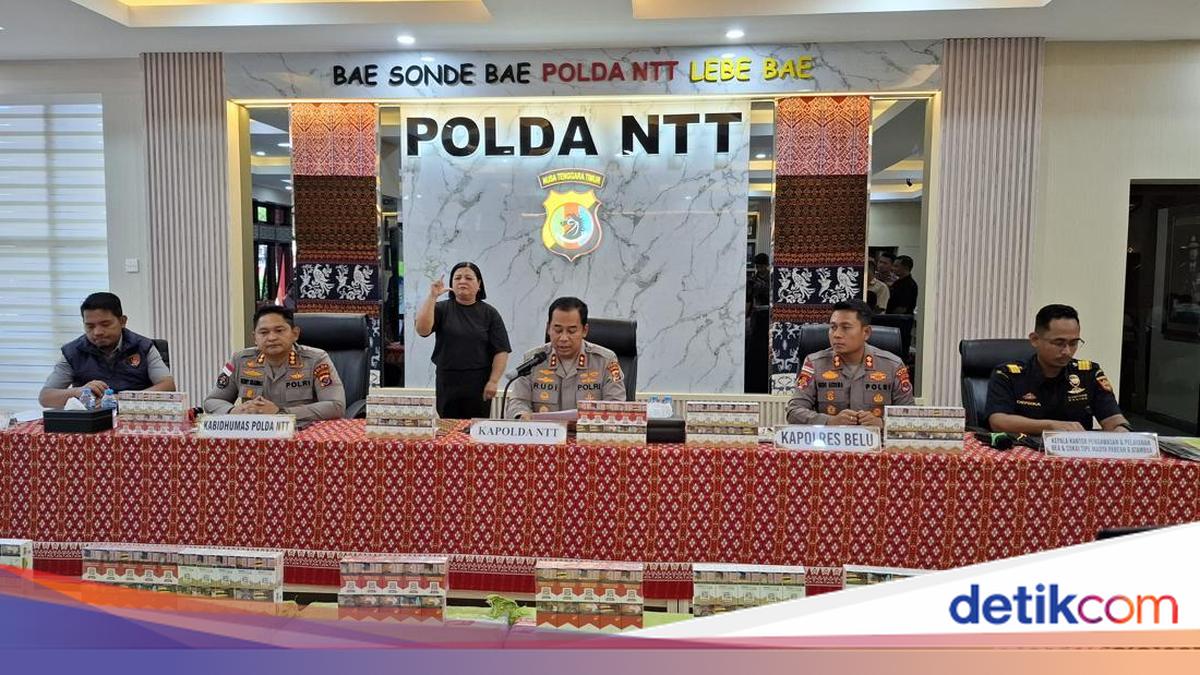
The East Nusa Tenggara Regional Police (Polda NTT) and Customs seized 11 million cigarettes in Belu Regency, NTT. Millions of illegal cigarettes from China were intended to be smuggled into Timor Leste.
The Head of Public Relations for Polda NTT, Commissioner Henry Novika Chandra, explained that the smuggling case was uncovered in the Indonesia-Timor Leste border area in December 2025. Three Chinese nationals were arrested: Li Shenger, Lin Jingwei, and Hu Renhao.
“This is the result of hard work and solid synergy between the Belu Police Resort and Atambua Customs,” Henry said during a press conference at Polda NTT Headquarters on Thursday (30/4/2026).
In the case, Li Shenger acted as the warehouse renter and main manager. Lin Jingwei was responsible for operational distribution. Meanwhile, Hu Renhao served as the technical executor for stockpiling goods. Currently, the three Chinese nationals are on trial at the Kefamenanu District Court in NTT.
“The 11 million cigarettes are machine-rolled white cigarettes equipped with fake excise stamps,” Henry stated.
Henry noted that the total value of the cigarettes amounts to Rp 23.1 billion, with a potential state loss of around Rp 12.3 billion. According to him, the circulation of illegal cigarettes not only harms the state but also disrupts a healthy and fair business ecosystem.
“Polda NTT is committed to continuing strict and sustainable enforcement, especially in border areas that have a high vulnerability to cross-border activities,” Henry explained.
Belu Police Chief AKBP I Gede Putra Astawa explained that the case was uncovered following a report from residents on 4 December 2025. Upon receiving the report, the team from Unit IV of the Belu Police Resort’s Intelligence and Security Division immediately conducted an operation against the three Chinese nationals suspected of involvement in the illegal activity.
“At that time, there was suspicious foreign activity at one house on MT Haryono Street, Tanukik Village, Atambua City, Belu Regency,” Astawa said.
Afterwards, officers, along with Atambua Customs and local government, conducted an inspection at the location. The joint team secured evidence of illegal cigarettes branded Marlboro from the house.
“It was found that one perpetrator, a Timor Leste national with initials YL, was conducting illegal activities at the house,” Astawa clarified.
Officers also visited a second location in Lolowa Subdistrict and found illegal cigarettes dominated by the Marlboro brand. According to him, the distribution of the illegal cigarettes from China went through the waters of Timor Leste, then entered Belu in the early hours. Shipments consisted of 50 bales per delivery.
“They used boats for the smuggling transport to Belu,” Astawa said.
NTT Police Chief Inspector General Rudi Darmoko emphasised that cigarette smuggling is a criminal act that causes significant losses to state finances, particularly in excise revenue, creates unhealthy business competition, and disrupts economic stability.
“Therefore, the disclosure announced today is a tangible manifestation of the Indonesian National Police’s presence in protecting the interests of the community and the state from economic losses and enforcing the law firmly,” Rudi stated.
State Seizure Goods
Head of the Atambua Type Madya Customs Supervision and Service Office Pabean B, Depdika Stevano, revealed that the millions of cigarettes are now state seizure goods. The perpetrators collected these fake cigarettes for distribution in the border areas, namely North Central Timor Regency (TTU) and Belu.
“So they haven’t been distributed outside NTT yet, but based on information, there were already attempts to rent containers and such to distribute to various regions. But fortunately, that hasn’t happened,” Depdika revealed.
Depdika stated that this illegal cigarette circulation case is the largest nationally using the eastern Indonesia route. In addition to falsifying excise stamps, he said, the perpetrators also falsified cigarette brands.
“This is the largest and the route is through eastern Indonesia, and the second interesting thing is falsifying the brand, which damages the brand’s reputation,” Depdika explained.
According to him, the falsification of excise stamps was done very neatly. Even, based on ultraviolet light examination, fibres were found almost identical to the original brand.
The excise stamps were also printed together with the packaging and brought to Indonesia-Timor Leste. The illegal goods were shipped from China to Dili (Timor Leste) and then intended for distribution to NTT.
“It was then followed up with laboratory examination and confirmed to be fake,” he concluded.