
1,280 Prospective West Java Migrant Workers to Join SMK Go Global Training
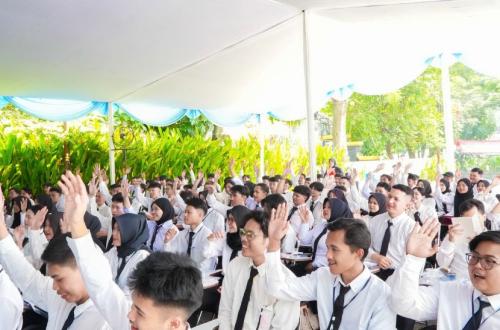
A total of 1,280 prospective Indonesian migrant workers (CPMI) in West Java will participate in training through the SMK Go Global Programme. Bandung University of Technology (UTB) serves as one of the training sites preparing participants to meet the requirements of the international workforce.
The programme was officially launched at the West Java level at the UTB Campus Migrant Centre on Wednesday (26/08/2026). The SMK Go Global Programme is part of a national initiative to increase the capacity of skilled Indonesian migrant workers.
Before undergoing training, participants must pass administrative selection and interviews. Those who pass will then undergo training according to their specific areas of competence and available job opportunities.
The Head of BP3MI West Java, Police Commissioner Singgih Hermawan, stated that 1,2<0xA0>280 prospective migrant workers in West Java will receive training lasting between one to three months. The curriculum is tailored to industry needs, including production operations, manufacturing, English, Japanese, and nursery care.
“Training is available in several sectors at UTB, including production operations, manufacturing, and English. There is also Japanese and nursery care. SMK Go Global covers everything for those who wish to go abroad and require capacity building,” he said in a press release on Saturday (05/09/2026).
Singgih noted that in addition to technical skills, participants must prepare themselves mentally and develop adaptability, as they will be working far from their families. “We hope the participants at UTB can carry out their training well, remain motivated, and maintain mental resilience,” he emphasised.
According to Singgih, participants are being prepared to work in destination countries designated by the government once placement requirements are met. They are expected to maintain their competence and represent Indonesia well in their host countries.
The Rector of Bandung University of Technology, Muchammad Naseer, stated that participants need to build both skills and character simultaneously. Discipline, adaptability, and professionalism are considered essential assets in an international working environment.
“Skills are important, but attitude also determines how someone is accepted, trusted, and able to grow within a working environment,” he said.
The Regional Secretary of West Java Province, Herman Suryatman, remarked that the SMK Go Global Programme brings together the government and higher education institutions to prepare the younger generation for the global labour market.
“This is an excellent programme scheme because relevant ministries, the government, and universities are collaborating to prepare our youth to enter the global job market through the SMK Go Global Programme,” Herman explained.
Herman added that the West Java Provincial Government will expand programme access through partnerships with both public and private universities. He noted that West Java’s educational ecosystem can be utilised to broaden opportunities for capacity building and job access for the youth.
“We will work hand-in-hand to ensure that by 2029, there are no unemployed youths in West Java,” he stated. He also noted that beyond vocational skills, the younger generation needs to master critical thinking, creativity, and Artificial Intelligence (AI) to adapt to changing global work requirements.
At the national level, the Minister for the Protection of Indonesian Migrant Workers (P2MI), Mukhtarudin, stated that the SMK Go Global Programme is a national priority to prepare competent and internationally competitive Indonesian talent.
The government aims to prepare 500,000 skilled workers for overseas employment between 2026 and 2029. This target consists of 300,000 vocational school (SMK) graduates and 200,000 participants from general education levels, including high school, diplomas, and undergraduates.
The workforce preparation target will be implemented in stages: 40,000 participants in 2026, 140,000 in 2027, 180,000 in 2028, and 140,000 in 2029. Participants are being prepared through technical skill enhancement, language proficiency, certification, and readiness for international work environments.
For UTB, involvement in the SMK Go Global Programme is an effort to bridge community competency enhancement with the needs of the international labour market. The UTB Campus Migrant Centre is being utilised as one of the training locations for prospective migrant workers within the programme.