
Zulhas Says PSEL Can Resolve 22.5% of Indonesia's Waste Problem
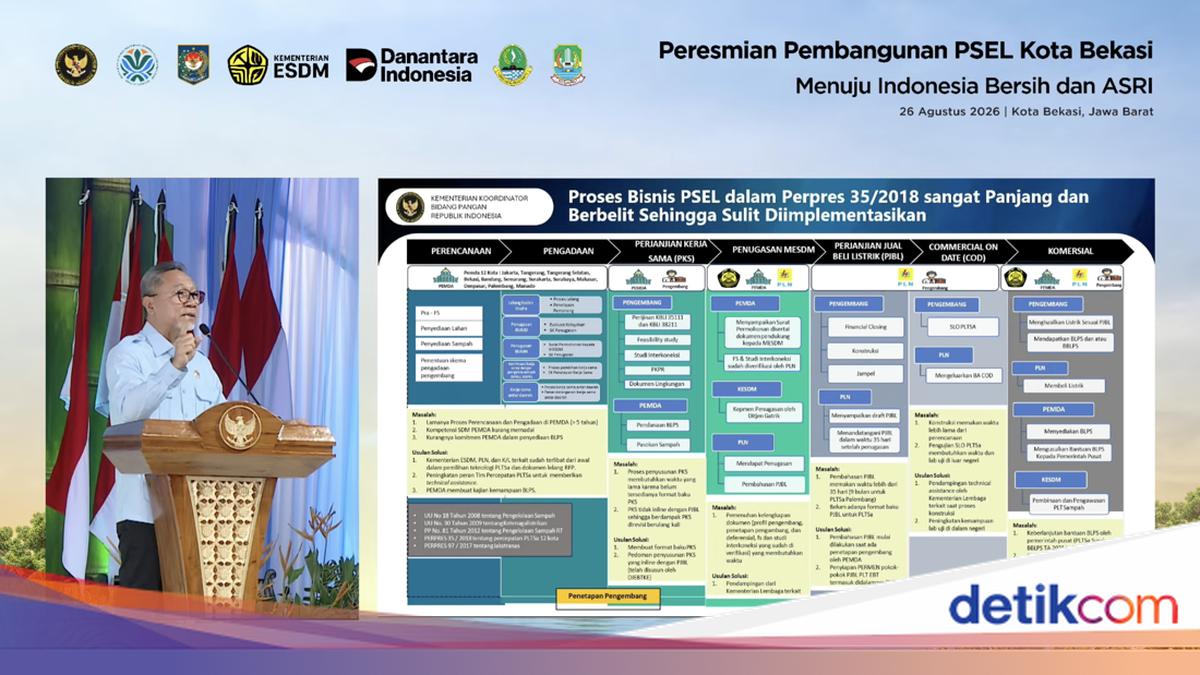
Coordinating Minister for Food Zulkifli Hasan (Zulhas) has revealed that the Waste-to-Energy (PSEL) facility in Bekasi has the potential to resolve approximately 22.5% of Indonesia’s waste problem.
According to him, PSEL is one of the solutions for handling waste generation on a large scale, particularly in urban and metropolitan areas.
Zulhas made the remarks at the groundbreaking ceremony for the Bekasi City PSEL in West Java.
“What we are discussing today is only 22%. So if everything being worked on by Pandu (CIO Danantara) and colleagues is completed, that is only 22%,” said Zulhas in his speech on Wednesday (26/8/2026).
“I hear that by next year it could reach 15%. If it reaches 15%, that is already extraordinary, excellent, already very good,” he continued.
Zulhas said that processing waste into electrical energy is one approach that can be applied to reduce the waste burden. Besides PSEL, the government is also preparing other technologies such as pyrolysis and refuse-derived fuel (RDF).
“If we can resolve 15% through waste-to-energy processing. But if this is completed, there is 24% or up to 40%, that is only 22%. There is also pyrolysis,” said Zulhas.
It is known that the government projects Indonesia’s waste generation in 2029 will reach around 146,780 tonnes per day. To anticipate this volume, the government is preparing a number of waste processing technology options based on the characteristics and capacity of each region.
These technology options include organic waste processing at source at the village or community level, TPS-3R and central waste banks, RDF-based TPST, non-RDF TPST with pyrolysis technology, and PSEL.
Organic processing at source at the village or community level, for example through biodigesters, teba, and composters, is projected to account for around 12.4%.
Meanwhile, management through TPS-3R and Central Waste Banks at a communal scale is projected to cover 19.8%. This scheme prioritises material recovery through facilities such as TPS-3R and TPST.
Furthermore, RDF-based TPST in areas close to the cement industry has a potential of around 25.3%. This technology can be utilised in regions that have access to cement factories, which currently number around 23 plants in Indonesia.
As for non-RDF TPST with pyrolysis technology at the urban level, it has a potential of around 20%. Besides pyrolysis, this category includes other technologies such as biogas, large-scale composting, and material recovery facilities.
For PSEL, the technology is directed at cities or regencies with waste generation exceeding 1,000 tonnes per day, whether managed independently or through an agglomeration scheme.
In addition, Zulhas emphasised the importance of collaboration among various parties in accelerating the resolution of the waste problem. According to him, the government needs the support of all stakeholders, including the Indonesian National Armed Forces (TNI).
“So if the TNI wants to participate, alhamdulillah, we will roll out the blue carpet. Quickly, immediately. We are grateful,” said Zulhas.
Zulhas also appreciated the TNI’s support in various government programmes, including in the food sector and infrastructure development.
“You help, you support, food is also supported by the TNI and others. Including bridges, rivers, clean water, and so on. Thank you very much,” said Zulhas.
According to Zulhas, resolving the waste problem also requires community involvement down to the grassroots level. He cited activities involving thousands of participants from various elements, ranging from NGOs, students, RT/RW to sub-district governments.
“If we work together like that, God willing, by 2029, 70-75% of this waste can be resolved,” said Zulhas.
Zulhas is optimistic that the waste problem, which has persisted for decades, can be addressed within the next few years if all parties work together.
“I am confident, as long as we can cooperate with all parties. Once again, that is our task to oversee the President’s directive so that this can be successful and fruitful,” said Zulhas.
This effort is part of the implementation of Presidential Regulation Number 109 of 2025, which marks a new milestone in the development of large-scale waste management in Indonesia.
On the same occasion, Chief Investment Officer of BPI Danantara Pandu Patria Sjahrir said that this groundbreaking is a continuation of a project previously inaugurated for the first time in Denpasar, Bali.
“This project is targeted to be able to manage more than 500,000 tonnes of waste per year, or around 70% of processed waste generation in Bekasi City,” said Pandu.
Pandu said that this PSEL will have a real impact on waste processing, green energy, and empowering the local economy with reference to the European Industrial Emissions Directive environmental standards.
This facility is targeted to reduce emissions from final disposal sites by up to 80% and reduce carbon emissions by 640,000 tonnes of CO2 equivalent per year.
“From the energy side, this initiative will produce green energy that can supply the needs of 55,000 households in Bekasi City,” he said.
For information, the event was also attended by CIO of BPI Danantara Pandu Patria Sjahrir, Chief of Staff of the Indonesian Army Maruli Simanjuntak, West Java Governor Dedi Mulyadi, and President Director of PT PLN (Persero) Darmawan Prasodjo.
Source: jawawa.id (https://jawawa.id/newsitem/zulhas-says-psel-can-resolve-22-5-of-indonesias-waste-problem-1787723527)
Originally published by detikcom (https://news.detik.com/berita/d-8634741/zulhas-sebut-psel-mampu-bereskan-22-5-permasalahan-sampah-di-ri), translated from Indonesian