
Zulhas Reveals Why Waste Management Regulations Must Be Simplified
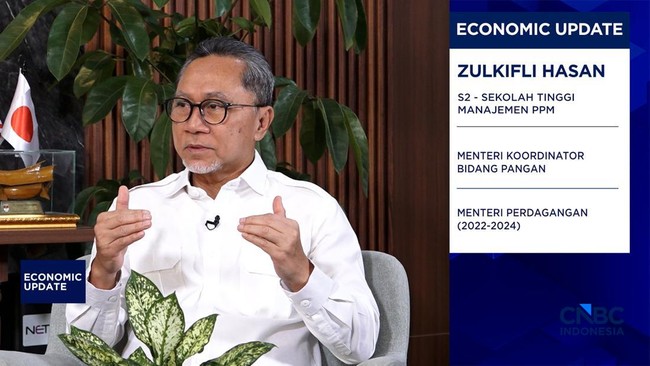
Coordinating Minister for Food Zulkifli Hasan (Zulhas) has stated that the government considers the waste problem a strategic issue within the national food security agenda. He argued that the ambition of achieving food self-sufficiency will be difficult to realise if environmental damage from waste continues.
Zulhas emphasised that success in achieving food self-sufficiency is not solely determined by rice production, fertiliser, or irrigation, but also heavily depends on a supportive environmental quality. The agricultural and fisheries sectors, which play a role in the self-sufficiency programme, will be threatened if the waste problem is not properly managed.
Indonesia is currently facing a waste emergency. Accumulation of waste is not only found at the Bantar Gebang Integrated Waste Treatment Plant (TPST) in Jakarta but also in other major cities and regions. This long-standing condition has caused negative environmental impacts, including soil and water pollution. “It causes casualties, generates emissions, damages rivers, ruins land, and pollutes our seas. Not to mention microplastics, which can cause cancer. The damage is extraordinary and has been going on for a long time without a solution,” he stated during the CNBC Indonesia Economic Update 2026 on Tuesday (23/6/2026).
Zulhas reiterated the strong link between the environment and food security. For instance, polluted rivers affect the quality of agricultural irrigation water, while waste-filled seas disrupt fishery ecosystems and reduce fishermen’s productivity. Furthermore, contaminated paddy fields impact soil fertility and agricultural output. He therefore views solving the waste problem as an integral part of ensuring sustainable food security.
“For 11 years I have studied why waste is so complicated to resolve. If I, as a businessperson, want to convert waste into energy, I need permits from the regent and the local parliament. If it’s a provincial matter, I need permits from the governor and the provincial parliament. By this stage, the businessperson is already overwhelmed by the complexity,” he explained.
To address this, the government has established a Task Force for the Acceleration of Waste Management and is simplifying inefficient regulations. Several obstructive rules are deemed necessary to cut in order to speed up the construction of waste processing facilities. One priority programme being accelerated is the development of Waste-to-Energy Plants (PSEL). The goal is to handle emergency waste hotspots that are the largest sources of pollution in various regions.
The government has mapped at least 72 priority locations, grouped into over 20 agglomeration areas to facilitate the construction of modern PSEL facilities. The implementation will utilise the latest generation of incinerator technology, which is already widely used in other countries and claimed to meet safe, tested emission standards. The government targets resolving approximately half of the emergency waste problems by 2027, with the remainder to be completed by 2028.
Additionally, the government is preparing different solutions for regions producing smaller amounts of waste. For areas generating less than 1,000 tonnes of waste per day, management will employ other technologies such as refuse-derived fuel (RDF), pyrolysis, and various more economical processing methods. This approach confirms that waste management efforts will not rely on a single type of technology.
Furthermore, the government is targeting a fundamental shift in national waste management patterns by 2029. The concept promoted is resolving waste at its source. In practice, offices, markets, shopping centres, schools, restaurants, and other public facilities will be required to separate organic and inorganic waste from the outset. Zulhas acknowledged that the biggest challenge lies in raising household-level awareness to sort waste, even though organic waste can be processed into fertiliser and inorganic waste can be utilised for energy or industrial raw materials.
Ultimately, the waste issue is not merely a matter of technology or regulation, but also concerns culture and civilisation. The success of waste management is not only about creating clean cities but also about ensuring fertile agricultural land and productive waters, thereby safeguarding Indonesia’s long-term food security. “Because if the environment is damaged, how can we want sustainable food? The environment must be good, the rivers good, the land good, the people good, everything good, then we can have sustainable food,” he concluded.