
Zulhas Promotes Green Investment via Carbon Markets and Waste-to-Energy Projects
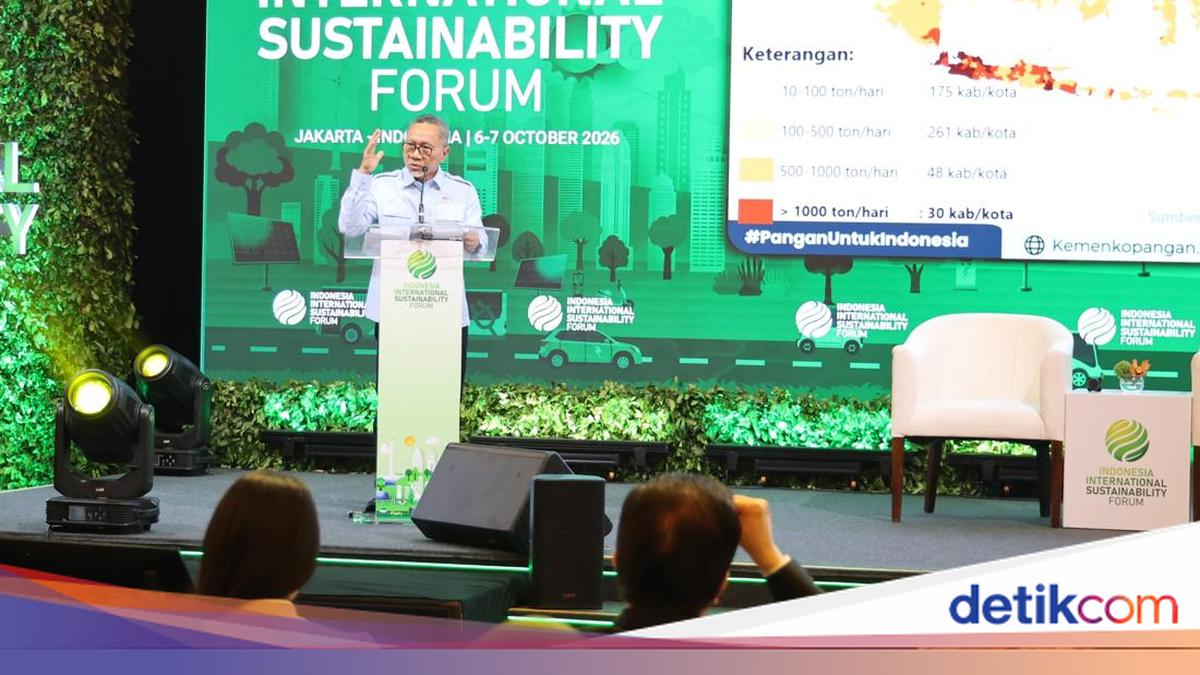
The impact of climate change is becoming increasingly evident, threatening food security, the environment, and economic stability. Indonesia’s potential economic losses are estimated to reach IDR 544 trillion.
At the same time, climate action financing still faces a significant gap. The State Budget (APBN) is estimated to cover only about 30% of the requirements, while the remaining 70% requires participation from the private sector and international partners. This was revealed by the Coordinating Minister for Food Affairs and Chairman of the Carbon Economic Value (NEK) Steering Committee, Zulkifli Hasan (Zulhas), during the Indonesia International Sustainability Forum (IISF) 2026 in Jakarta on Tuesday (6/10/2026).
On this occasion, Zulkifli Hasan also invited the business world, investors, and financial institutions to fill this gap through five green growth engines and two investment gateways, namely the carbon market/NEK and Waste-to-Energy (PSEL) projects.
“We are already feeling the effects of climate change through prolonged El Niño, forest and land fires, harvest disruptions, and threats to community livelihoods. We need financing that reaches the field. The government is opening space for the private sector to invest with measurable returns while providing real benefits to the environment and society,” said Zulhess in a written statement on Wednesday (7/10/2026).
He stated that climate-resilient development strategies have the potential to reduce national economic loss risks by up to 79.2%, equivalent to IDR 61.71 trillion. The government is also positioning forests, peatlands, mangroves, oceans, and rice fields as climate assets to support the food system, which must be protected alongside the communities that guard them.
Through NEK policies, the government is encouraging five sectors as sources of growth and financing opportunities: (1) forests and land, through nature protection and restoration that maintains community livelihoods; (2) energy, through renewable energy investment, reducing fossil fuel dependency, and job creation; (3) green industry, to ensure cleaner production processes and more competitive Indonesian products; (4) other strategic sectors, including agriculture, waste management, and blue carbon; and (5) farmers, fishermen, and villagers, who must also enjoy the economic benefits of climate action.
“The measure of success for the carbon market is not just the transaction value, but how much benefit reaches farmers, fishermen, and forest village communities,” said Zulhas.
He noted that the first gateway is investment through the NEK ecosystem and the carbon market. NEK provides economic value to emission reductions, so efforts to preserve and restore nature can generate income. Businesses can participate through domestic carbon trading, voluntary markets involving global buyers, and international cooperation based on the Paris Agreement.
“The government is also preparing carbon tax instruments and results-based payments, where partners pay after verified emission reductions; the results-based payment scheme for the forestry sector is already running in East Kalimantan,” he revealed.
He ensured that the government continues to strengthen the certainty and credibility of this ecosystem through Presidential Regulation Number 110 of 2025 concerning the Implementation of Carbon Economic Value. The Carbon Unit Registry System (SRUK) is operational and has issued carbon units for the first four forestry (FOLU) projects.
“Six derivative regulations have been issued in less than a year since the Presidential Regulation was released. The National Carbon Trading Roadmap is targeted for completion before the end of 2026,” he explained.
He stated that the four initial forestry projects have a potential emission reduction of 30 million tonnes of CO2e, with an estimated economic transaction value of IDR 5 trillion and potential Non-Tax State Revenue (PNBP) of approximately IDR 500 billion. More broadly, 45 cross-sector mitigation projects are currently being processed.
“The energy sector is the largest contributor with a potential carbon credit of 358 million tonnes by 2030. Indonesia’s carbon market has the potential to generate a value of up to US$7.7 billion per year.”
Zulhas explained that the second gateway is investment in PSEL projects. To reduce emissions and address the urban waste emergency, the government is encouraging PSEL in areas with waste generation exceeding 1,000 tonnes per day. Based on Presidential Regulation Number 109 of 2025 and supported by investment participation from Danantara, four strategic PSEL projects have commenced the groundbreaking stage throughout 2026.
“The waste-to-energy approach provides environmental, social, and economic benefits simultaneously,” he explained.
According to him, other opportunities lie in blue carbon. The rehabilitation of coastal ecosystems has the potential to generate economic value of up to US$909 million, or approximately IDR 14 trillion per year, in the next five to 10 years. This potential is supported by coastal carbon reserves from mangroves and seagrass, which can reach 3.4 billion tonnes.
Agriculture and blue carbon are also projected to be the next wave in carbon financing so that benefits can reach farmers, fishermen, and coastal communities.
“The regulations are available, the registry is running, initial projects have been issued, and cross-ministerial coordination has been formed. We now invite private capital and international partners to move together, with benefits that are also felt by communities at the grassroots level,” he said.
“Let us make Indonesia’s food and nature assets financeable by the world, and ensure that the financing returns to those who protect them,” concluded Zulhas.
Source: jawawa.id (https://jawawa.id/newsitem/zulhas-promotes-green-investment-via-carbon-markets-and-waste-to-energy-projects-1791370927)
Originally published by detikcom (https://news.detik.com/berita/d-8696742/zulhas-dorong-investasi-hijau-lewat-pasar-karbon-dan-psel), translated from Indonesian