
Zulhas: Prabowo-Gibran Government Achieves Self-Sufficiency in Eight Commodities in Two Years
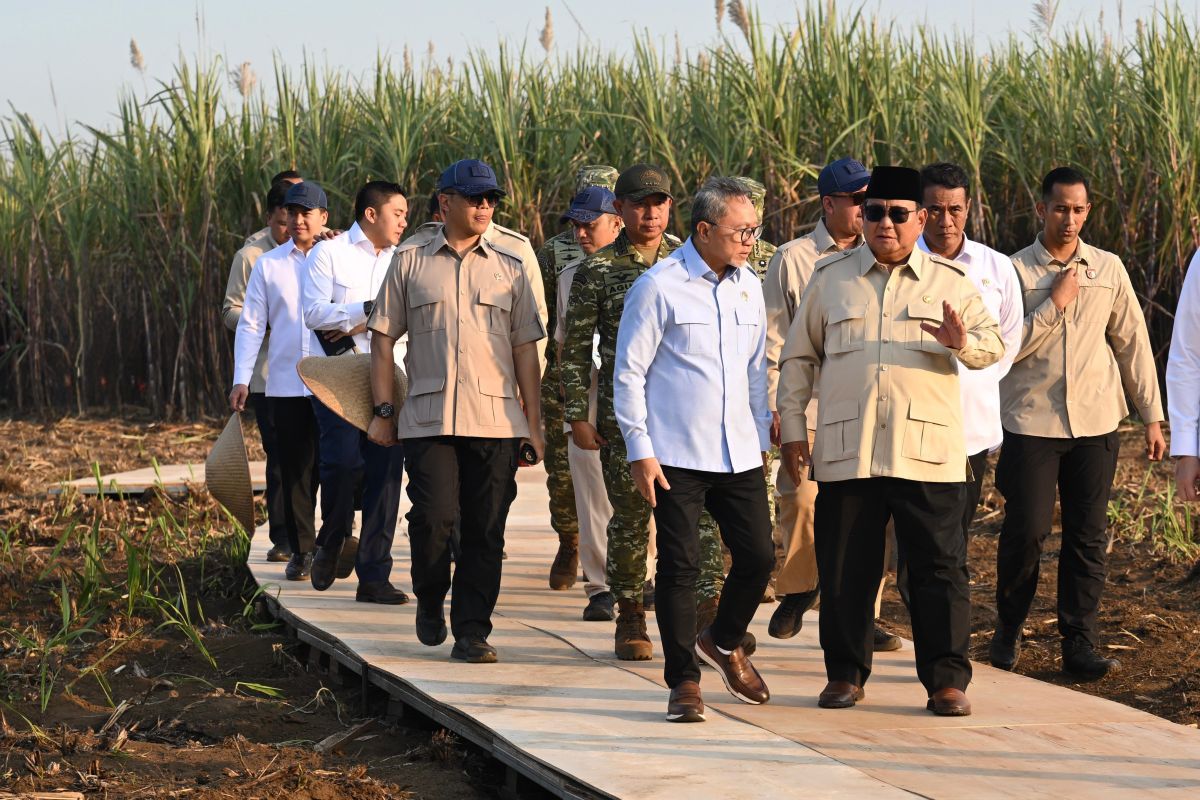
“We want Indonesian food to become increasingly sovereign and the people working in the food sector to become more prosperous.”
Jakarta (ANTARA) - Co-ordinating Minister for Food Zulkifli Hasan (Zulhas) said that, in the two years of President Prabowo Subianto and Vice-President Gibran Rakabuming Raka’s administration, Indonesia had achieved self-sufficiency in eight food commodities, alongside an increase in the Farmers’ Terms of Trade.
Zulhas said the achievement was part of efforts to strengthen domestic food production, accompanied by policies to protect agricultural prices, provide subsidised fertiliser and develop the village economy.
“Thankfully, our efforts to strengthen food sovereignty are beginning to show results. We are grateful that Indonesia is increasingly able to meet its food needs from domestic sources,” Zulhas said in an official statement received in Jakarta on Thursday.
He said the eight commodities deemed self-sufficient were rice, maize, household sugar, bird’s eye chillies, large chillies, chicken eggs, chicken meat and shallots.
According to Zulhas, the government is also no longer importing rice for public consumption, as national food production capacity has increased.
Domestic supply has also been bolstered by government rice reserves managed by state-owned Perum Bulog. The company’s president director, Ahmad Rizal Ramdhani, reported on 20 October 2026 that government rice stocks stood at about 4.55 million tonnes.
In terms of farmers’ welfare, Statistics Indonesia (BPS) recorded a national Farmers’ Terms of Trade (NTP) of 131.11 in September 2026, up from 120.30 in September 2024.
The NTP measures the ratio between the price index received by farmers and the price index they pay for consumption needs and agricultural production.
The increase reflects improved purchasing power from agricultural output, although it does not directly represent the income of all farmers.
The government has also strengthened protection for crop prices through a government purchase price of Rp6,500 per kilogram for harvested dry paddy at the farm gate.
The government purchase price for maize is Rp5,500 per kilogram for crops ready for harvest with a moisture content of 18–20 per cent.
Alongside these purchase-price policies, the government has simplified the distribution system for subsidised fertiliser to speed up deliveries to farmers.
It also cut the maximum retail prices of subsidised fertiliser by 20 per cent from 22 October 2025. The price of urea fell from Rp2,250 to Rp1,800 per kilogram, while NPK fertiliser fell from Rp2,300 to Rp1,840 per kilogram.
According to Agriculture Ministry data, the number of farmers redeeming subsidised fertiliser by July 2026 was up by an average of 7 per cent compared with the same period a year earlier.
Zulhas stressed that increased food production must directly benefit people working in agriculture and fisheries.
“These achievements must be felt by farmers, fishers and people whose voices have often gone unheard in the food supply chain. This is a trust we must uphold together,” he said.
In villages, the government is developing the Merah Putih Village/Urban Ward Cooperatives (KDKMP) as a channel for distributing basic necessities and subsidised products, as well as providing local economic services.
Zulhas said 10,070 KDKMP cooperatives were operational, while 28,662 cooperative buildings had been completed during the same period. The government aims to raise the number of completed buildings to about 35,000–40,000 by the end of 2026.
The government is also seeking to improve the welfare of coastal communities through the Merah Putih Fishermen’s Village (KNMP) programme, which aims to upgrade business-support facilities and strengthen fishing-based economic activity.
The Ministry of Marine Affairs and Fisheries recorded that 65 KNMP pilot sites had traded 719 tonnes of fish worth Rp18.77 billion since early June 2026.
The Co-ordinating Minister for Food said the achievements and policies provided a foundation for further strengthening national food security and improving people’s welfare amid global volatility.
“We want Indonesian food to become increasingly sovereign and the people working in the food sector to become more prosperous. These efforts must continue through policies that support farmers, fishers and village communities,” he said.
Source: jawawa.id (https://jawawa.id/newsitem/zulhas-prabowo-gibran-government-achieves-self-sufficiency-in-eight-commodities-in-two-years-1792630328)
Originally published by Antara (Indonesian) (https://www.antaranews.com/berita/5803553/zulhas-dua-tahun-prabowo-gibran-mencapai-swasembada-delapan-komoditas), translated from Indonesian