
Zulhas: No nation can progress without self-sufficiency
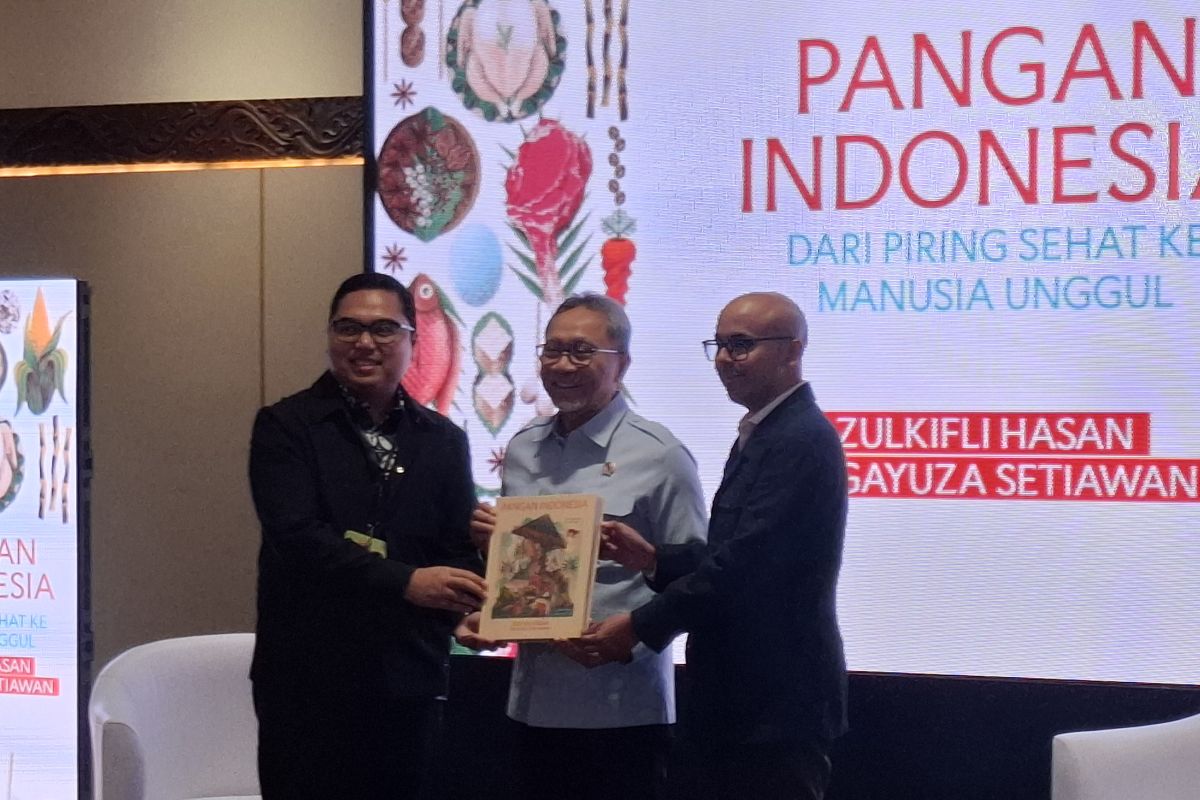
The Coordinating Minister for Food, Zulkifli Hasan (Zulhas), stated that no nation can progress without food self-sufficiency, as food independence is closely linked to sovereignty and the livelihoods of food producers.
“No nation can progress without self-sufficiency. Therefore, Mr Prabowo says that self-sufficiency is an honour,” said Zulhas in Jakarta on Friday.
According to Zulhas, food issues involve more than just food availability; they also encompass the lives of farmers, fishermen, and livestock breeders who are integral parts of the national food production chain.
These remarks were made during the launch of the book Indonesian Food: From Healthy Plates to Superior Humans, co-authored by Zulhas and the Special Assistant to the President for Communication and Policy Analysis, Dirgayuza Setiawan. He noted that the book aims to make complex food issues more accessible to the public, ranging from policy perspectives to their connection with national sovereignty and the nation’s future.
“It is not just about rice or side dishes on a plate. We must begin to understand how vital food is, as it concerns our sovereignty, our civilisation, and our future,” he added.
Regarding national food policy developments, President Prabowo Subianto stated in August 2026 that Indonesia had achieved self-sufficiency in eight food commodities: rice, maize, consumer sugar, chicken meat, chicken eggs, shallots, large chillies, and bird’s eye chillies. The government continues to target self-sufficiency for several other commodities. Prabowo mentioned that garlic self-sufficiency is targeted within three years, while beef and buffalo meat are targeted within five to six years.
From the producer’s perspective, Statistics Indonesia (BPS) recorded the national Farmer Terms of Trade (NTP) in August 2026 at 129.19, an increase of 1.05 per cent compared to July 2026. During the same period, the Fisherman Terms of Trade (NTN) rose by 0.50 per cent from 108.49 to 109.04, driven primarily by catches such as mackerel, scad, sea prawns, and anchovies.
Zulhas assessed that the position of food producers must continue to be strengthened, including fishermen who face limited bargaining power when selling their catches. “Fishermen lack bargaining power and support; no matter how hard they work, if they catch fish, their bargaining power remains low and prices remain cheap, unless the fish goes rotten,” Zulhas said.
The government is also expanding the Kampung Nelayan Merah Putih (Red and White Fishing Village) programme as an effort to strengthen the fisheries sector. As of August 2026, 100 fishing villages have been established, with a target of 1,386 villages being operational by the end of December 2026.
In the same forum, Dirgayuza stated that one of the inspirations for the book was President Soekarno’s speech regarding the need for food production to achieve food self-sufficiency and sovereignty. “I was inspired to write this with Mr Zul after reading President Soekarno’s speech opening the UI Bogor Campus, now IPB, in its entirety,” said Dirgayuza.
He noted that this line of thinking positions consumption and production as two interconnected sides in determining a nation’s ability to meet its food needs. “That speech is mathematically powerful because President Soekarno felt the end result is mathematics. How much we consume determines how much we must produce,” he said.
Dirgayuza added that this approach serves as a foundation for the book to view food not just through production figures, but through the food consumed by the public and its origins. Furthermore, Zulhas expressed hope that discussing food through an approach close to daily life would broaden public understanding of the importance of food independence for economic sustainability, producer welfare, and the future of Indonesia.