
Zulhas Invites Students to Oversee Policies Through Dialogue, Open to Answering Criticism
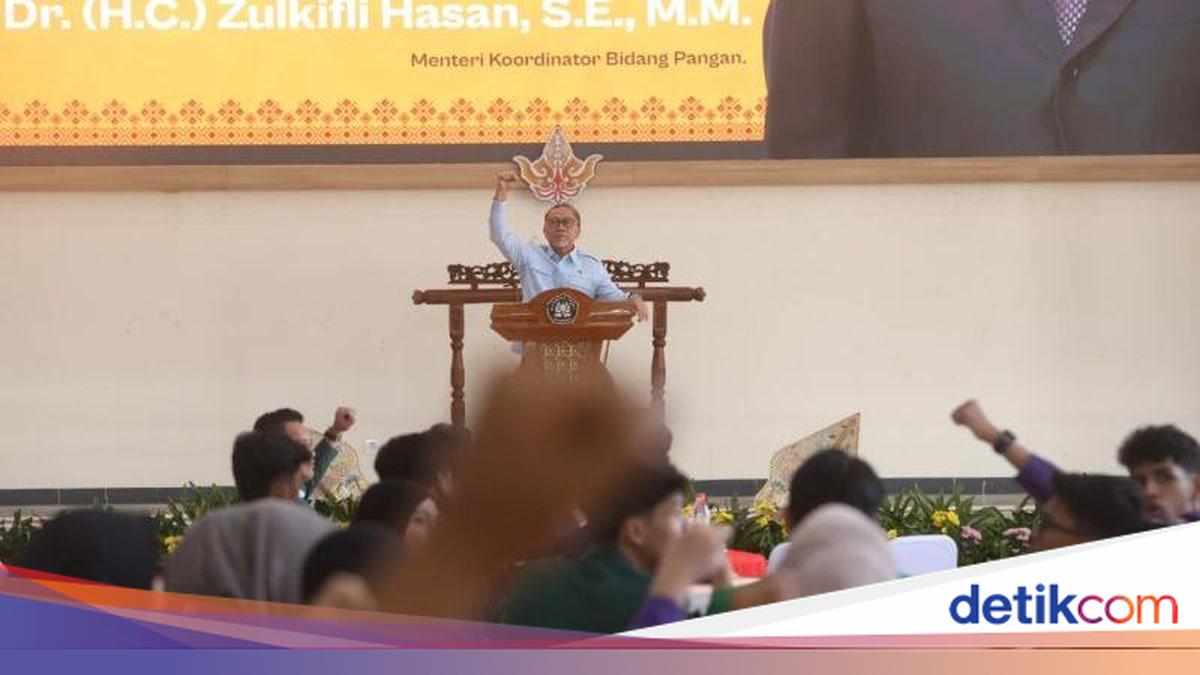
Coordinating Minister for Food Affairs Zulkifli Hasan (Zulhas) has invited university students to scrutinise various government policies through open dialogue. Zulhas explained that opening dialogue is part of the democratic process.
He made the remarks whilst engaging with 178 members of the All-Indonesia Student Executive Board (BEM SI) at the BEM SI National Congress in Semarang, Central Java, on Monday (27/7), as reported by the Antara news agency on Tuesday (28/7/2026). Zulhas invited the students to voice their criticism.
“Let us have a dialogue now. We have an hour. Criticism is welcome, protests are welcome,” Zulhas said.
Zulhas said a healthy democracy does not stop at the expression of aspirations in public spaces, but must continue through dialogue. The government, he said, has an obligation to open spaces for discussion.
“Democracy does not stop on the streets; it must continue in the dialogue room. Demonstrating is the right of every citizen. Once aspirations have been expressed, the government is obliged to open a space for discussion. Students have the right to question every government policy, and it is our duty to explain it openly,” he said.
During the dialogue, the students raised various questions concerning the implementation of the Red and White Village/Neighbourhood Cooperatives (KDMP), governance of the food sector, the welfare of farmers and fishermen, and the direction of national development, all of which Zulhas answered directly. According to Zulhas, the greatest challenge facing the world in the 21st century is the question of food, which concerns not only availability but also people’s access to nutritious food.
Zulhas then cited the State of Food Security and Nutrition (SOFI) report by the Food and Agriculture Organization of the United Nations (FAO) released in July 2026. Zulhas said one in three of the world’s inhabitants still faces problems accessing nutrition, so every country is required to strengthen its food resilience.
According to Zulhas, strengthening community economic institutions is one of the government’s strategies to improve the welfare of farmers and fishermen. The government, he said, is also continuing to strengthen the Free Nutritious Meals (MBG) programme as part of its food resilience strategy and efforts to improve the quality of human resources.
Based on government data presented in the June 2026 edition of the APBN KiTa report, MBG budget realisation up to May 2026 reached Rp 88.15 trillion, covering 63.13 million beneficiaries served through 29,679 Nutritional Fulfilment Service Units (SPPG) across Indonesia.
Meanwhile, through the KDMP programme, the government is targeting the formation of more than 80,000 cooperatives serving as hubs for food distribution, financing, the provision of production inputs, and the marketing of village enterprises.
In the maritime and fisheries sector, the government is also accelerating the construction of Red and White Fishermen’s Villages, with a target of 2,000 villages by the end of 2026. Data from the Ministry of Marine Affairs and Fisheries (KKP) presented at the forum showed that Indonesia has 84,276 villages, comprising 12,968 coastal villages and 2,910 fishing villages.
The national number of fishermen is recorded at 3,228,209, whilst the Fishermen’s Exchange Value (NTN) in 2025 stood at 103.9, with an average of 104.4 over the past five years.
Zulhas judged that Indonesia possesses abundant natural resources but still faces various governance problems that require continuous improvement. For that reason, he continued, the government is siding with vulnerable groups, namely farmers and fishermen, by strengthening their access to capital, markets, technology and economic institutions.
“It is impossible for farmers and fishermen to compete on their own without the state taking their side. That is why the government continues to strengthen various policies so that they obtain better access to capital, markets, technology and economic institutions such as the Red and White Fishermen’s Village Cooperatives and the Red and White Village/Neighbourhood Cooperatives,” he said.
He added that achieving food self-sufficiency is not merely about increasing production, but also about safeguarding national sovereignty so that smallholder farmers retain room to grow amidst market dynamics. Furthermore, Zulhas urged students to maintain the tradition of critical thinking whilst contributing to building solutions for the nation.
“The future of Indonesia is in your hands. No other country wants Indonesia to progress more than the Indonesian people themselves. So let us safeguard this nation together. Criticism remains necessary, but dialogue and mutual cooperation are the way for that criticism to truly bring about change,” he said.
Source: jawawa.id (https://jawawa.id/newsitem/zulhas-invites-students-to-oversee-policies-through-dialogue-open-to-answering-criticism-1785210805)
Originally published by detikcom (https://news.detik.com/berita/d-8593268/zulhas-ajak-mahasiswa-kawal-kebijakan-lewat-dialog-terbuka-jawab-kritik), translated from Indonesian