
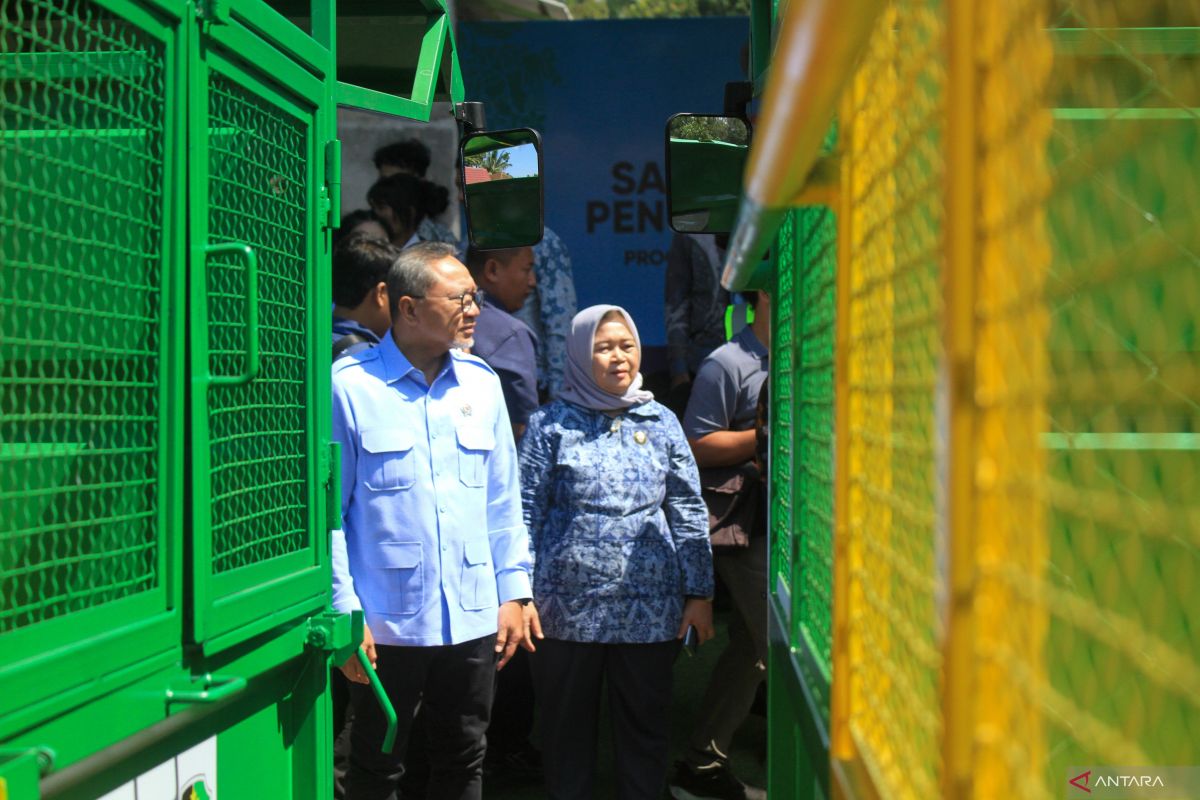
Zulhas hands over operational vehicles for Banyuwangi TPS3R
Waste processing is carried out in a modern way with the help of technology, from sorting and processing organic and non-organic waste to converting waste into alternative fuel or RDF (factory fuel).
Banyuwangi (ANTARA) - Coordinating Minister for Food Zulkifli Hasan handed over dozens of operational vehicles for the Balak Reduce Reuse Recycle Waste Processing Site (TPS3R) in Songgon District, Banyuwangi Regency, East Java, on Thursday.
The operational vehicle grant for Balak TPS3R is assistance from the Clean Rivers organisation from the United Arab Emirates (UAE), consisting of 21 three-wheeled motorcycles, 12 pickups, two armroll trucks and five armroll containers.
“Banyuwangi is one of the best regencies in waste management, which is why there is a lot of assistance for TPS3R in Banyuwangi, one of which is from the United Arab Emirates (UAE),” said Minister Zulhas to reporters after symbolically handing over the assets to Banyuwangi Deputy Regent Mujiono at Balak TPS3R.
The Banyuwangi Regency Government has made circular waste processing one of its development priorities in an effort to achieve more environmentally friendly handling.
The Balak Reduce Reuse Recycle Waste Processing Site (TPS3R) in Songgon District stands on 1.5 hectares of land with a waste processing capacity of 84 tonnes per day.
Waste processing is carried out in a modern way with the help of technology, from sorting and processing organic and non-organic waste to converting waste into alternative fuel or RDF (factory fuel).
Waste management at Balak TPS3R is designed to ensure household waste can be handled effectively, from source to final processing.
Waste management uses technology to minimise residue and prevent odours, and every day village waste collectors go around to collect residents’ waste.
Balak TPS3R serves residents in 64 villages across 10 sub-districts. All waste arriving at the TPS3R is sorted using a conveyor machine based on organic and non-organic categories.
Valuable non-organic waste such as plastic bottles/cups and paper/duplex is pressed and then sent to recycling plants or processing industries.
Meanwhile, the remainder of non-organic waste such as plastic packaging with no economic value is processed into environmentally friendly alternative fuel.
Organic waste is processed into compost using the windrow composting method, and leachate or water produced by organic waste is treated using a wastewater treatment plant (WWTP) to prevent environmental pollution.