
Zombi-Killer Fungus Parasite Spreads in Kalimantan
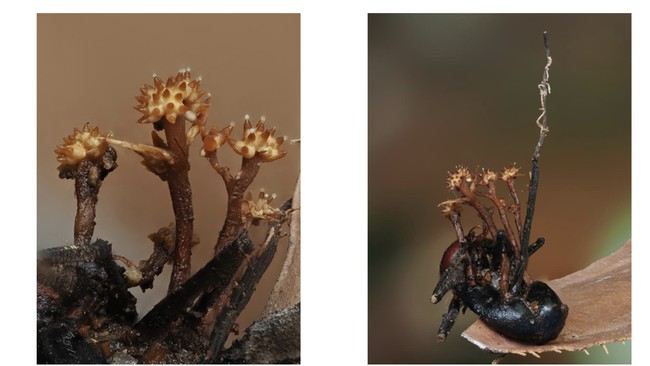
A team of Malaysian scientists has discovered a new fungus species with a unique and rarely seen lifestyle in the wilds of Kalimantan. This fungus does not attack insects or animals directly, but instead preys on another notoriously vicious fungus often dubbed the ‘zombi fungus’. The discovery is a world first due to its highly distinctive form and characteristics.
The new species has been given the scientific name Pleurocordyceps cornusynnemata. Its epithet is derived from its remarkable physical appearance, resembling a horn protruding from the body of its host. The fungus is categorised as a hyperparasite, a term for an organism that lives as a parasite of another parasite.
The discovery was made by researchers from the Institute for Tropical Biology and Conservation at Universiti Malaysia Sabah during field research in the Danum Valley, a remote area in Sabah, the northern part of the island of Kalimantan. Their observations and identification were published in the scientific journal Phytotaxa in April 2026.
According to the Institute’s Deputy Director, Jaya Seelan Sathiya Seelan, this fungus targets ants already infected by fungi from the Ophiocordyceps genus. It is the Ophiocordyceps fungus that is widely known as the ‘zombi fungus’ due to its ability to control the nervous system of the insects it attacks, causing them to move abnormally before ultimately killing the host and growing out of its body to spread new spores.
“Unlike the zombi fungus which manipulates insect behaviour, Pleurocordyceps infiltrates and consumes the tissue of the zombi fungus that is reproducing inside the insect’s body,” Seelan explained. This means the presence of this new fungus could actually halt the spread of the deadly zombi fungus.
Although not the first hyperparasite discovered in the world, the scientists emphasise this is the first species from its genus to possess such a clearly defined and unique horn-shaped structure. This physical characteristic distinguishes it from all similar fungi previously documented.
In addition to the Pleurocordyceps discovery, the research team also found another new fungus species with its own lethal method, named Leptobacillium geminatum. This fungus has a specialised ability to hunt and kill spiders by spreading spores throughout the animal’s body until it dies.
The researchers stated that both discoveries hold enormous potential value for the fields of health and agriculture. “These newly documented fungi could serve as the basis for developing next-generation antimicrobial drugs, as well as functioning as highly effective biological control agents to eradicate agricultural crop pests,” Seelan added.
This discovery reaffirms that the tropical rainforests of Kalimantan still harbour extraordinary biological wealth and many undiscovered natural mysteries, which could provide significant benefits to humanity if preserved and studied properly.