
Ziswaf as a Pillar to Propel the Nation in an Era of Disruption
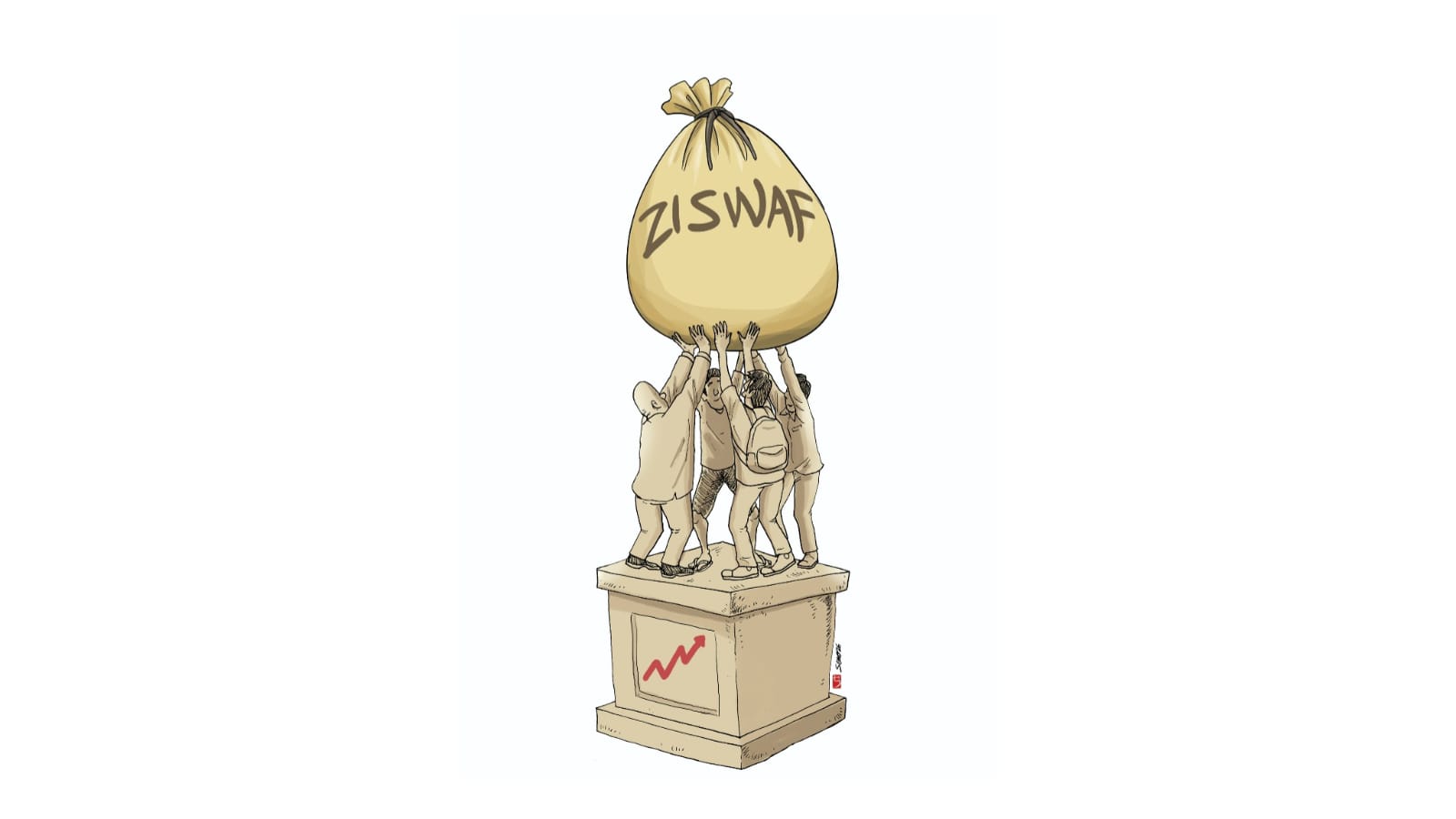
PEMERINTAH as the representative of the state manager has an obligation to realise public welfare as stipulated in the national goals. To realise these state goals, other instruments are needed to participate actively in fulfilling this noble objective. It cannot be denied that economic disparity still occurs among the nation’s people, especially amid the weakening of the rupiah, which impacts various sectors of life. Statistics Indonesia (BPS) reported the latest poverty data in Indonesia up to September 2025, at around 8.25% (23.36 million people). Although economic growth is classified as high, equitable distribution remains an issue. So, how to optimise zakat, infaq, sedekah, and wakaf (ziswaf) to lift the people out of poverty? This is where breakthroughs that can have a real impact are needed. These breakthroughs are important to accelerate national development and improve the welfare of the people. In this context, aside from the state, religion with one of its main tools, namely zakat, infaq, sedekah, and wakaf, has a responsibility to demonstrate its contribution in the life of the nation and state with a social dimension. The state’s presence to advance the nation and improve the welfare of its people is manifested through government programmes, both central and regional, sourced from taxes, grants, and the management of natural resources (SDA), among others. The presence of religion through the optimisation of social teachings sourced from ziswaf is ijtima’iyah-maliyah (socio-financial) in nature, binding its adherents to fulfil religious teachings as a social obligation that holds the same degree of importance as vertical obligations. Emile Durkheim, the French sociologist (1858-1917), stated that religion as a binder of solidarity, social control, and provider of moral values can unite society. Thus, if the social function of religion through ziswaf is implemented consistently, it will have a significant impact on advancing the nation. This is the importance of synergy between ziswaf and taxes. OPTIMALISASI ZISWAF In the Indonesian context, religion can synergise with the state in a way that strengthens and complements each other like two sides of a coin. Optimising ziswaf as the primary tool of religion is urgent because this teaching becomes a dimension of social worship that has the power to lift the people out of poverty and powerlessness. The presence of the state through institutional instruments of central and regional governments with the programmes launched, if synergised and collaborated with religious instruments through ziswaf carried out optimally, both conventionally and digitally, will have a significant impact on advancing the nation. Along with the data and facts that poverty is still relatively high, synergy and collaboration between state and religious instruments need to be further optimised, even though institutionally, ziswaf social institutions have been formed, such as the National Amil Zakat Agency (Baznas) and the Indonesian Waqf Board (BWI). Even every religious and community organisation also has similar institutions, equally aiming for the noble goal of advancing the community and the nation in general. Optimising the collection of zakat and productive waqf in the era of disruption is a shared agenda to strengthen the contribution of zakat and waqf in lifting the people out of poverty and realising public welfare. This is in line with the state goals that are important to realise together. The Ministry of Religious Affairs (Kemenag) is targeting a 10% increase in national zakat collection in 2025, with total zakat collected reaching Rp42 trillion, but this figure is still far from the maximum potential, which is estimated at more than Rp327 trillion. This is a shared challenge on how to manifest and carry out productive ziswaf breakthroughs, without eliminating conventional methods that have long been a characteristic of the Indonesian nation. Regarding waqf, BWI Chairman Kamaruddin Amin stated that Indonesia has a waqf potential reaching almost Rp400 trillion each year. The results of studies and research show that the potential for cash waqf reaches Rp181 trillion each year. Throughout Indonesia, there are waqf assets spread across 451 thousand points, which if combined are approximately the same size as, or even larger than, Singapore. Its growth is 4% to 5% each year. In its implementation, the commitment to applying ziswaf is indeed not yet optimal. Therefore, it raises the question of what strategies need to be implemented to move ziswaf into a fast and effective algorithm for the nation’s progress, especially amidst current challenges. Therefore, it is necessary to formulate methods and formulas that can accelerate the optimisation of ziswaf through the use of technology with its various platforms, fostering collective public awareness, and showing the significant impact of ziswaf for the community. First, the utilisation of technology is very helpful and effective for serving the community in men-tasharuf-kan (distributing) a portion of owned assets easily and quickly, especially in the era of the industrial revolution 4.0, which is characterised by the use of technology, such as sedekah or infaq through various digital platforms like transfers and QRIS. Although the use of technology is a necessity in accelerating ziswaf, conventional methods are still important to maintain solidarity and togetherness, as per the principle or rule of usul fiqh, al-muhafadhah ‘alal qadim al-shalih wal akhdzu bil jadidil ashlah (preserving old traditions that are still good and taking new things that are more beneficial). The conventional method in ziswaf distribution serves as a ’cultural heritage’ that can foster relationship-building through direct interaction between muzaki (zakat giver) and mustahik (zakat receiver) so that values.