
Zelensky Urges NATO to Strengthen Defence and Pave the Way for Ukraine’s Membership
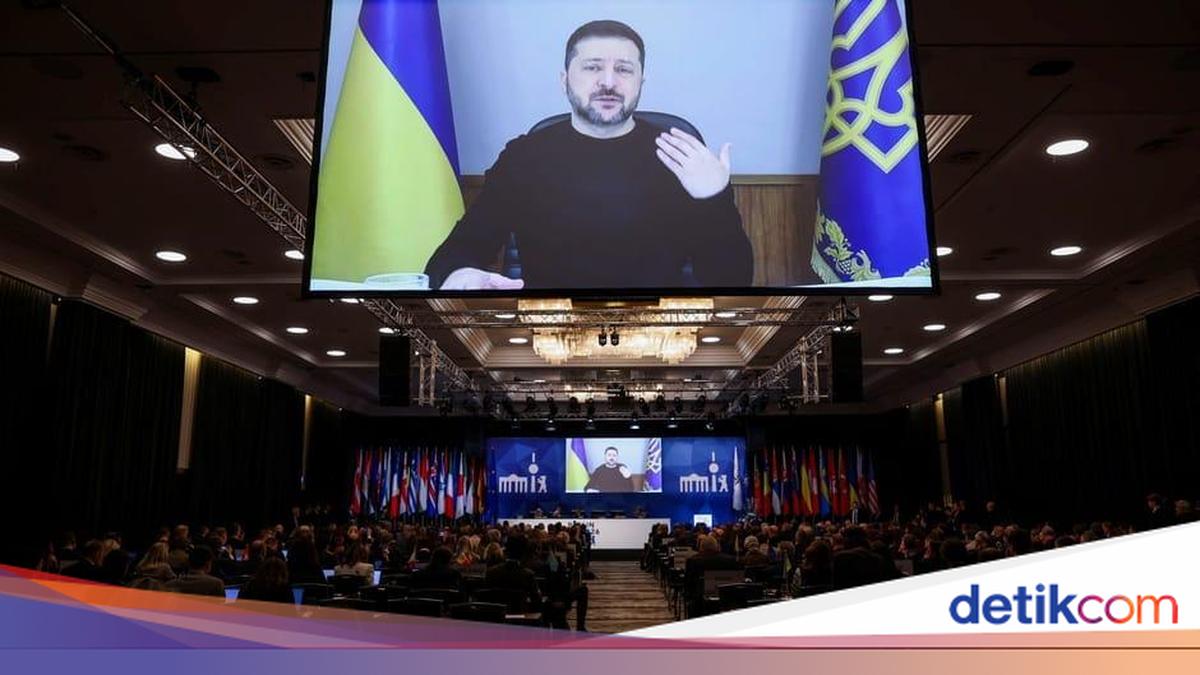
The video call took some time to connect. But applause erupted as Ukrainian President Volodymyr Zelensky finally addressed delegates in Berlin. He asked parliamentarians from NATO’s 32 member states to continue supporting Ukraine, particularly as it faces large-scale Russian air strikes.
“Ladies and gentlemen, winter is fast approaching. And, of course, our top priority is air defence,” Zelensky told the delegates. Ukraine needs more Patriot air-defence systems and other comprehensive systems to counter aerial attacks.
“Your countries have these systems. Missiles capable of intercepting Russian ballistic missiles should not just be sitting in warehouses gathering dust. We are saying this openly. Please help us.”
Ukraine wants to join NATO
Zelensky again called for Ukraine to be admitted to the NATO military alliance. Decisions on membership are not within the remit of the NATO Parliamentary Assembly, which met in Berlin for its 72nd annual session. But the Ukrainian president said it was important to repeat his request.
After the war ends, Ukraine will need strong security guarantees. NATO, Zelensky argued, could provide them.
“Wouldn’t it be more effective if Ukraine were admitted to NATO directly?” he asked. He went on to argue: “Wouldn’t that be better for all of us? Less costly to achieve? And more reliable in guaranteeing security?”
NATO members have yet to reach agreement on the possibility of admitting Ukraine. The alliance has repeatedly said that Ukraine remains eligible to join, but regards membership as a long-term goal rather than something achievable in the near future.
One of the main obstacles is the ongoing war and the possibility that NATO members would be obliged to provide military assistance to Ukraine, which is the target of Russia’s invasion.
NATO Secretary-General Mark Rutte rejected Ukraine’s demand at a high-level meeting held in Berlin for the first time in 26 years. Ukraine has prospects of joining, but NATO members have not reached consensus on the issue. Decisions on admitting new members rest entirely with the alliance.
“There is no doubt about that within the alliance,” Rutte said.
Merz: Rejecting Ukraine’s NATO membership in 2008 was a ‘mistake’
German Chancellor Friedrich Merz supported providing Ukraine with security guarantees equivalent to those enjoyed by NATO members if a ceasefire is reached.
Looking back at past decisions, Merz said, it was clear that “it was a mistake not to follow the United States’ proposal at the 2008 NATO summit in Bucharest, which called for Ukraine to be admitted as a member”.
The possibility of Ukraine joining NATO as part of negotiations with Russia is a separate issue, Rutte said. He welcomed current US efforts to promote peace talks. Europe is also continuing to coordinate closely with Ukraine and the US to develop a common position.
“But we now also need to test whether Putin is willing to engage in this process. If so, these various issues may be discussed again,” he said.
Russia’s invasion of Ukraine has prompted NATO countries to increase their arms and military capabilities substantially. Member states have committed to raising defence spending to 5% of their respective gross domestic products (GDP) by 2035.
Rutte warned that every member state must have a credible roadmap for reaching that target. “Ideally, they should achieve it before 2035,” he said.
Weapons production in member states also needs to keep increasing, he added, as “demand is still far outstripping supply”.
Germany’s military budget rises sharply
Carsten Breuer, Germany’s highest-ranking military officer, outlined the Bundeswehr’s contribution to NATO. He highlighted the country’s substantial increase in defence spending.
“Our defence budget has tripled since 2021. The aim is to reach the 5% target set at the NATO summit in The Hague well before 2035,” Breuer said.
Next year, Germany’s defence budget is set to rise to more than €139 billion (around Rp2.3 quadrillion).
Breuer said the Bundeswehr is being developed into a modern, effective and innovative armed force through continuous renewal. Its personnel numbers will also be significantly increased.
“To achieve the current military capability targets, we will expand the Bundeswehr to a total of 460,000 personnel by the mid-2030s,” said Germany’s Chief of Defence.
Of these, 200,000 will be reservists. “It is a balancing act, because we have to find the right balance between expanding personnel numbers and operational readiness,” he said.
After his speech, Breuer answered questions from delegates who showed considerable interest in developments in Germany’s military.
The discussion also offered a first glimpse of his new role. Breuer has been elected as the next Chair of the NATO Military Committee and will move to the alliance’s headquarters in Brussels in the middle of next year. In that position, he will be the senior military adviser to NATO Secretary-General Mark Rutte.
“I see this election as recognition that Germany has now accepted its responsibility and role in security policy,” Breuer said.
Source: jawawa.id (https://jawawa.id/newsitem/zelensky-urges-nato-to-strengthen-defence-and-pave-the-way-for-ukraines-membership-1795697476)
Originally published by detikcom (https://news.detik.com/dw/d-8771466/zelensky-desak-nato-perkuat-pertahanan-buka-jalan-keanggotaan-ukraina), translated from Indonesian